
Which Cabinet Box Parts Face the 50% Canada Duty
Identify which cabinet-box materials face the 50% Canadian plywood duty, estimate the upgrade impact, and compare MDF, particleboard, and other sources.
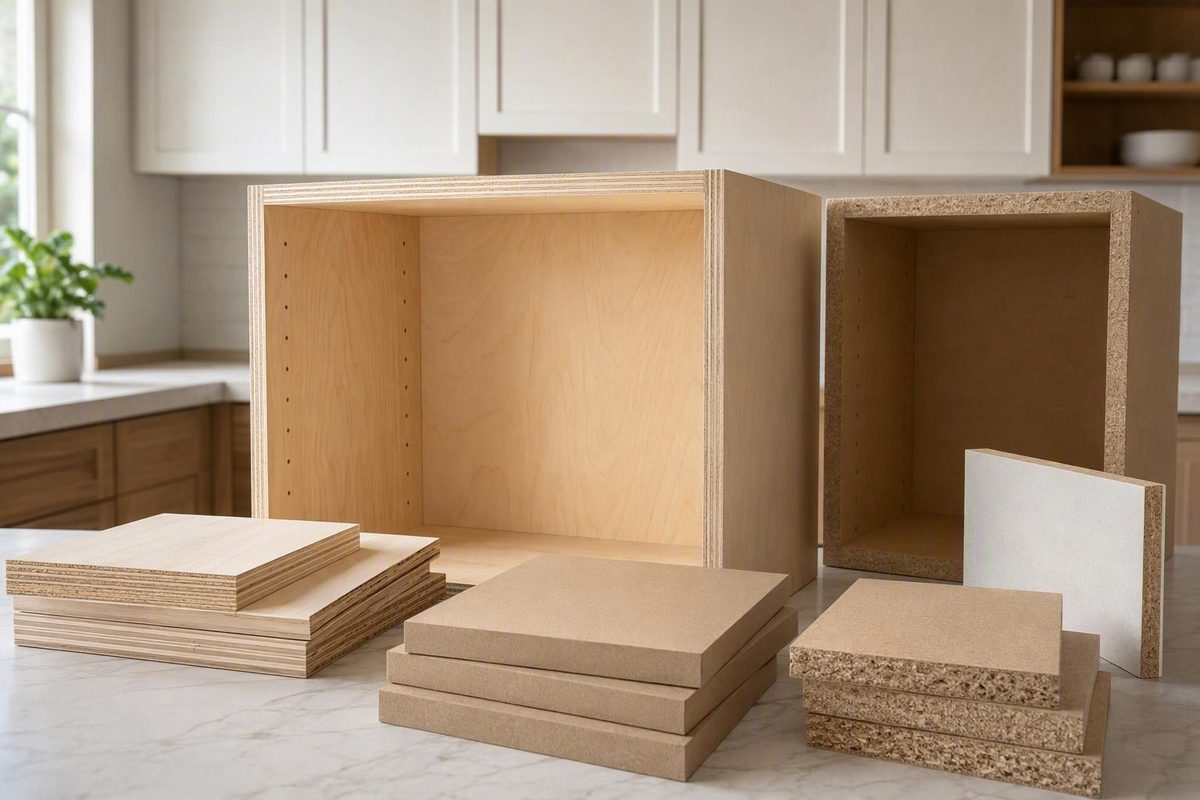
Only the Canadian hardwood-plywood portion of a cabinet order is exposed to the new 50% Section 338 duty. Canadian birch or maple plywood imported under a covered HTSUS 4412 provision can trigger the duty when used for box sides, bottoms, backs, or shelves. MDF and particleboard boxes are not covered by the plywood provisions; hardwood veneer and finished cabinets shipped from Canada are excluded from this action. The plywood-box upgrade is therefore the line item likely to move—not the entire cabinet quote. Finished cabinets can require a separate Section 232 analysis.
Choose the box material and enter the quote’s customs-value basis; the calculator shows the Section 338 difference.
This isolates the additional 50% Section 338 duty. It does not estimate ordinary duties, Section 232, freight, fees, or a supplier’s markup.
For confirmed Canadian plywood with a $100,000 customs value, the calculation is $100,000 × 50%. If the full duty is passed through, a $100,000 upgrade becomes $150,000.
Switching to U.S.- or Asian-origin plywood, MDF, or particleboard reduces this specific Section 338 difference to $0.
Filter the full list by the likely result under this Canadian hardwood-plywood action.
| Imported Product | Section 338 Result | Reason | Next Check |
|---|---|---|---|
| Canadian birch plywood sheets | Potential 50% | May fall in listed HTSUS 4412 | Full subheading and origin |
| Canadian maple plywood sheets | Potential 50% | May fall in listed HTSUS 4412 | Core, plies, and full subheading |
| U.S.-origin hardwood plywood | $0 from this action | Not Canadian origin | Document origin |
| Asian-origin hardwood plywood | $0 from this action | Not Canadian origin | Check other applicable tariffs |
| Canadian particleboard | Not plywood duty | Different engineered-wood product | Confirm its own classification |
| Canadian MDF | Not plywood duty | Different engineered-wood product | Confirm its own classification |
| Canadian hardwood veneer | Excluded | Veneer is outside this plywood action | Confirm it is veneer, not a panel |
| Cut-to-size Canadian panels | Review required | Processing may affect classification | Dimensions and machining |
| Drilled or edge-banded panels | Review required | May be plywood or cabinet parts | Drawings and component function |
| Flat-packed Canadian box | Review required | May be an unassembled cabinet | Components presented together |
| Assembled Canadian carcase | Review required | Cabinet or cabinet-part analysis | Check Section 232 scope |
| Finished Canadian cabinet | Excluded from this action | Imported as a cabinet, not plywood | Check Section 232 separately |
Sources: White House Section 338 fact sheet and Annex I; KCMA analysis based on Decorative Hardwoods Association review. The 50% calculation applies to covered customs value, not automatically to a retail quote.
The Duty Follows the Imported Product, Not Its Intended Use
The additional duty is 50% ad valorem, meaning 50% of the applicable customs value. It is not automatically 50% of the retail cabinet price, installation contract, or plywood-upgrade charge.
The White House announcement covered Canadian goods entered under listed tariff provisions, including nearly every relevant hardwood-plywood line in heading 4412. It also stated that USMCA qualification does not exempt an otherwise covered product and that articles subject to Section 232 restrictions are excluded.
The action was announced on July 20, 2026. After the original implementation timetable was postponed during additional negotiations, later reporting placed the effective date on August 22, 2026. The affected Canadian hardwood-plywood trade was approximately $197 million per year. Entry-date treatment should still be checked against current CBP instructions, particularly for goods shipped or warehoused during the postponement.
“Cabinet grade,” “cabinet plywood,” and “for cabinet boxes” are commercial descriptions. They are not tariff classifications. The importer must identify what physically crosses the border, its complete HTSUS classification, its supported customs origin, its entry date, and its customs value.
That distinction produces different results for materials that may appear on the same cabinet order:
| Order Component | Typical Section 338 Result | Reason |
|---|---|---|
| Canadian birch or maple plywood | Potential additional 50% | May enter under a listed 4412 provision |
| Canadian MDF or particleboard | Not covered as plywood | Different engineered-wood products |
| Canadian hardwood veneer | Excluded | Veneer is outside the covered plywood action |
| Finished Canadian cabinet | Excluded from this action | Classify the cabinet and check Section 232 separately |
A U.S. cabinet shop that imports Canadian plywood and builds boxes domestically may have a covered plywood entry. A buyer receiving a completed cabinet from a Canadian factory is importing a different article even if plywood forms its sides, bottom, back, and shelves.
Canadian Plywood Box Parts Carry the Clearest Exposure
The most direct exposure occurs when Canadian-origin hardwood plywood enters the United States as sheet stock under a listed HTSUS 4412 provision. Birch-faced and maple-faced panels commonly used for cabinet boxes can fall within that analysis, but the species description alone does not establish the complete classification.
The Kitchen Cabinet Manufacturers Association, relying on Decorative Hardwoods Association analysis, reported that nearly all relevant 4412 series appeared in the annex. KCMA identified the series 10, 31, 33, 34, 39, 41, 42, 49, 51, 52, 91, 92, and 99 and said Canadian hardwood plywood used to manufacture cabinet boxes may be affected. It separately reported that Canadian cabinet imports were not affected by the Section 338 plywood provisions. That is useful industry guidance, not a binding CBP classification for an individual shipment or processed component.
The reviewed portion of the official annex includes HTSUS 4412.10.05, 4412.31.06, 4412.31.26, 4412.31.42, and 4412.31.45. The annex says the listed tariff provisions—not the accompanying descriptions—control the legal scope. The displayed 4412.31 descriptions concern specified thin plywood with tropical-wood outer plies and particular face-ply or surface characteristics, so those excerpts cannot be treated as a universal description of every hardwood panel in the complete annex.
For a typical cabinet order, the exposed material can include plywood used for:
- Cabinet sides and finished ends
- Bottoms and tops
- Full-height partitions
- Fixed and adjustable shelves
- Structural backs or back panels
- Stretchers and nailers made from qualifying plywood
These uses do not independently create the duty. They identify where covered imported plywood may appear in a box specification. If a domestic cabinet manufacturer already holds the material, the cabinet buyer is not necessarily the importer of record; any cost pass-through is a commercial decision reflected in the supplier’s quote.
MDF, Particleboard, and Veneer Do Not Become Hardwood Plywood
An MDF or particleboard cabinet box does not enter heading 4412 merely because it competes with plywood or receives a wood-look finish. Switching the box specification from Canadian plywood to MDF or particleboard removes the Section 338 plywood exposure described here. Other ordinary duties or trade measures may still require review based on the product’s origin and classification.
Core construction matters. A panel sold as maple or birch can have a veneer core, particleboard core, MDF core, lumber core, or another composite construction. The face species printed on a sample door does not disclose the full tariff facts.
Hardwood veneer is also expressly outside this plywood action. A separate veneer sheet is not the same imported product as a multilayer plywood panel. Once veneer is bonded to a core, however, the finished panel must be classified from its complete construction. The exclusion for veneer should not be applied automatically to a veneered composite panel without reviewing that panel’s tariff provision.
Useful specifications include:
- Number and composition of plies or layers
- Face- and back-veneer species and thickness
- Core material and construction
- Overall panel thickness, length, and width
- Film, laminate, paper, paint, stain, or other surface covering
- Sanding, edge banding, grooves, dados, rabbets, boring, and hardware holes
- Whether panels are separate, bundled as a coordinated box, or assembled
- Included shelves, backs, frames, doors, drawers, and hardware
A purchase order saying “3/4-inch cabinet plywood” is not technically complete enough to settle the classification.
Machined Panels and Flat-Packed Boxes Need Separate Classification
Classification becomes less certain as plywood is processed into cabinet-specific components. The reviewed evidence does not establish a universal point at which a plywood sheet becomes a cabinet part or unassembled cabinet.
| Form At Entry | Typical Condition | Required Decision |
|---|---|---|
| Raw plywood | Full or standard-size sheet | Whether a listed 4412 provision applies |
| Cut panel | Rectangular cabinet blank | Whether it remains classified as plywood |
| Machined component | Bored, routed, shaped, or edge-banded | Whether processing changes classification |
| Flat-packed box | Coordinated components presented together | Panel, cabinet-part, or unassembled-cabinet treatment |
A supplier’s statement that a side panel is “made from 4412 plywood” describes its input. It does not necessarily classify the processed component as imported.
For cut, drilled, or edge-banded parts, give the broker drawings, dimensions, machining details, component functions, packaging, and assembly relationship. For a flat-packed box, identify whether all panels are presented together and whether shelves, backs, face frames, doors, drawers, or hardware are included.
An assembled carcase without doors may also require a cabinet-parts analysis. Do not label it “plywood” solely because plywood is its principal material, and do not label it a “finished cabinet” solely to seek an exclusion.
Finished Canadian Cabinets Follow the Cabinet Rules
A finished or substantially complete cabinet shipped from Canada is excluded from this Section 338 hardwood-plywood action. Its plywood content does not cause the completed cabinet to be entered as raw plywood.
That does not necessarily mean the cabinet is free of additional duties. Specified kitchen cabinets, vanities, and parts can fall under Section 232. Canadian government guidance identifies a 25% Section 232 rate, scheduled to increase to 50% on January 1, 2027, for listed classifications including HTSUS 9403.40.9060, 9403.60.8093, and 9403.91.0080 in its U.S. trade summary.
Those numbers do not prove that every cabinet box is covered. A frameless carcase, face-frame assembly, vanity component, closet component, unfinished box, or coordinated set may present different classification facts.
The announced framework also means the additional Section 338 and Section 232 rates should not be stacked automatically. An article subject to Section 232 is excluded from Section 338. The importer must first determine which classification and measure apply.
USMCA status does not answer that classification question. It also does not exempt covered Canadian plywood from Section 338. The cited Canadian guidance reports that USMCA-qualifying goods are exempt from a separate 10% Section 301 measure, but each program has its own scope and conditions.
Calculate the Increase From Customs Value
If Canadian-origin sheet stock has a customs value of $100,000, is confirmed under a listed 4412 provision, and is not subject to Section 232, the additional Section 338 duty is calculated as $100,000 × 50% = $50,000.
That arithmetic does not make the completed cabinet order 50% more expensive. The landed-cost calculation may also include ordinary customs duty, merchandise-processing fees, brokerage, bond charges, freight, and other applicable costs. The supplier may pass through all, part, or none of the additional duty.
The same limit applies to a quoted plywood-box upgrade. Suppose a cabinet quote separates a plywood upgrade from the base particleboard box. The exact duty-related increase cannot be calculated from that retail upgrade alone unless the supplier identifies how much covered customs value is represented in it.
Ask the supplier for three separate figures:
- The existing quoted plywood upgrade.
- The customs value of covered Canadian plywood allocated to the order.
- The amount of additional duty the supplier intends to pass through.
If the customs-value basis is unknown, the exact increase is also unknown. Applying 50% to the whole upgrade is only a scenario, not a customs calculation.
Linear feet can help compare versions of the same kitchen. Divide the quoted upgrade and projected duty pass-through by the same cabinet run. Linear feet do not determine customs value and should not be used to classify the material.
Verify Origin Rather Than the Supplier’s Address
Canadian shipment and Canadian customs origin are not always the same. Veneers or cores may come from a third country, panels may be manufactured in one country and machined in another, and boxes may contain components from several origins.
The importer should retain production records showing where the panel was manufactured, where subsequent processing occurred, and what materials were used. A Canadian seller’s invoice or warehouse address is not a substitute for an origin analysis.
USMCA qualification should be documented separately where it affects another tariff program. Under the Section 338 announcement, qualification does not remove the additional duty from an otherwise covered article.
Check the Entry Date and Operative Instructions
The timing changed between announcement and implementation:
| Date | Event | Significance |
|---|---|---|
| July 20, 2026 | Section 338 action announced | White House initially described a 30-day period |
| August 14, 2026 | KCMA published its analysis | It cited August 19 as the planned date |
| August 22, 2026 | Duties took effect after postponed talks | Later implementation date reported after negotiations collapsed |
Later reporting described implementation after the original date was postponed for additional negotiations. For a live shipment, the importer should still confirm the operative proclamation, complete annex, CBP entry instructions, HTSUS edition, and any later amendment or suspension.
This is particularly important for goods entered for consumption or withdrawn from a bonded warehouse near the changeover. The purchase date, shipping date, arrival date, and customs entry date are not interchangeable.
Require a Material-Specific Quote
A useful cabinet quote should identify the box construction and source rather than using “all plywood construction” as a complete description. Request the panel manufacturer, manufacturing country, face and back species, core construction, thicknesses, and whether the supplier is pricing raw sheets, machined parts, assembled boxes, or finished cabinets.
The quote should also state:
- Whether an additional tariff is included
- The customs-value assumption behind it
- Whether later duty adjustments can be passed through
- Who bears added cost if CBP changes the classification or origin decision
- Whether the alternate price changes the material, supplier origin, or both
A move from Canadian birch plywood to U.S.-origin plywood erases this Canada-specific Section 338 difference without changing the basic box-material category. Asian plywood is also outside this Canada-specific measure, although other tariffs may apply. A move to MDF or particleboard removes the hardwood-plywood exposure but changes the box construction itself.
For recurring, high-value, or technically ambiguous imports, the importer should ask a customs broker or U.S. trade adviser whether a prospective CBP binding ruling is appropriate. That is especially useful when the product sits near the boundary between a plywood panel, identifiable cabinet part, and unassembled cabinet.