
Sanded Maple Plywood Veneer: What the Surface Tells You
Learn how sanded maple plywood veneer looks and feels, why color and grain vary, and which surface details to inspect for kitchen cabinets.
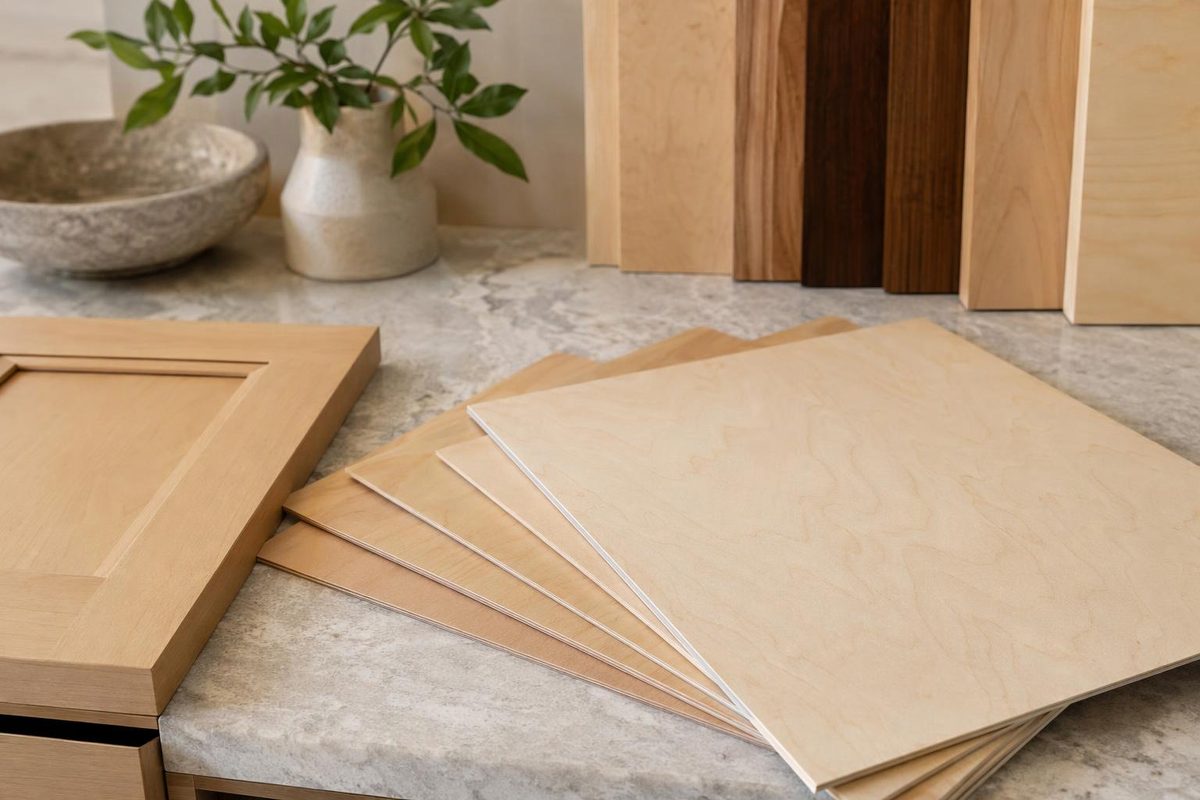
Sanded maple plywood veneer typically offers a smooth, tight-textured wood face, with light coloring and subtle growth rings. But “sanded” describes surface preparation—not a color selection, veneer grade or protective finish. For visible kitchen-cabinet panels, judge the actual face and a finished sample rather than expecting every sanded maple sheet to look alike.
What “sanded” means—and leaves open
A sanded panel has received abrasive preparation to smooth its surface. For example, Lowe’s describes its CorryCabinet maple plywood as pre-sanded for painting and staining, rather than already finished. That makes it a starting material for a finish, not a completed cabinet surface.
Do not confuse this with prefinished maple plywood. A prefinished panel has an applied coating; Columbia’s UV Wood, for example, carries a clear topcoat. Ask separately whether either face is coated. Columbia’s plywood product guide distinguishes its finishing options.
Sanding also does not tell you whether the face is pale sapwood, mixed-color natural maple, rotary-cut or sliced veneer.
Color and texture: pale does not mean identical
The characteristics here refer to hard maple veneer; confirm the species if a listing says only “maple.” Columbia describes hard maple as having a smooth, tight and dense surface, with growth rings that can be barely perceptible. Its sapwood ranges from pinkish white through light yellow to light khaki; heartwood can be much darker. Brown streaks sometimes called “sugar” or worm track are another possible natural characteristic. Columbia’s hard maple species guide documents these variations.
For cabinet selection, separate three characteristics:
| Characteristic | What to expect or check |
|---|---|
| Surface texture | A smooth, close-textured face—not necessarily a visually featureless one. |
| Background color | Pale maple can still have pink, yellow or khaki tones. Compare adjoining panels. |
| Natural markings | Streaks, knots and small areas of figure depend on the particular veneer and grade. |
White maple is a color selection, not white paint. Sierra describes its white maple plywood as selected for sapwood, excluding reddish-brown heartwood. Its C-grade offering can still include pin knots, small burls and permitted knots or repairs while having a smooth, sound surface. Smoothness and visual uniformity are therefore different specifications. Sierra’s white maple grade explanation makes that distinction useful when inspecting an exposed cabinet end.
Grain pattern comes from the cut and matching
Maple’s subtle growth rings do not guarantee straight, uniform grain across a whole panel. Rotary cutting peels a continuous sheet from the log and can create a strongly varied pattern. A whole-piece face has no veneer splice lines, but that does not make its grain uniform. Plain-sliced faces use narrower pieces joined together; quarter slicing produces a straighter grain appearance. Columbia’s veneer-cutting guidance explains these differences.
Matching can also affect the finished appearance. In book-matched veneer, adjacent pieces are reversed like book pages. They may show alternating light and dark bands after finishing—the “barber pole” effect—because the two veneer surfaces absorb finish differently. This is not necessarily uneven sanding or careless staining. Columbia identifies slip matching as one way to avoid that effect in its matching guidance.
For a broad island back or several adjacent slab fronts, approve a sample large enough to show the pattern and joins, not just a small color chip.
Smooth maple still needs a finish test
Maple’s dense, closed grain can absorb stain unevenly, particularly when the target is a dark, uniform color. General Finishes specifically warns about this behavior and recommends particular stain systems for maple. A sanded face alone does not remove that risk. Its maple staining guidance supports testing the chosen finish on the actual panel material.
The decorative face is also thin wood, not a solid maple board that can be repeatedly leveled by sanding. Excessive sanding can irreversibly damage veneer; Timesavers’ veneer guidance warns of that limit. For preparation technique, use our veneer-sanding guide.
Before approving visible cabinet panels, inspect them in angled light for scratches, rough areas, repairs and veneer joins. Then compare a finished panel sample beside the door and edge treatment under your kitchen lighting. Record the accepted color range, markings and grain pattern. Those details describe the surface you want more reliably than “sanded maple plywood” alone.