
Is That Hairline Seam Normal—or Is the Cabinet Finish Failing?
Cracking across flat surfaces, or cracking accompanied by peeling, swelling, or separation, deserves a deeper coating and substrate investigation.
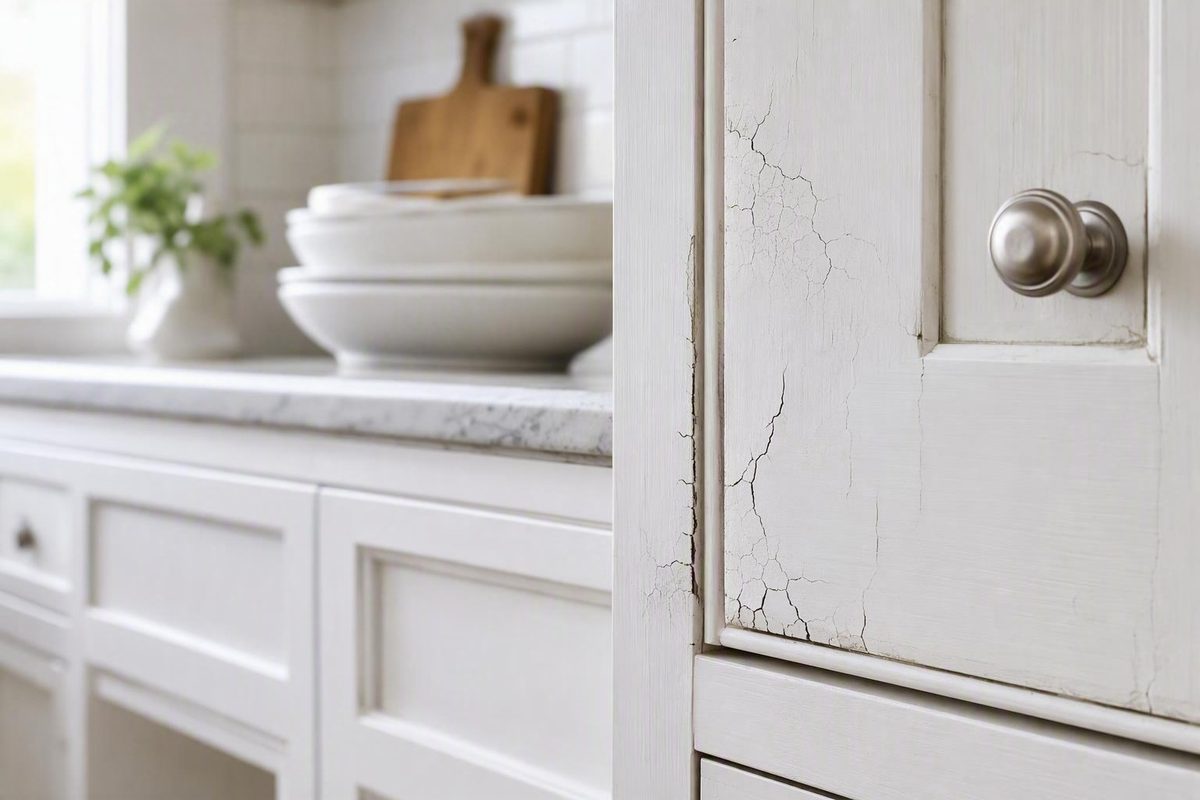
White painted cabinets cracking can mean several different things. A fine line at a door joint may be the finish revealing movement between assembled wood parts. Cracks spreading across a flat door, peeling around a sink, or a visibly separated face frame point to different—and potentially more serious—problems.
The supplied evidence does not identify white pigment as a distinct cause of cracking. Instead, an opaque white finish creates a visually uniform field in which dark seams, exposed substrate, chips, and imperfect repairs are especially conspicuous.
Diagnosis should begin with where the crack is located. Then consider what the surrounding coating is doing, whether the symptom changes seasonally, and how the cabinet is constructed.
Start Here: Identify the Crack Before Trying to Fix It
Before filling, sanding, or repainting anything, place the defect into one of four broad categories:
- A hairline finish split over an assembled joint
- Checking or cracking across a broad painted surface
- Peeling, bubbling, or delamination
- A true split or open joint in the cabinet material
These categories can overlap, but they do not call for the same response.
Learn the cabinet parts
A few basic terms will help you report the defect accurately:
- Stiles are the vertical members on the left and right sides of a framed door.
- Rails are the horizontal members at the top and bottom.
- The center panel fills the area inside the frame. It may be solid wood, MDF, veneered material, or another substrate.
- The door face is the visible front surface, including the frame and panel.
- The cabinet box is the main case behind the doors and drawers.
- A face frame is the wood framework attached to the front of some cabinet boxes. Doors and hinges may be mounted to it.
A witness line is a very thin line that follows the meeting point of two components. It commonly appears where a stile meets a rail, along a center-panel edge, or at an assembled corner. Dean Cabinetry describes an ordinary movement-related witness line as narrow and confined to a joint, without surrounding paint chipping or peeling in its cabinet-joint guidance.
What movement-related cracking usually looks like
A pattern consistent with component movement generally has most of these characteristics:
- The line sits exactly over a known joint.
- It is straight or follows the joint profile.
- It is very narrow.
- The surrounding finish remains firmly attached.
- There is no bubbling, flaking, or powdering.
- The joined parts remain secure.
- The line may become more or less visible at different times of year.
This pattern does not prove that humidity caused the line. It does, however, distinguish a joint-related symptom from cracking across a continuous surface.
Warning signs that deserve closer investigation
Look beyond routine joint movement when you see:
- Cracks crossing the middle of a flat door face
- Cracking across cabinet-box panels as well as doors
- Branching, alligator-like, or networked checking
- Paint lifting in sheets or flakes
- Bubbling or blistering
- A chalky or powdery coating
- Exposed material that feels swollen or soft
- Warped doors or panels
- A joint that is physically open
- A split running through a face-frame member
- Damage concentrated near a leak, sink, dishwasher, range, or steam source
Cracking across a broad flat surface is especially significant because it does not follow the assembled-joint pattern associated with a witness line.
A quick decision tree
Use this for initial triage, not as a final diagnosis:
| What you see | First response |
|---|---|
| Hairline, joint-only, stable, firmly adhered | Photograph, document, and monitor |
| Peeling, bubbling, or flat-surface cracking | Investigate coating adhesion, preparation, compatibility, and substrate condition |
| Swelling, softness, or active moisture | Correct the moisture source promptly and assess the damaged material |
| Visible separation or a true material split | Obtain a repair assessment rather than applying cosmetic filler |
| Widespread defects on new cabinets | Preserve the evidence and contact the installer or manufacturer before altering the finish |
Photographs are useful for documenting the pattern and obtaining an initial opinion. They cannot establish whether a particular failure resulted from humidity, wet material, inadequate preparation, incompatible coatings, workmanship, installation movement, or several factors acting together.
Why White Cabinets Show Cracks So Clearly
There is no good basis in the supplied evidence for saying that white pigment causes cabinet finishes to crack. The documented mechanisms—wood movement, coating adhesion loss, moisture exposure, substrate problems, impact, and cabinet movement—apply to painted cabinetry generally.
What white changes is visibility.
An opaque painted finish creates a nearly continuous field of one color and sheen. When the film splits, a shadow, dark joint, or exposed substrate interrupts that field. Even a narrow line can become noticeable from across the room.
Paint also conceals much of the visual activity of the material beneath it. Stained wood retains grain, pores, color variation, and natural markings, which can make a small movement line less conspicuous. That does not mean stained cabinets cannot crack, chip, separate, or sustain other damage. Canyon Creek’s comparison similarly describes painted finishes as smooth and uniform while noting that stained surfaces retain visible grain and are generally easier to touch up in its painted-versus-stained overview.
White finishes can also be difficult to repair inconspicuously. A fresh touch-up may appear:
- Brighter or cleaner
- Warmer or cooler
- Glossier or flatter
- Smoother or more textured
- More opaque around the repair edge
A spot repair can therefore be technically adequate yet remain visible. In a prominent location, refinishing an entire door or drawer front may produce a more consistent appearance.
White cabinets are not inherently defective or uniquely fragile. They simply reveal seams, chips, grime, fingerprints, and mismatched repairs readily.
The diagnostic takeaway is straightforward: color explains conspicuousness; location, construction, moisture history, and coating behavior are more useful for explaining cause.
The Most Common Joint-Line Cause: Wood Movement Through the Seasons
Industry guidance frequently attributes thin lines at assembled wood joints to seasonal movement, although the supplied evidence does not provide comparative failure data proving that this is the most prevalent cause in every installation.
Wood exchanges moisture with its surroundings. As conditions change, wooden components can change dimension. An opaque finish spans the surface but cannot eliminate movement in the material underneath.
A framed cabinet door contains multiple components. The two stiles meet the top and bottom rails, and the center panel sits inside the frame. Each interface is a potential location where small dimensional changes can become visible through the finish.
Why cracks may appear after winter heating begins
When heating season starts, indoor relative humidity may fall. Wood can release moisture and contract, making a joint line or corner gap more visible. A finish spanning that interface may split instead of moving invisibly with it.
General Finishes attributes some corner and joint cracks after the heat is turned up to seasonal humidity changes. It also cautions that numerous heavy layers of primer, paint, and topcoat can break where a panel shrinks in its cabinet-cracking FAQ.
That does not mean every winter crack is caused by humidity. Timing is evidence, not proof. A defect noticed during winter could also involve:
- An aging or brittle coating
- Heavy finish buildup
- Poor adhesion between layers
- Cabinet or building movement
- A nearby heat or moisture source
- A weak or damaged joint
- Earlier preparation problems becoming visible
The pattern most consistent with seasonal movement is a narrow line that follows a known joint, becomes wider under drier conditions, and grows less visible as conditions become more humid—without peeling, swelling, or physical separation.
Why the repair may reopen
A cosmetic repair does not immobilize the underlying parts. If a rail-and-stile joint continues moving, filler, caulk, primer, or paint applied over it must accommodate that movement.
“Repair” can therefore mean several different things:
- Concealing the current line
- Moderating environmental swings
- Restoring failed coating adhesion
- Repairing a weak or open joint
- Replacing a damaged component
Only the last two change the cabinet assembly itself. Even then, repairing one joint does not eliminate the ordinary moisture response of the surrounding wood.
Superior Cabinets states that hairline lines may occur at painted door joints and presents MDF-based options as ways to reduce—not universally eliminate—the visible risk in its discussion of painted wood and MDF doors. Whether a particular line is acceptable, repairable under warranty, or excluded from coverage depends on the written warranty and the actual condition.
When Cracking Points Beyond Normal Joint Movement
A crack crossing a broad, uninterrupted surface is meaningfully different from a line located exactly where two components meet. So is a coating that bubbles, flakes, powders, or pulls away from the substrate.
These symptoms require investigation rather than an automatic humidity diagnosis.
Plausible causes to consider
Depending on the pattern and cabinet history, relevant possibilities include:
- Grease, polish, dirt, or residue left before painting
- Inadequate sanding or deglossing
- Primer that did not bond to the existing finish
- An unsuitable coating or incompatible product layers
- Heavy coating buildup
- Inadequate drying between coats
- Moisture exposure or a leak
- Steam and poor ventilation
- Heat or prolonged sunlight
- A damaged, unstable, or wet substrate
- Impact or abrasion
- Cabinet-box movement or weak installation
- A true split in the cabinet material
This is a list of possibilities, not a diagnosis. More than one factor may be involved.
Adhesion failure has its own clues
Peeling, flaking, bubbling, or lifting indicates that the coating has lost adhesion somewhere in the finish system.
Without pulling away additional material, note what remains underneath a naturally loose edge.
RW Professional Painting identifies cleaning, surface preparation, primer selection, moisture, heat, and coating choice as relevant categories when evaluating peeling cabinet paint in its adhesion troubleshooting guide. Because this is contractor guidance rather than a controlled technical comparison, the categories are best used as inspection prompts rather than proof of a particular cause.
Examine wet and hot zones first
Pay particular attention to cabinets:
- Beneath or beside a sink
- Next to a dishwasher
- Near a range or wall oven
- Above a kettle, coffee maker, or steam source
- Below plumbing connections
- Near a known roof, wall, or appliance leak
- In sustained direct sunlight
Look for swollen edges, raised fibers, distorted profiles, softness, staining, recurring dampness, or finish failure concentrated around one source. If the substrate is wet, soft, or actively swelling, stop treating the problem as merely cosmetic.
Widespread new-cabinet cracking is not a typical seam pattern
One homeowner report described new cabinets developing cracks across doors and later across cabinet boxes rather than only at seams. Forum participants proposed humidity, wet wood, primer or paint problems, and poor adhesion, but photographs and a single whole-house humidity reading did not establish a final cause in the original Houzz discussion.
That anecdotal case is useful primarily as an example of uncertainty. Widespread checking can resemble several different failures, and repainting may obscure evidence needed to identify them.
When new cabinets show broad checking, delamination, swelling, or cracks across both doors and boxes, seek an in-person assessment before accepting a blanket repaint. Ask what failed, what evidence supports the diagnosis, and how the proposed work addresses the suspected cause.
Use Location, Timing, and Humidity Records to Narrow the Cause
Useful documentation gives a painter, installer, or manufacturer more information than “the cabinets are cracking.” It also helps distinguish a recurring seasonal line from progressive finish or substrate failure.
Build a defect record
For each affected area, collect:
- A full-door or full-cabinet photograph
- A close-up in clear, consistent lighting
- The component name and location
- The installation or refinishing date
- The date the defect was first noticed
- Notes on whether it is changing
- Dates when it becomes wider, narrower, or more numerous
- Nearby water, heat, steam, or sunlight sources
- Whether the paint is firmly attached or lifting
- Whether the underlying material feels hard, swollen, or soft
- Any staining, odor, or evidence of a leak
Include a ruler or another scale reference in selected photographs without pressing tools into the coating. Photograph the same area from the same angle over time.
Map each defect to the construction
Label the location as specifically as possible:
- Rail-and-stile joint
- Center-panel edge
- Door corner
- Flat center panel
- Flat slab-door face
- Face-frame joint
- Face-frame member
- Finished cabinet end
- Cabinet-box interior or exterior
- Toe kick or sink base
- Molding joint
A line that repeatedly tracks a rail-and-stile intersection supports a different working explanation from cracks that wander across a slab door and continue onto the cabinet box.
Record humidity as a trend
Place an independent hygrometer near the affected cabinets and record readings over time. A whole-house control may be located elsewhere, and one display shows only conditions at a particular moment.
A single reading cannot prove why a finish cracked. A more useful record pairs:
- Dated readings near the cabinets
- Heating or cooling conditions
- Seasonal context
- Photographs of the same crack
- Notes about changes in crack width
If a line consistently widens when nearby air is drier and narrows when it is more humid, that supports a movement explanation. It does not rule out a brittle coating or another weakness at the joint.
Know when monitoring is reasonable
Monitoring through changing conditions can be sensible when the defect is:
- Hairline
- Confined to a known joint
- Clean rather than branching
- Not peeling or bubbling
- Not associated with swelling or moisture
- Not a physically open separation
- Not worsening rapidly
Do not postpone action when there is active moisture or an approaching warranty deadline. If alteration could affect a claim, contact the responsible company before touching the finish.
Preserve the paperwork
Keep copies of:
- Purchase contracts and invoices
- Cabinet specifications
- Door construction and substrate descriptions
- Finish names and product information
- Care and environmental instructions
- Warranty terms and exclusions
- Previous emails and inspection notes
- Touch-up products supplied with the cabinets
- Written repair proposals
- Terms covering recurrence after repair
Ask neutral, specific questions:
- What is the substrate in the affected component?
- Is the center panel solid wood, MDF, or another material?
- What primer, color coat, and topcoat were used?
- Is this pattern being classified as a witness line or coating failure?
- What evidence supports that classification?
- What repair products are compatible with the original finish?
- Will refinishing address the cause or only conceal the symptom?
- How will color and sheen be matched?
- What happens if the defect returns?
- Will the repair affect the remaining cabinet warranty?
How Door Material and Construction Affect Cracking Risk
“MDF versus wood” is too simple a comparison. The number and location of assembled joints matter as much as the material name.
Assembled solid-wood doors
A traditional frame-and-panel door has separate wood rails and stiles surrounding a center panel. The assembled joints can telegraph through paint as the components respond to changing conditions. A solid-wood center panel may also change dimension, making a line at its edge more visible.
This construction offers real wood, familiar joinery, and established repair methods. Its tradeoff under an opaque finish is that movement can become visible.
Wood frame with an MDF center panel
This hybrid uses wood rails and stiles around an MDF center panel. The MDF panel may reduce movement associated with a solid-wood panel, but it does not remove the wood-frame joints. A hairline line can still develop where a rail meets a stile.
The construction addresses one movement-prone area without eliminating every assembled interface.
Five-piece MDF doors
A five-piece MDF door also has separate rails, stiles, and a center panel, but the components are engineered material rather than solid wood. It may reduce some wood-movement risk, yet it still contains assembled joints.
Five-piece MDF should not be described as joint-free or crack-proof.
One-piece routed MDF doors
A one-piece routed MDF door is machined from a single sheet to resemble a frame-and-panel design. Because the visible face is not assembled from separate rails and stiles, it removes those particular assembly joints from the door face.
That can be useful when minimizing rail-and-stile witness lines is a priority. A roundup of professional opinions describes MDF as more dimensionally stable for painted applications while also warning that inadequate sealing or water exposure can lead to swelling and finish damage in this painted-cabinet finish discussion.
MDF has different vulnerabilities
If water enters the material, it may swell, distort, or lose finish adhesion. A swollen MDF edge is not simply a paint crack; the substrate itself may have changed.
Material selection is therefore a tradeoff involving:
- Desired door profile and appearance
- Number and location of assembled joints
- Exposure to water and steam
- Sealing of edges and routed profiles
- Susceptibility to dents or impact
- Ease of repair
- Availability of a matching replacement
- Cost and manufacturer support
There is no universal ranking that makes one construction best for every kitchen.
Questions to ask before buying painted doors
Ask the supplier:
- What is the door substrate?
- Are the rails and stiles solid wood, MDF, or another material?
- What is the center panel made from?
- Is the door assembled in five pieces or routed from one piece?
- How are edges and routed profiles sealed?
- What finish system is used?
- What care and environmental guidance applies?
- Does the warranty exclude minor joint witness lines?
- How are broad finish failures handled?
- Are matching touch-up materials available?
- How long are replacement doors and finish colors expected to remain available?
- Can a replacement be matched after the installed finish has aged?
Choose the Repair That Matches the Defect
There is no universal repair procedure for white painted cabinets cracking. The right response depends on whether the goal is monitoring, concealment, finish restoration, joint repair, or replacement.
| Defect | First response | Likely direction | Main limitation |
|---|---|---|---|
| Clean hairline over a joint | Document and monitor | Environmental moderation or approved touch-up | The line may reopen |
| Localized chip with sound surrounding paint | Confirm adhesion and coating identity | Compatible localized repair | Color or sheen may not blend |
| Widespread checking | Identify coating and substrate cause | Full-component preparation and refinishing | Repainting may fail if the cause remains |
| Peeling or bubbling | Check adhesion and moisture | Remove failed material and rebuild a compatible system | Topcoating cannot secure loose layers |
| True wood split | Assess depth and joint integrity | Possible glue-and-clamp repair followed by finish restoration | Filler alone does not repair the split |
| Swollen MDF or warped material | Find and correct moisture source | Professional assessment or replacement | Repainting does not reverse substrate distortion |
| Repeated failure | Reassess the diagnosis | Revised repair system or replacement | Repeating the same treatment may repeat the result |
Clean seasonal hairline over a joint
If the line is stable, joint-only, and free of peeling or swelling, reasonable options include:
- Leaving it alone
- Monitoring it through changing seasons
- Moderating large environmental swings according to manufacturer guidance
- Using a manufacturer-approved touch-up product
- Refinishing the full component if appearance justifies it
Filler, caulk, or paint may split again if the joint continues moving. Evaluate a proposed repair partly by its recurrence expectations, not only by how it looks when completed.
Localized chip with sound surrounding paint
For a small chip where the adjacent coating remains firmly attached, a repair usually involves cleaning the area, removing only material that is already loose, softening the abrupt repair edge, using a compatible primer if required, and applying thin matching coats.
This is not a universal recipe. Factory conversion varnish, lacquer, enamel, and unknown site-applied finishes may respond differently to repair materials. Do not assume that a particular primer, aerosol, caulk, clear coat, or preparation method is suitable for every cabinet.
Widespread checking, peeling, or adhesion loss
Do not begin with a broad repaint. First determine, as far as practical:
- What coating is already present
- Where adhesion is failing
- Whether moisture is present
- Whether the substrate is sound
- Whether inadequate preparation may be involved
- Whether the proposed products are compatible
A refinishing scope may require removing failed material, preparing the entire component, applying a suitable primer, and rebuilding the finish. The exact process should come from the selected coating system rather than from a generic internet procedure.
A true split in a face frame
A split through a wood face-frame member differs from a hairline line confined to the finish.
Repair may involve opening the split enough to introduce adhesive, clamping it into alignment, and then restoring the finish. A cabinet-parts seller illustrates the distinction between gluing and clamping a cracked face frame and merely concealing its surface in this repair example. Its coating products and process are specific to the finishes it sells and should not be treated as universal instructions for another manufacturer’s cabinets.
Swollen, warped, soft, or repeatedly failing components
Prioritize the source of the problem when you find:
- Active leaks
- Soft or swollen material
- Distorted MDF profiles
- Warped doors
- Open joints
- Repeated failure in the same location
- Widespread delamination
Consider how visible the repair will be
A small repair can be functionally adequate yet remain conspicuous on aged white cabinetry. Refinishing the entire door, drawer front, finished end, or defined face-frame section may create a more consistent appearance.
This article is not a universal sanding or spraying procedure. Before disturbing an unknown coating, identify the finish as far as practical and obtain the coating manufacturer’s product-specific instructions. If compatible products and procedures cannot be confirmed, use a qualified refinisher rather than experimenting with caulk, primer, aerosol paint, or clear topcoat.
Prevention, Warranty Questions, and When to Escalate
Prevention begins by separating conditions homeowners can influence from construction and finishing variables that routine care cannot correct.
Conditions homeowners can manage
Helpful practices include:
- Wiping up spills promptly
- Repairing plumbing and appliance leaks
- Using normal kitchen ventilation
- Avoiding prolonged steam exposure against doors and finished ends
- Following the cabinet maker’s cleaning instructions
- Avoiding saturated cloths on exposed or damaged edges
- Maintaining reasonably stable indoor conditions
- Recording recurring seasonal changes
Wellborn Cabinet’s care guidance connects changes in humidity and temperature with wood movement and identifies water exposure and painting over dirty or wet material as possible contributors to bubbling, cracking, or peeling in its cabinet-damage guide.
Humidifiers and dehumidifiers may moderate large seasonal swings.
Follow the cabinet manufacturer’s environmental guidance rather than treating one relative-humidity target as universal for every product, building, and climate.
Variables controlled by the maker or refinisher
Construction and finishing variables include:
- Substrate selection
- Lumber and substrate condition
- Joint design and assembly
- Edge and profile sealing
- Surface cleaning and preparation
- Primer selection
- Coating compatibility
- Film thickness
- Drying and curing
- Handling, installation, and acclimation
For future painting, the general priorities are thorough cleaning, sound surface preparation, a suitable primer, a compatible cabinet-grade coating, thin coats, and adequate drying under the selected manufacturer’s instructions.
When to escalate
Request an in-person assessment when you see:
- An active leak
- Swelling or softness
- Warping
- Physical separation
- Broad flat-surface cracking
- Widespread checking or delamination
- Cracking across both doors and cabinet boxes
- Recurrence soon after repair
- Rapidly progressive damage
- An unexplained widespread pattern in newly installed cabinets
Do not assign fault from appearance alone. Cabinet construction, finishing, installation, building conditions, homeowner care, and appliance or plumbing leaks may all be relevant. More than one factor can contribute.
Approach warranty discussions precisely
Warranty treatment varies. Some manufacturers distinguish minor rail-and-stile witness lines from broader coating failure, open joints, swelling, or substrate damage. One manufacturer’s exclusion does not establish how another company must classify a particular condition.
Before accepting refinishing or replacement, ask for the proposed diagnosis and remedy in writing.
A useful repair proposal should identify:
- The diagnosed defect
- The evidence supporting that diagnosis
- Every affected component
- The preparation method
- The proposed primer, coating, and topcoat system
- Compatibility with the existing finish
- Whether components will be removed or repaired in place
- Protection for countertops, floors, appliances, and adjacent surfaces
- Expected color, sheen, and texture variation
- Whether repairs will be localized or full-component
- Known recurrence limitations
- The written warranty covering the repair
- What happens if the cracking returns
A cosmetic repair may be reasonable for a harmless witness line. It is not a complete response to swelling, adhesion loss, physical separation, or an unidentified widespread failure.
Frequently Asked Questions
Are hairline cracks at the joints of white painted cabinets normal?
They can be common at assembled wood joints, especially where a vertical stile meets a horizontal rail. A movement-related witness line is generally very thin, follows the joint, and has no surrounding chipping, peeling, bubbling, or physical separation.
“Common” does not mean every crack is harmless or that every manufacturer will classify it the same way. A line that crosses a flat surface, branches, widens substantially, or accompanies coating loss should be investigated.
Will cabinet cracks close when humidity rises?
Some movement-related gaps may narrow or become less visible as conditions grow more humid and wood components change dimension. That outcome is possible, not guaranteed.
Track the same line with dated photographs and nearby humidity readings. Peeling, swelling, softness, or broad checking should not be left untreated in the hope that a seasonal change will reverse the damage.
Can I caulk and repaint a moving cabinet-door joint?
A compatible repair system may conceal a fine joint line, but caulk and paint do not prevent the underlying joint from moving. The line may reopen, or the repair may remain visible because its color, sheen, or texture differs from the surrounding finish.
When the original coating is unknown or factory applied, consult the cabinet manufacturer or a qualified refinisher before adding caulk, primer, paint, or clear coat.
Do MDF cabinet doors prevent paint cracking?
No. MDF may reduce some movement-related risks, but it does not prevent every kind of cracking.
A wood-frame door with an MDF center panel still has wood rail-and-stile joints. A five-piece MDF door still has assembled joints. A one-piece routed MDF door removes those face joints, but its finish can still be damaged by impact, poor preparation, adhesion problems, inadequate sealing, or water exposure.
When does cracking in new cabinets justify a warranty claim or professional inspection?
Contact the installer or manufacturer promptly when new cabinets show cracks across flat doors or cabinet boxes, widespread checking, peeling, bubbling, swelling, softness, warping, open joints, or repeated failure after repair.
Preserve photographs, invoices, cabinet specifications, environmental records, and warranty documents before anyone sands or repaints the evidence. Ask for the diagnosis, supporting evidence, proposed coating system, recurrence limitations, and repair warranty in writing.
Closing takeaway: Use a location-first rule. A narrow line over a rail, stile, corner, or panel edge may be a recurring movement-related witness line. Cracking across flat surfaces—or cracking accompanied by peeling, swelling, or separation—deserves a deeper coating and substrate investigation. Document the pattern before altering it, correct obvious moisture sources, confirm the cabinet construction and finish system, and choose a repair that addresses the defect rather than merely covering it. White makes many problems easier to see, but it does not by itself explain why the finish cracked.