
Inset Cabinet Doors Look Precise—If the Quote Is Precise
Learn how inset cabinet doors differ from overlay doors, where fit and humidity matter, and what to require in the quote and final installation.
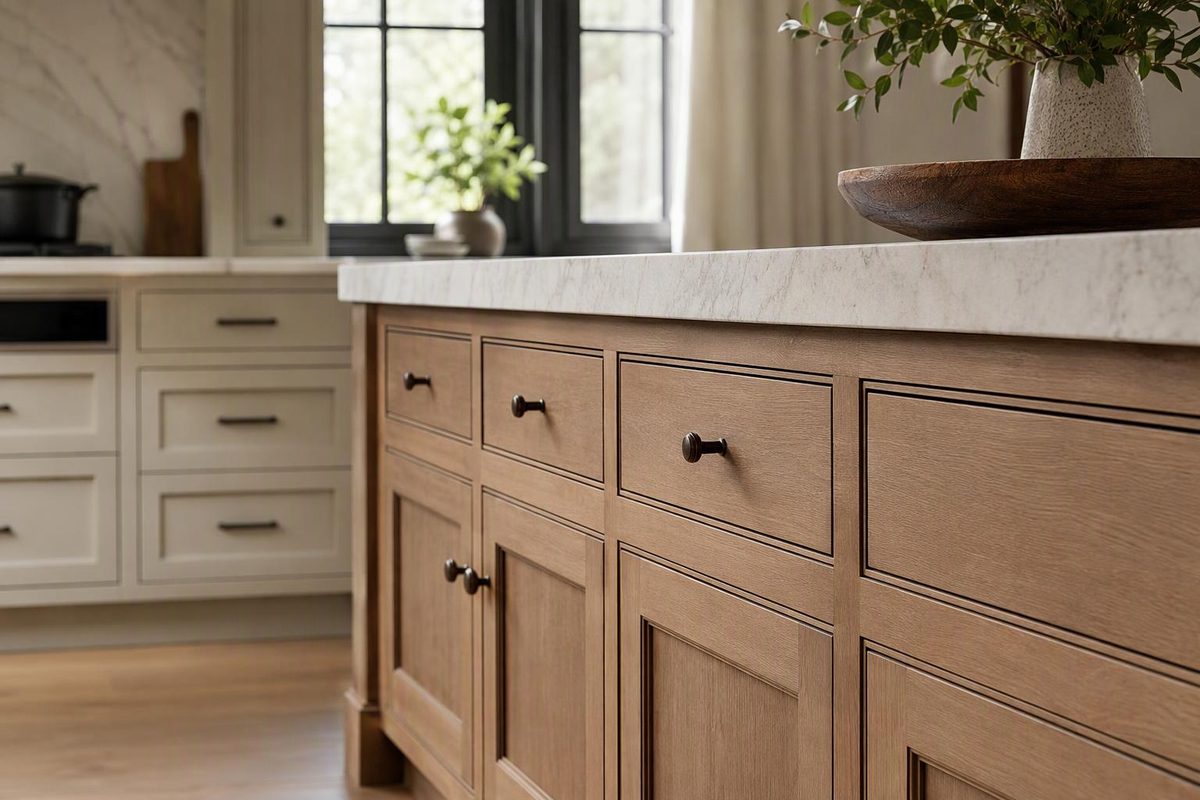
A cabinet with inset doors has a face frame, and its doors and drawer fronts close inside the frame openings rather than overlapping them. The fronts sit approximately flush with the frame, leaving a narrow reveal around each one.
That construction creates visible, furniture-like frame lines. It also makes uneven fabrication, installation and seasonal movement easier to see. Inset is worth choosing for those proportions—not because the term guarantees better box materials, joinery or hardware.
Inset describes the fit, not the door design
“Inset” is often confused with “recessed panel.” They describe different details:
- Inset tells you how the entire door fits relative to the cabinet face frame.
- Recessed, raised or slab tells you how the door face is constructed.
An inset cabinet can therefore have Shaker-style recessed-panel doors, raised-panel doors or another compatible design. Conversely, a recessed-panel door can be mounted as an overlay.
Inset cabinetry is normally framed cabinetry. Wellborn defines inset as a framed cabinet with doors and drawer fronts set inside the frame, leaving the frame uncovered (Wellborn Cabinet). Frameless cabinets do not have that surrounding face frame, so a seller offering “frameless inset” should provide a section drawing or sample showing exactly what the term means in that product line.
The decision is mostly about reveals
The reveal is the small gap between a front and its opening. Because every inset front is bordered by this line, inconsistent gaps quickly make an entire run look poorly fitted.
There is no universal reveal dimension. Showplace, for example, specifies a 3/32-inch gap for its inset construction (Showplace Cabinetry). Treat that as one manufacturer’s specification, not a target every cabinet shop must copy. The order should identify the cabinet line and construction, while the installer should have that line’s intended gaps and adjustment instructions.
Choose between two frame treatments as well:
- Flush inset: The inside edge of the face-frame opening is square and plain. This is the quieter treatment.
- Beaded inset: A small molded bead follows the inside of each opening, adding another shadow line and a more decorative effect.
View a corner cabinet, a bank of drawers and a pair of doors—not just one sample door. Those areas show how often the frame lines repeat and whether the result will look too busy in the room.
Ask for usable openings, not just cabinet widths
A face frame narrows the clear opening of a framed cabinet. With inset construction, the closed door or drawer front also sits within that opening instead of in front of it. MasterBrand describes inset as producing a smaller opening than overlay, although it characterizes the reduction in storage as minimal (MasterBrand).
The practical issue is clear access rather than necessarily a major loss of box volume. Pullouts, roll trays and interior drawers must clear the frame and hinges. Showplace notes that the frame on its framed cabinets decreases the available size of internal drawers and roll trays compared with its frameless construction (Showplace Cabinetry).
Before approving the design, ask for the usable opening width and interior accessory width on narrow base cabinets, pantry pullouts and double-door cabinets. A nominal 15-inch cabinet width does not establish either measurement.
Specify the hinges and adjustment
Inset does not automatically mean visible hinges. Depending on the cabinet line, options can include concealed soft-close hinges or exposed barrel or finial hinges selected partly for appearance. Showplace offers concealed and visible finial hinges on its inset cabinets, while Wellborn lists both concealed and barrel hinges in its terminology (Showplace Cabinetry; Wellborn Cabinet).
If a quote merely says “soft-close hinge,” ask for the manufacturer and model—or at least its adjustment instructions and opening angle. Adjustable hardware is useful because narrow reveals may need correction after installation. Blum, for example, says its hinges provide side, depth and height adjustment, but the specified hinge still has to suit the door and cabinet application (Blum).
Confirm the hinge finish when the hardware will be exposed. Also check hinge and handle clearance at adjacent walls, perpendicular cabinet runs and appliances; the door must open far enough for any pullout behind it to operate.
Humidity can turn a small gap into a rub
Wood takes on and releases moisture as surrounding temperature and relative humidity change, which can cause it to swell or shrink (U.S. Forest Service). With an overlay door, modest movement may alter the spacing between fronts. With a tightly fitted inset front, it can make an edge rub or bind.
Showplace specifically warns that dimensional changes can cause its inset doors and drawer headers to bind (Showplace Cabinetry). Its warranty requires cabinets to remain in a controlled space at 50–85°F and 30–55% relative humidity, including controlled storage before installation (Showplace Cabinetry). Those are Showplace’s limits, not universal cabinet-industry thresholds; obtain the care and warranty requirements for the brand being quoted.
This deserves extra attention in homes with large seasonal humidity swings, when cabinets might be stored in an unconditioned building, or while construction materials are still drying. Ask who handles doors that bind after installation and whether a return adjustment is included in the installer’s service period.
For painted cabinets, request the exact door construction—solid-wood frame, MDF or HDM components, or another build—rather than accepting “paint grade” as a complete specification. Material selection can reduce some movement, but it does not override the maker’s environmental limits. It also does not guarantee that painted joints will remain invisible; different crack patterns point to different causes.
Do not apply a universal inset premium
Inset usually requires precise fitting and application-specific hardware, but there is no defensible percentage to add to every kitchen. Bishop Cabinets says its own inset pricing is similar to full overlay while reporting that some other manufacturers charge 15–30% more (Bishop Cabinets). That manufacturer-reported range illustrates why a generic premium is a poor budgeting tool.
Compare itemized quotes from the same manufacturer and cabinet line, keeping the door, finish, box construction, accessories and installation scope the same while changing only inset versus overlay. Check whether the difference includes exposed-hinge upgrades, beaded frames, finished ends, fillers and field adjustments. Comparing unrelated brands will not isolate the cost of inset construction.
Put these details in the order
Before signing, the cabinet schedule, quote or attached specifications should identify:
- Framed inset construction, not merely an inset-looking door sample.
- Flush or beaded face frames.
- Door style, material and finish.
- Hinge type, visibility, finish, soft-close function, opening angle and adjustability.
- Usable openings and accessory widths where access is tight.
- Fillers and operating clearances at walls, corners, appliances and perpendicular runs.
- Manufacturer humidity requirements and relevant warranty exclusions.
- Who performs final door and drawer adjustment after installation.
At final inspection, look along the entire run rather than judging one front at a time. Reveals should be consistent, fronts should sit in their intended plane, and every door and drawer should operate without rubbing. Test pullouts with neighboring doors and appliances in their normal positions.
Choose inset when the exposed frame grid and flush fronts are central to the design—and when the product, installation and home environment can preserve that precise fit. Choose overlay when wider access, more forgiving front alignment or a lower matched quote matters more than the framed furniture look.