
Choose Inset Shaker Cabinets by the Whole Front
Compare inset and overlay Shaker cabinets, then specify face frames, drawer fronts, paint or stain materials, and matched quotes before approving your order.
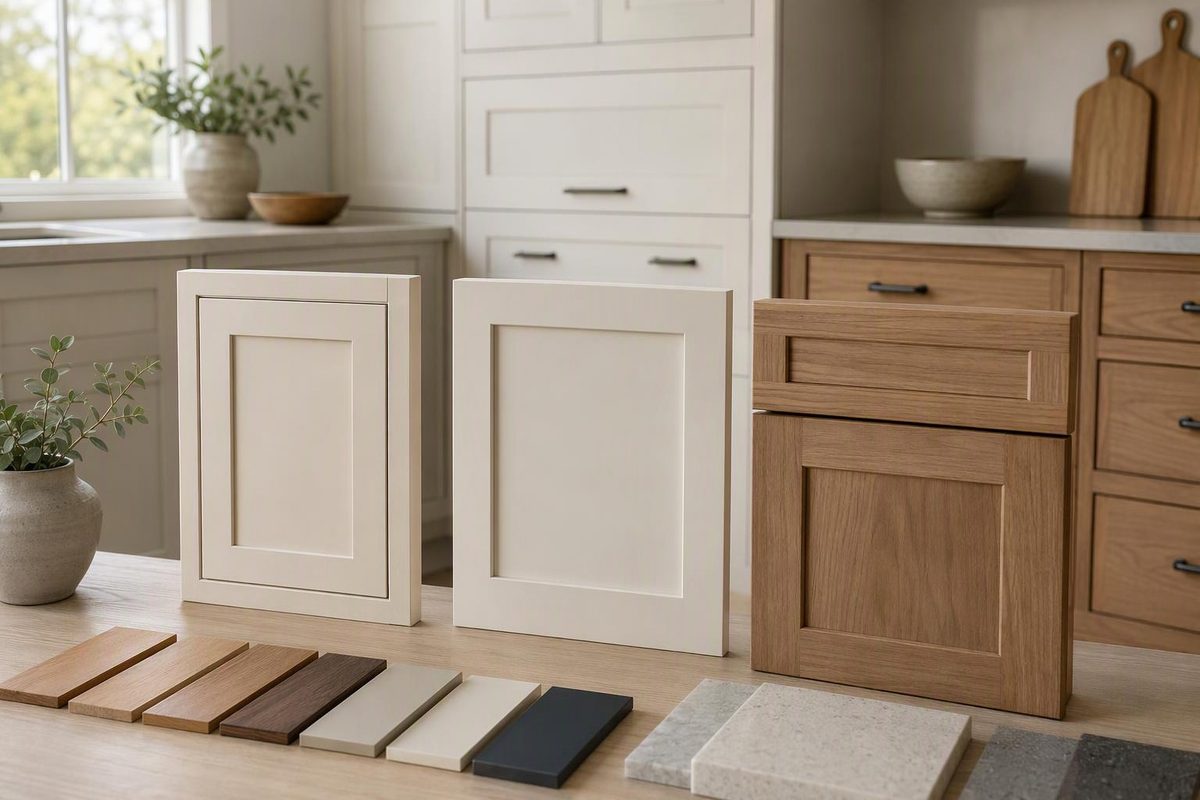
Inset Shaker cabinets pair a recessed-panel Shaker door with an inset fit: the doors and drawer fronts sit inside the cabinet’s face frame, flush with it when closed. Choose them for the exposed framework around the fronts. If you mainly want the simple Shaker panel, compare full-overlay Shaker cabinets—you can keep that door style without choosing inset construction.
The decision is not settled by a sample door. You also need to approve the face-frame proportions, drawer-front treatment, material beneath the finish and price for the complete design. A quote that says only “inset Shaker” leaves those choices unresolved.
Choose your preferred front, finish and frame detail; use the result to brief your cabinet supplier.
Cabinet Specification Selector
Specify Plain Inset Shaker
Keep the exposed face frame and specify plain openings. Approve the face-frame widths alongside the door rails and stiles.
For paint, confirm the frame and panel materials, separate-piece or routed construction, and treatment of joints under the finish warranty.
Next: request an elevation showing drawer fronts and pull locations. Availability must be confirmed for the quoted inset line.
Source: article guidance and Dura Supreme construction and Paintable handout. Selection aid only; it does not establish line availability or pricing.
Inset Describes the Fit; Shaker Describes the Door
Inset is the mounting arrangement. Doors and drawer fronts fit within the face-frame openings rather than covering the cabinet face. Dura Supreme’s construction explanation illustrates the distinction between inset and overlay cabinetry.
Shaker is the door design. A conventional Shaker door has two vertical stiles, two horizontal rails and a flat recessed center panel, with a simple inside profile. Craft Custom Cabinets describes its Shaker doors as five-piece doors with an unbeveled frame and recessed panel.
These descriptions answer different questions. “Inset” tells you where the front sits; “Shaker” tells you what the front looks like. Neither term specifies the cabinet-box material, finish quality, drawer construction or hardware. Those need their own entries in the order specification.
This distinction also gives you a useful comparison. If the visible cabinet framework is what attracts you, inset construction belongs in the design brief. If the recessed panel is the attraction, ask to see that Shaker profile in both inset and full-overlay versions before choosing the construction.
| Choice | What It Specifies | What Remains Open |
|---|---|---|
| Inset | Fronts within the face frame | Door profile and materials |
| Shaker | Recessed-panel door design | Mounting arrangement |
| Beaded Frame | Profile around the opening | Door border and finish |
| Paint or Stain | Finish direction | Underlying construction |
Avoid treating an attractive showroom front as a complete specification. Ask which parts of that display are included in your quote and which are separate options. That is especially useful when the display combines inset construction, a decorative frame and visible hinges.
Approve Both Frames on the Cabinet Elevation
An inset Shaker front contains two visible frames: the cabinet’s face frame and the border of the Shaker door. Approve them together. A loose door sample shows the rails, stiles and panel, but not how that door will look inside the cabinet framework.
Request an elevation drawing of the proposed cabinet fronts. It should identify the face-frame widths, including the vertical members between doors and drawer stacks, and the rail and stile widths of the doors. If the drawing is only illustrative, ask for those dimensions separately rather than judging proportions from an unscaled picture.
Review the narrow doors in your actual layout, not just the largest door on the sample wall. As the front gets narrower, the recessed panel can become a smaller part of what you see. Ask the supplier to show the selected profile on those doors so you can decide whether the balance still looks right.
Do the same for adjacent cabinets. Compare the visible framework around a door cabinet with the framework around a drawer stack. The aim is not to impose one universal set of widths; the draft sources provide no standard dimensions for this choice. The aim is to see and approve the proportions the supplier will build.
Plain and Beaded Openings Are Separate Choices
A beaded inset frame adds a small decorative profile around the opening; a plain frame leaves a simpler edge. Dura Supreme offers both and describes its beaded option as more traditional in appearance. Its frame options show why the bead needs a separate decision.
The bead belongs to the cabinet frame, not the recessed Shaker panel. Specifying “Shaker doors” therefore does not establish whether the openings will be plain or beaded. Ask the supplier to name the frame treatment on the quote and show exactly where the bead appears on the elevation.
For a quieter front, start by comparing a plain opening with your selected Shaker profile. If you want the additional decorative line, review the beaded version with the same door and finish. Keeping the other choices unchanged makes the frame detail easier to judge.
Neither treatment needs to be selected from a style label alone. “Traditional” is Dura Supreme’s description of its beaded option, not a requirement that every traditional kitchen use a bead. Approve the actual combination of cabinet frame, door border and finish.
Resolve Drawer Fronts Before Placing the Pulls
“Shaker cabinets” does not tell the supplier how every drawer front should look. Specify whether the drawer fronts are slab, recessed-panel or a deliberate mix, and identify where each treatment belongs. Do not leave the shallow top drawers to an assumption based on the larger doors.
Wide horizontal rails on a shallow drawer front can leave little panel space for a pull. Dura Supreme discusses this issue in its drawer-front design guidance. The options described there concern its full-overlay styles; that guidance does not establish which fronts are available for your inset order.
For inset cabinetry, have the supplier confirm the available drawer-front treatment and show the actual pull location on the drawing. Review the proposed hardware against the front it will occupy, rather than approving the handle and drawer design separately.
A useful approval drawing identifies the drawer-front style and the proposed pull position for each distinct front size. If the supplier proposes slab top drawers with recessed-panel fronts below, ask to see that arrangement across the whole run. You are approving a visible pattern, not merely a list of door-style names.
Keep the distinction between an aesthetic decision and an availability check. You can prefer a recessed-panel top drawer, but the supplier still needs to confirm that the quoted inset line offers the proposed front and hardware arrangement. A photograph from another cabinet line is not that confirmation.
Specify the Construction Beneath Paint or Stain
Do not treat “solid wood” as the only acceptable description of a Shaker door, or “paintable” as a complete specification. The finished appearance and the underlying build are separate things to approve.
For example, Dura Supreme’s Paintable construction handout describes five-piece high-density fiberboard, or HDF, doors and a separately quoted option using a maple frame with an HDF panel. That is evidence about those described constructions, not proof that every inset Shaker style is available in both.
Ask which construction is available for the exact inset style being quoted. The same general recessed-panel appearance can conceal different builds, so a door-style name should not substitute for a material description.
Painted Doors Need Frame and Panel Specifications
For paint, ask whether the frame and panel are solid wood, medium-density fiberboard, or MDF, or HDF. Also ask whether the door is assembled from separate pieces or routed from one panel. Record the answer for the door and for any drawer fronts whose construction differs.
Then ask how the manufacturer treats visible joints and movement under its finish warranty. A material name alone does not establish finish performance, and the supplied sources do not provide a universal comparison of warranty coverage or paint durability across these constructions.
Approve a finished sample representing the proposed build. If the sample uses a different frame or panel material from the quote, ask the supplier to resolve that mismatch before you sign off. Keep the sample’s construction description with the finish selection so “painted Shaker” does not become the only surviving instruction.
Stained Doors Need a Visible-Wood Specification
For stain, specify the visible wood species, whether the center panel is solid wood or real-wood veneer, and the expected grain direction. Ask for a finished sample that represents the proposed construction rather than choosing the stain from a sample of a different material.
Our guide to stainable Shaker panels explains why identifying the visible face matters. For the order itself, get the frame and panel descriptions in writing. “Wood door” is less useful than a specification that distinguishes what you will see on the border from what you will see in the center.
If the door and drawer fronts use different constructions, ask the supplier to show their finishes together. The approval should cover the proposed combination, not just the most attractive individual sample.
Compare Matched Quotes, Not a Universal Inset Premium
Craft Custom Cabinets says its inset styles are typically more expensive than overlay. That supports expecting a possible premium. It does not support applying a universal percentage to your kitchen, and the draft provides no price figure or percentage to use.
Request inset and full-overlay prices from the same manufacturer and cabinet line for the same layout, door profile, materials, finish and accessories. Otherwise, a difference in the totals may include changes beyond the mounting arrangement you meant to compare.
| Quote Item | Hold Constant | Identify Separately |
|---|---|---|
| Layout | Cabinets and sizes | Any layout revisions |
| Fronts | Shaker profile and materials | Inset or overlay fit |
| Finish | Approved paint or stain | Finish substitutions |
| Details | Accessories and hardware | Beading and hinge changes |
Have beading and decorative hinges identified rather than bundled into an unexplained upgrade. If a detail cannot be carried across both versions, ask the supplier to describe that difference. The comparison should make clear what each price buys, even when the designs cannot be identical in every respect.
Also keep the drawer-front choices consistent wherever the line allows. Comparing an inset quote with recessed-panel drawer fronts against an overlay quote with slab fronts does not isolate the price of inset construction. Ask for the difference to be explained rather than treating the two totals as a clean inset-versus-overlay test.
Separate Design Approval From Fit Responsibilities
Before ordering, the approved package should connect the elevation, door profile, frame treatment, drawer fronts, materials, finish sample and hardware arrangement. If one changes, ask which drawings or specifications need to change with it.
That package settles the appearance you intend to buy. It does not, by itself, settle usable openings, hinges, humidity requirements or installation responsibilities. Use our inset cabinet buying checklist to address those purchase and fit questions with the supplier.
Choose inset Shaker cabinets when the exposed face frame is a feature you want—not merely because a recessed-panel sample appealed to you. Approve the whole front, obtain the construction details beneath the finish, and compare matched quotes before committing to that choice.