
A Slab Door Is a Style, Not a Material
Learn what defines a slab cabinet door, how MDF, veneer, laminate and solid-wood versions differ, and what to verify before approving a quote.
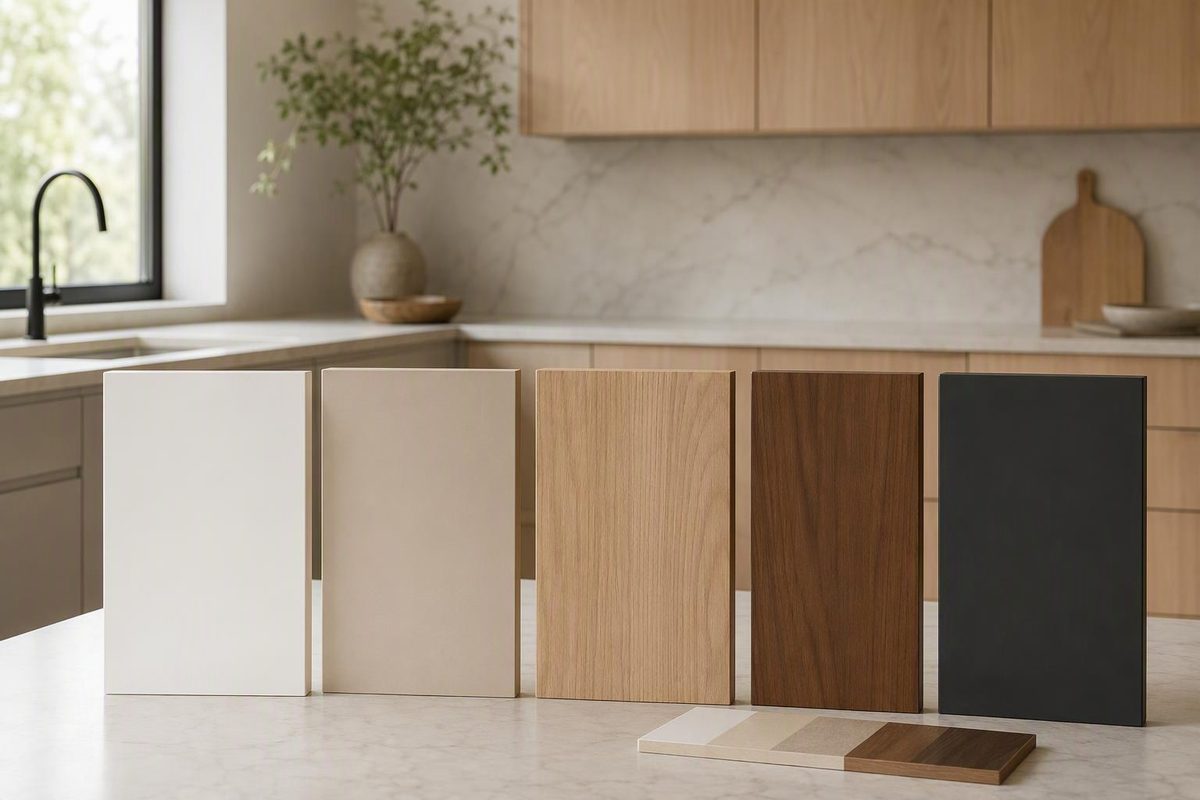
A slab door is a flat, frame-free cabinet door or drawer front. It has no rails and stiles surrounding a recessed or raised center panel. The face may still have a shaped edge or routed finger pull, but it reads as one continuous surface. Conestoga describes slab doors as having simple, flat surfaces with little profile detail to collect dust (Conestoga Wood Specialties).
“Slab” describes the door style, not its material. A slab may be painted MDF, wood veneer over an engineered core, laminate, melamine or solid wood. A finished door can look like one solid board even when its face, core and edges are different materials.
Choose the surface you want; the guide shows which slab construction to examine first.
Match the Surface to the Construction
The result identifies a construction to examine first, not a substitute for the manufacturer’s full specification.
Construction to examine first
Painted MDF
MDF provides a smooth, grain-free face. Scherr’s recommends it for the company’s painted slab doors because of its consistent surface and lower cupping concern than its solid-wood option.
Verify: finished face, back and edges—not merely raw or primed MDF.
Wood Veneer Over an Engineered Core
This construction provides real wood grain without using one wide solid board. The core, face, back and edge treatments can differ by product.
Verify: core, edge banding, grain direction and whether adjacent fronts will be matched.
Laminate or Melamine
These surfaces can provide solid colors, printed wood looks, textures and gloss finishes. The quote should name the surface product and its core.
Verify: edge material, seam appearance, corner quality and color match.
Solid Wood
A solid-wood slab has no floating center panel to accommodate movement. The maker’s size limits and warranty matter.
Verify: maximum sizes, warranty exclusions and the remedy if a door cups or warps.
Sources: Conestoga material definitions; Scherr’s slab-door guidance; WalzCraft Style 60; Decore edge-banded doors. Product construction varies by manufacturer.
Slab, Shaker, and Raised-Panel Doors Are Different
| Door style | What you see | Design effect |
|---|---|---|
| Slab | One frame-free front | Emphasizes color, grain, hardware and cabinet alignment |
| Shaker | Four-piece frame around a flat, recessed center panel | Adds depth and shadow without an ornate profile |
| Raised panel | Frame surrounding a shaped, raised center panel | Adds profile detail and a traditional furniture reference |
Some sellers use “flat-panel” as another name for a slab. Others use it for a framed door with a flat recessed panel. Compare the manufacturer’s drawing or a physical sample instead of relying on that label. For the contrasting construction, see how raised-panel cabinet doors are built.
Slab also does not mean frameless, full overlay or inset. “Slab” describes the face; those other terms describe cabinet construction or how the door sits against the cabinet.
The Flat Face Can Hide Four Different Constructions
The silhouette alone does not tell you how a slab door will look, move or wear. Compare the complete face-core-edge-finish assembly.
Painted MDF Provides a Smooth, Grain-Free Face
Medium-density fiberboard is made by combining wood fibers with resin under heat and pressure. Its smooth, grain-free surface is suited to an even painted finish (Conestoga Wood Specialties). Scherr’s recommends MDF for its own painted slab doors because it provides a consistent surface without the same cupping concern as the company’s solid-wood option (Scherr’s).
Confirm that the quote covers a fully finished door rather than raw or merely primed MDF. On the sample, inspect the coating on the edges and back as well as the face. Pay particular attention to the lower edge near a sink or dishwasher, where damage to the finish could expose the core.
Wood Veneer Needs a Core and Edge Specification
A veneered slab provides real wood grain without making the whole door from one wide piece of lumber. The exact assembly varies. WalzCraft’s Style 60, for example, has an MDF core with wood veneer on both the face and back. Its available edges include exposed MDF, thin veneer banding and thicker solid-wood banding (WalzCraft). “Wood veneer slab” is therefore not a complete specification.
Grain layout also needs to be deliberate. Grain can run vertically or horizontally. If a rendering shows grain flowing across adjacent doors and drawers, require continuous grain matching in writing.
WalzCraft says its matched fronts must be planned from project drawings and cost more than its unmatched option. Without matching, adjacent pieces may come from different sheets and show conspicuous changes in grain or color.
Laminate and Melamine Depend on Their Edges
Laminate and melamine surfaces can provide solid colors, printed wood looks, textures and high-gloss finishes. The names are not interchangeable, so the quote should identify both the surface product and its core.
Many laminate and melamine slab doors use edge banding to cover the core. The band may match or contrast with the face, and its thickness can range from barely noticeable to intentionally prominent (Decore).
Inspect the corners and handle area on a physical sample. A rendering will not reveal the edge seam, color match or corner quality.
Solid Wood Carries a Movement Risk
Solid-wood slabs exist, but “solid” does not automatically mean better. A wide, frame-free wood door has no floating center panel to accommodate wood movement. Scherr’s recommends its veneered construction for wood-look slabs because it reduces the risk of cupping and warping compared with the company’s all-solid-wood option (Scherr’s).
If you prefer solid wood, ask about maximum sizes, warranty exclusions and the maker’s response if a door stops lying flat. Do not assume the most expensive material carries the lowest movement risk.
Flat Faces Simplify Cleaning but Expose Alignment Errors
A flat face has fewer grooves in which dust and cooking residue can collect, so it is generally simpler to wipe than a profiled door. Hardware becomes a larger part of the composition because there are no rails or panels to guide pull placement.
An integrated pull can preserve the uninterrupted appearance, but it changes the edge profile and the way the door feels in use. IKEA’s VOXTORP, for example, is a smooth door with an integrated handle rather than separate hardware (IKEA). Try the actual pull profile if possible; appearance alone does not show whether it will be comfortable for every user.
The simple face also makes installation errors conspicuous. On a long run of slab fronts, inconsistent gaps, doors that sit out of plane and misaligned drawer fronts become part of what you see. Inspect alignment with the doors closed after installation, not only whether each hinge and drawer operates.
If the design uses inset cabinetry, confirm its fitting and clearance requirements separately in what to specify for inset doors.
A Complete Quote Names More Than “Slab”
Do not approve a line that says only “slab doors.” Record:
- Core material and finished thickness
- Face and back materials, including the finish or product name
- Edge construction on all four sides
- Paint color and sheen, or veneer species and cut
- Grain direction and matching for adjacent fronts
- Pull type and location, including any integrated profile
- Overlay or inset condition
- Maximum door sizes and any different construction used for wide or tall fronts
- Finished end-panel material, so exposed cabinet sides coordinate with the doors
- A physical sample showing the face, edge, back and hinge-boring area
A slab door is easy to recognize but not safe to buy by name alone. The quote should define the complete construction, and the final inspection should check how accurately the installed fronts align.