
What Is Sande Plywood—and Is It Suitable for Cabinets?
Sande plywood has a tropical hardwood face. Learn where it fits in kitchen cabinets and which core, finish, thickness and moisture details to check.
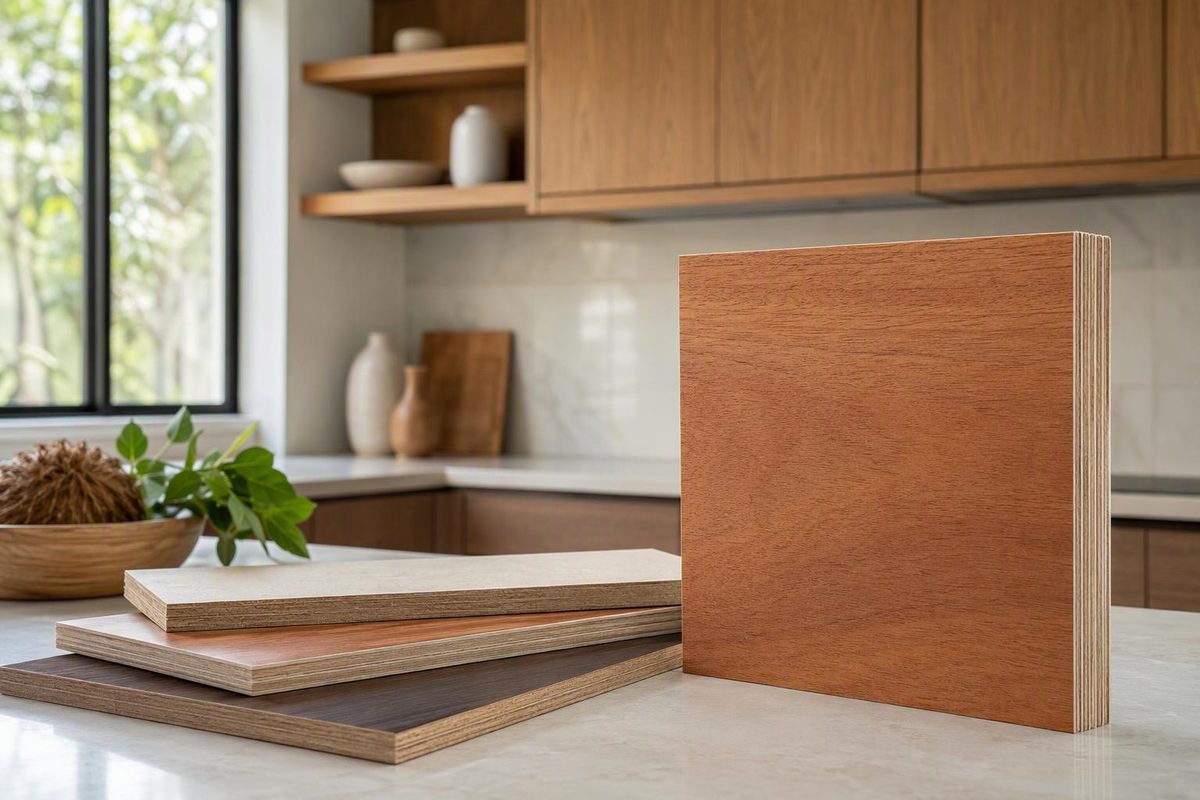
Sande plywood is hardwood plywood with sande wood veneers on its surface. Sande is a tropical hardwood, most commonly Brosimum utile, from Central America and northern South America. Its wood is generally pale yellow to light brown. “Sande” names the wood—not a sanding process—so it is not another term for “sanded plywood.” Species reference: The Wood Database.
For kitchen cabinets, sande plywood is worth considering for indoor cabinet boxes, shelves and panels that will be painted or laminated. But the species name is not a complete construction specification. It does not establish the core quality, actual thickness, adhesive rating or finished appearance.
What is inside the sheet?
Veneer-core plywood consists of thin wood layers glued together, with adjacent layers’ grain directions running across one another. The face supplies the visible wood; the core influences properties such as weight, screw holding and stability. Columbia Forest Products explains this construction.
As of October 2026, Plywood Company lists its 18 mm sande panel as seven-ply, with a veneer core and sande veneer on both the face and back. The supplier identifies it as B/C—B face, C back. That describes this listing, not every sheet sold as sande plywood. Nor does “sande face and back” establish that every inner layer is sande. Confirm the current specification for the panel being supplied. Product specification.
The practical distinction is simple: a smooth face is useful, but it is not proof of a sound core. Ask for the exact panel specification and inspect a cut edge for gaps, overlapping layers or separation.
Where does it fit in a kitchen?
Assuming normal indoor use and an appropriately designed cabinet, these are reasonable places to consider it:
| Cabinet component | What to judge before choosing sande |
|---|---|
| Box sides and partitions | Core construction, thickness, flatness and joint details—not just the face species |
| Shelves | Thickness, unsupported span and intended load; ask the maker whether reinforcement is needed |
| Painted exposed panels | A finished sample showing whether grain or surface texture remains visible |
| Laminated panels | Surface suitability, laminate construction and treatment of exposed edges |
| Clear-finished or stained parts | Whether the actual color and grain suit the kitchen and match adjacent components |
Suppliers describe sande panels as suitable for painting, staining and laminating. Canusa specifically markets its smooth surface for lamination, while Plywood Company lists all three finishing options. Those are intended uses, not guarantees of a particular finish result. Canusa panel details; Plywood Company finishing guidance.
For paint, approve a primed and painted sample rather than assuming “sanded” means ready for a flawless cabinet finish. For stain, approve the exact stain and topcoat on the proposed panel. Sande is real wood with its own appearance; it should not be treated as an automatic visual substitute for birch, maple or oak.
Also specify edge treatment. A face veneer does not cover a cut plywood edge. Decide whether those edges will receive banding, solid-wood edging or an intentionally exposed finish.
Is sande plywood waterproof?
Do not assume water resistance from the word “sande.” Interior and marine-labelled versions are sold separately. Canusa lists Type 2 MR adhesive on its sande page, and Edensaw’s inventory distinguishes B/C interior-grade sande from marine-labelled WBP products. Check the adhesive and exposure specification for the exact panel being supplied rather than applying one rating to every sande product. Canusa specifications; Edensaw product listings.
An adhesive’s moisture resistance does not make the wood decay-resistant: APA distinguishes bond durability from resistance to fungal decay. Sande wood itself is generally reported to have poor natural resistance to decay. The Wood Database.
For a sink cabinet, ask how the maker protects cut edges and plumbing openings, and what the warranty says about leaks. A marine label is not a reason to leave a leak unaddressed. For the broader distinction between bond durability and waterproofing, see our marine-grade plywood guide.
What should the quote say?
Require the panel supplier or product, core type, face/back grade, actual thickness, adhesive rating, finish and edge treatment.
For cabinets sold in the United States, also request TSCA Title VI compliance documentation for regulated composite-wood materials. EPA identifies hardwood plywood among the regulated products. Canusa lists compliance for its sande product, but that does not document another supplier’s panels. EPA requirements; Canusa compliance details.
Watch nominal thickness. As of October 2026, Home Depot’s 18 mm SANDEPLY is sold in the 3/4-inch category but lists an actual thickness of 0.709 inch. That matters when planning grooves, joints and hardware placement. Retail product specification.
If sande is offered as a saving or an upgrade, compare quotes with the same box thickness, finish, edging and hardware. Choose it because the specified panel and finished sample meet the job—not because “hardwood plywood” sounds premium.