
The Moisture-Resistant Panel That Still Needs Protection
Its adhesive bond is intended to tolerate demanding moisture exposure, but the wood veneers still absorb water. That is bond durability, not waterproofing.
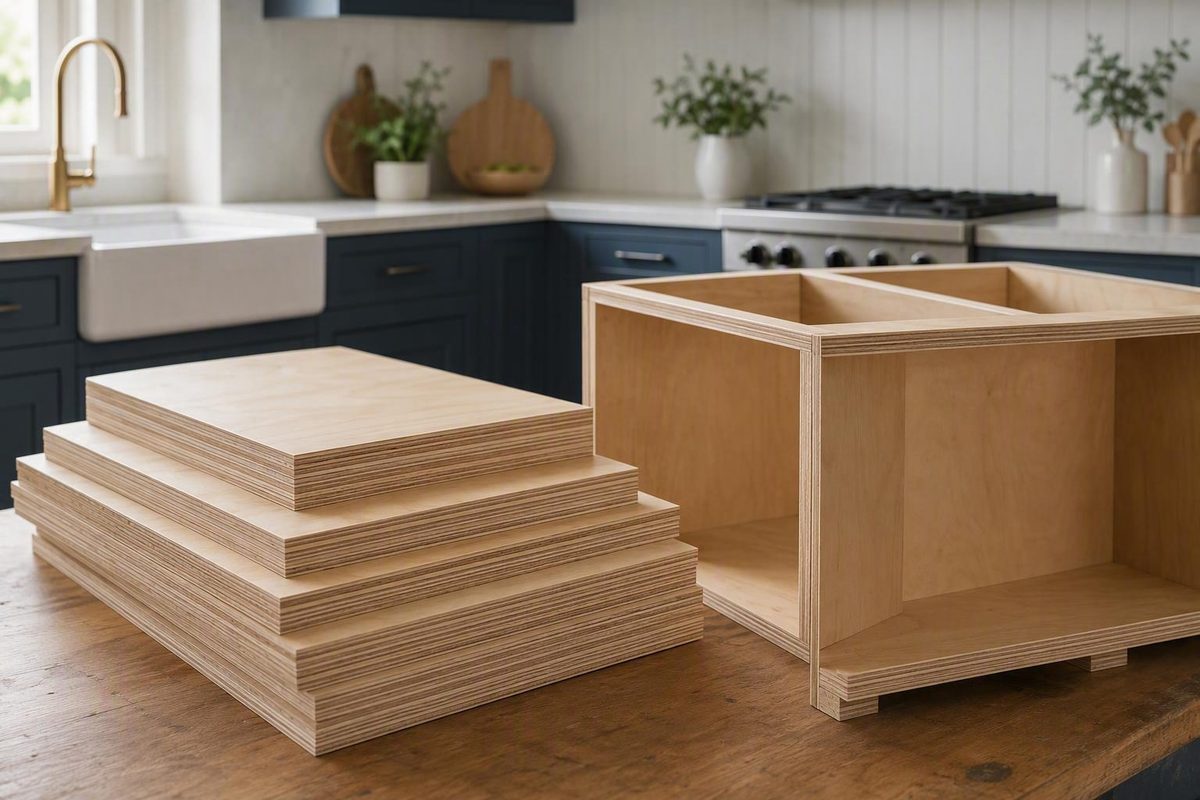
Marine-grade plywood, defined in plain language
Marine-grade plywood is plywood manufactured for demanding conditions in which repeated dampness, splash, or wet-dry cycling is expected. Its main advantages are durable exterior-type glue bonds, better-controlled veneers, and tighter limits on internal gaps than are typical of ordinary construction plywood.
Those qualities do not turn the sheet into a waterproof block of wood. The term describes how the panel is bonded and assembled, not a surface treatment that prevents moisture from entering. Water can still reach the veneers through unfinished faces, cut edges, drilled holes, joints, fastener penetrations, or damaged coatings.
Like other plywood, a marine panel consists of thin wood veneers bonded in layers. Adjacent veneers commonly have their grain running in alternating directions. This cross-laminated construction distributes strength in both panel directions, discourages splitting, and limits some of the dimensional movement associated with solid boards.
The practical advantage is consistency. Reliable glue lines, sound veneers, and a closely fitted core reduce the likelihood of hidden weak areas or bond failure during repeated moisture exposure. The WoodenBoat School’s marine-plywood guide recommends evaluating glue, veneers, core construction, species, stiffness, weight, manufacturer, and supplier rather than relying on the word “marine” alone.
Exact requirements differ among grades, specifications, countries, manufacturers, species, and intended uses. One product may be designed for structural boat components, while another is sold for wet architectural work. A sheet identified only as “marine plywood,” with no named grade or supporting documentation, is therefore incompletely specified.
The label alone does not establish that:
- The panel is made entirely from tropical hardwood.
- Both faces are suitable for clear decorative finishing.
- The sheet has no permitted patches, repairs, knots, or restricted gaps.
- Preservative treatment has been applied.
- The wood cannot absorb water, swell, check, decay, or suffer insect damage.
- The panel is suitable for every boat, dock, cabinet, or exterior structure.
- A particular thickness is adequate for a particular load or span.
In short, marine-grade plywood is a comparatively consistent exterior-type panel built to retain its integrity under demanding moisture exposure. It still has to be matched to the project, protected against water entry, installed correctly, and maintained.
What is inside a marine plywood panel
Three features account for most of the performance associated with marine plywood: durable adhesive bonds, sound veneers, and a core with tightly controlled gaps.
Durable adhesive between the veneers
Marine panels use an exterior-durability adhesive intended to resist separation under severe moisture testing. Depending on the product and specification, documentation may identify phenolic, melamine-based, or another qualifying adhesive system.
The adhesive protects the bond between veneers; it does not waterproof the veneers themselves. A sheet can remain laminated while absorbing moisture, gaining weight, changing dimension, developing surface checks, or beginning to decay. Bond durability and wood durability are separate properties.
Good glue also cannot correct poor core construction. If veneers are split, irregular, loosely fitted, or damaged, even a durable adhesive will not make the resulting panel uniformly dependable.
Better-controlled veneers and core gaps
The inner layers matter at least as much as the visible faces. Splits, overlapping veneers, loose knots, or substantial gaps can create localized weaknesses. They may also make fastening less predictable because a screw passing through sound layers has better support than one that intersects a hidden cavity.
Internal gaps can also hold or channel moisture after water breaches the finish. Damage in those areas may remain concealed, and enclosed spaces can dry slowly. Marine grades are therefore associated with stricter core controls than general construction panels.
“Minimal or tightly restricted gaps” is more defensible than describing every marine sheet as completely void-free. Requirements vary, and recognized grades may permit limited repairs, joints, sound knots, plugs, or narrowly controlled gaps. Compliance with a specification does not necessarily produce furniture-perfect veneers.
Balanced construction and ply count
Many plywood lay-ups are arranged to balance veneers around the center of the panel. A balanced lay-up can help distribute stresses and improve flatness or dimensional stability. Using more, thinner veneers may also support smoother bending and reduce the influence of a defect in any one layer.
Ply count is not a stand-alone measure of quality. A panel with many inconsistent or poorly bonded layers is not automatically better than one with fewer sound veneers. Species, veneer thickness, adhesive, core fit, lay-up, and manufacturing control all affect performance.
When comparing panels, consider whether each sheet lies reasonably flat, whether the layers look consistent along the factory edges, and whether the documented construction suits the intended bending or structural requirements.
Face grades are only one part of the specification
In North American product descriptions, labels such as A-A, A-B, and B-B commonly indicate the grades assigned to the two faces. An A-A panel has the same higher face grade on both sides; A-B combines different face grades; B-B assigns the lower of those two grades to both faces. The exact defects and repairs permitted within each grade depend on the applicable specification.
Face grades influence appearance, finishing, and the amount of visible repair allowed. They do not, by themselves, establish adhesive durability, core quality, species, preservative treatment, strength, or conformity with a marine specification.
That distinction matters when buying material for visible work. A clear-finished boat interior, painted cabinet end, and concealed structural component may need similar bond durability but very different face quality.
Water-resistant does not mean waterproof or rot-proof
Marine plywood can become wet, and its durable glue lines can help it remain laminated when ordinary interior plywood might separate. The wood itself can still absorb moisture, swell, check, stain, soften, or decay.
The Epoxyworks overview of marine-grade plywood makes this distinction and emphasizes protecting exposed surfaces, particularly absorbent end grain. Its standards references are historical, so current product and project requirements should be verified independently.
Four different forms of protection are commonly confused:
- Glue-bond durability: The adhesive’s ability to keep adjacent veneers bonded during moisture exposure.
- Natural decay resistance: The inherent resistance of the wood species to fungi under decay-supporting conditions.
- Preservative treatment: Chemical treatment intended to improve resistance to decay organisms or insects.
- Applied water protection: Paint, sealant, epoxy, fiberglass, membrane, or another system intended to reduce water entry.
A panel may perform well in one category and poorly in another. It can have a highly durable glue bond but contain wood with limited natural decay resistance. It may be preservative-treated yet have faces or a core poorly suited to smooth bending. It may also be carefully coated but installed in a joint that traps water.
Marine plywood is not pressure-treated by default. Where fungi, termites, or borers are significant risks, verify whether treatment is included and whether the treated panel is compatible with the required fasteners, adhesives, finishes, and service environment.
What WBP actually means
WBP is commonly expanded as weather and boil proof. It is used to describe glue-bond performance under severe moisture or boiling-water testing. It does not mean the completed plywood sheet is impervious to water.
A WBP-bonded panel may remain laminated while its wood veneers absorb moisture. The sheet can still become heavier, change dimension, check, or decay if it remains wet. WBP is therefore information about the bond, not a complete statement of face grade, species, core construction, treatment, strength, or finished water protection.
Species still matters
Wood species differ in density, stiffness, weight, bendability, appearance, and natural decay resistance. Okoume, for example, is valued for its low weight and ability to form smooth curves, but it has limited natural durability. In demanding wet service, it consequently depends heavily on continuous protection and prompt repair of coating damage.
A species with better natural decay resistance is not a substitute for drainage or sound detailing. Natural durability varies within a species, and it does not prevent moisture movement, surface checking, coating failure, or damage at exposed edges.
The practical approach is to expect that a finish may eventually be scratched, drilled, or breached. Protect the most likely entry routes, give water a path to drain, allow the assembly to dry, and choose a panel with enough construction quality and species suitability to tolerate temporary exposure.
Marine vs. exterior, ACX, CDX, treated, and cabinet-grade plywood
Marine plywood belongs to the wider family of exterior-bonded panels, but exterior bonding alone does not establish marine quality. Marine and ordinary exterior products may both use moisture-resistant structural adhesive. The usual distinction is that marine grades place tighter controls on veneers, repairs, internal gaps, and overall core consistency.
The following table describes common market conventions rather than universal rules. Product ratings and specifications should always be checked.
| Plywood type | Typical adhesive | Veneer and core quality | Preservative treatment | Suitable exposure | Finish quality | Common use |
|---|---|---|---|---|---|---|
| Marine grade | Durable exterior-type bond meeting the claimed specification | Sounder veneers and closely controlled core gaps; permitted repairs vary | Not included by default | Repeated wet-dry cycling, splash, demanding fabrication, or high-consequence moisture exposure when properly protected | Commonly sanded; face appearance depends on grade | Boat components, docks, marina work, wet utility panels, curved parts |
| General exterior plywood | Exterior-rated structural adhesive | Wide range of faces, repairs, knots, and core quality | Usually untreated unless labeled otherwise | Weather-exposed or intermittently damp work where the panel rating and assembly permit | From rough sheathing to sanded panels | Sheathing, covered exterior work, signs, furniture, general construction |
| ACX | Exterior-rated adhesive | A-grade face and C-grade reverse under common North American conventions; core controls vary | Usually untreated | Protected exterior or intermittently damp applications with suitable finishing | One comparatively smooth visible face | Painted outdoor furniture, soffits, signs, utility enclosures |
| CDX | Exterior-type bond appropriate to the panel’s designated construction exposure | Construction-oriented faces; more knots, patches, splits, and possible internal gaps | Usually untreated | Concealed construction where the product rating and assembly allow it | Rough and generally unsuitable for fine visible work | Roof, wall, and floor sheathing |
| Pressure-treated plywood | Depends on the base panel selected for treatment | Depends on the original panel grade | Yes | Locations where decay or insect exposure is a central concern, subject to the treatment rating | May be rough, discolored, or difficult to finish finely | Exterior and decay-prone construction |
| Cabinet-grade or prefinished plywood | Bond class varies; many products are intended primarily for interiors | Selected for appearance, machining, joinery, or factory finish | Normally no | Dry interiors and ordinary household humidity unless specifically rated otherwise | Often best suited to visible cabinetry | Cabinets, closets, shelves, built-ins, furniture |
Marine plywood versus ACX
ACX can be a practical choice when one smooth face matters and moisture exposure is moderate. In a sheltered outdoor assembly that drains and dries readily, a suitable ACX panel may provide the needed appearance and durability without the cost of marine core controls.
Marine plywood becomes more attractive when repeated wetting, tight bending, critical fastener placement, or difficult replacement makes hidden core defects more consequential. Even then, the decision should be based on documented product properties rather than the label alone.
Marine plywood versus CDX
CDX is generally intended for construction in which the panel will be covered. Its rougher faces and greater allowance for visible defects make it a poor fit for clear finishing or precise fabrication, but those characteristics do not make it defective for its intended role.
Using marine plywood as ordinary covered sheathing may be unnecessary. Conversely, selecting construction sheathing for a tightly curved or repeatedly wet component can introduce avoidable variation. A supplier comparison of CDX, ACX, and marine plywood presents ACX as a common option for visible outdoor projects and CDX as construction-oriented material; because product categories vary, the actual panel rating remains more important than the general label.
Marine plywood versus pressure-treated plywood
Pressure treatment and marine construction address different risks. Marine specifications focus primarily on bond durability and panel construction. Preservative treatment is intended to improve resistance to biological attack.
A treated exterior panel may be the better choice where decay or insect exposure controls the decision. An untreated marine panel may be more suitable where smooth bending, face quality, low-gap construction, or precise machining matters most. Some projects may require both a particular panel construction and an approved treatment.
Treatment can affect the condition in which a panel is supplied and may influence drying, finishing, gluing, and fastener selection. Follow the treatment provider’s technical information and the project specification instead of assuming that treated and untreated panels are interchangeable.
Marine plywood versus cabinet-grade plywood
Cabinet-grade plywood is generally selected for visible veneers, machining, joinery, color, surface finish, or factory-applied coatings. Those properties usually matter more in an ordinary kitchen than resistance to repeated severe wetting.
“Cabinet grade” is not one universal technical standard, so individual products still require evaluation. In a dry interior, however, a good cabinet panel usually directs the budget toward the qualities occupants see and use. Marine plywood may cost more without improving decorative appearance, factory finish, or cabinet joinery.
Where marine plywood makes sense—and where it usually does not
Marine plywood justifies its premium when greater panel consistency reduces a meaningful risk. Common applications include boat components, docks, marina structures, wet utility panels, curved exterior work, and assemblies exposed to repeated wet-dry cycles. It is also worth considering when failure would be difficult to detect, expensive to repair, or structurally important.
Do not decide solely on whether the project is indoors or outdoors. Evaluate:
- Severity of wetting: Humidity is different from direct splash or standing water.
- Frequency: An occasional spill presents less risk than routine exposure.
- Drainage: Water should have a path away from the panel.
- Drying potential: Ventilation and access to air can be as important as the panel grade.
- Structural demand: Important loads and critical fastener locations increase the value of consistent core construction.
- Fabrication: Curves, scarf joints, precise machining, and clear finishes impose different requirements.
- Repair access: An inaccessible panel may warrant a larger material margin.
- Consequences of failure: Cosmetic staining and structural damage are not equivalent risks.
- Protective system: Faces, edges, holes, and joints must be capable of receiving and retaining the required finish.
A sheltered panel beneath a ventilated roof has a different exposure from a dock component subjected to repeated splash. Likewise, a removable screen does not require the same margin as a panel buried beneath expensive equipment.
Boats, docks, and marina work
These are the applications most closely associated with marine plywood, but the label is not a complete boatbuilding or structural specification. Boat components may have particular requirements for weight, stiffness, species, bend radius, joints, coatings, and fasteners. Waterfront structures add abrasion, ultraviolet exposure, structural loads, persistent wetting, and possible biological hazards.
Use the grade, species, lay-up, and thickness required by the designer. Material suitable for a sheltered locker may not be suitable for a hull component, and a panel used as decorative waterfront cladding may not meet the requirements for a loaded walkway.
Kitchens and bathrooms
A kitchen or bathroom does not automatically require marine plywood. Properly installed cabinets should normally remain dry despite nearby plumbing and fluctuating humidity. Reliable plumbing, ventilation, durable finishes, protected penetrations, and prompt leak repair usually contribute more than upgrading every cabinet box.
Marine plywood may merit consideration for a vanity exposed to persistent splash, a wet utility area, or a cabinet whose replacement would require extensive demolition. Before paying for the upgrade, compare it with better detailing: raising panels above wet floors, protecting sink-base cutouts, using removable liners, improving ventilation, and keeping plumbing accessible.
Marine plywood cannot neutralize an active leak. If a failed connection keeps a cabinet wet, the panel remains vulnerable regardless of its grade.
Ordinary cabinets, closets, and furniture
Dry cabinets, shelves, closets, and furniture generally gain little from marine-grade bonding. Cabinet-grade or prefinished plywood is more likely to provide the desired face, color, machining behavior, and finished interior.
When a cabinet is advertised as “marine plywood,” ask what specification the panel meets and what practical exposure the upgrade addresses. Cabinet quality also depends on joinery, shelf spans, back construction, hardware attachment, edge treatment, finish, and installation. One material label cannot describe the whole cabinet.
Covered outdoor and intermittently damp work
A suitable exterior panel may be more economical where wetting is occasional, drainage is dependable, ventilation is available, and repairs are straightforward. Where fungi or insects are the primary concern, a properly rated preservative-treated panel may be more relevant than an untreated marine product.
The decision is best framed as risk control. Marine plywood is worthwhile when its tighter construction addresses a credible failure mode. It is unnecessary when the environment is dry and those additional controls do not improve the completed assembly.
Grades, standards, and species without the label confusion
Buyers may encounter APA marine designations, BS 1088, WBP descriptions, bond classifications, mill documents, or third-party approvals. These terms address different subjects and should not be treated as interchangeable.
Because the available specifications and editions can change, the safest general statement is that a named marine standard may address some combination of bonding, veneer quality, core construction, permitted repairs, and dimensional requirements. Verify the current edition, regional applicability, and project-specific requirements through the standards body, designer, manufacturer, or authority responsible for the work.
APA marine and BS 1088
APA marine designations are commonly encountered in North American purchasing, while BS 1088 is often associated with marine plywood made from tropical hardwoods. Neither name should be assumed to be a universal legal requirement for every boat, cabinet, dock, or wet-area project.
When a seller claims compliance, ask:
- What specification and edition are being claimed?
- Is the product certified, or merely described as comparable?
- Which face and back grades apply?
- Which species are used in the faces and core?
- What repairs, joints, and gaps are permitted?
- What bond classification or test requirement is covered?
- Does the paperwork identify the delivered product?
A standard may permit controlled repairs or defects, and a compliant sheet can still suffer shipping or storage damage. The McIlvain discussion of marine and exterior plywood also warns that “marine grade” is used inconsistently and recommends evaluating exposure, veneers, core, glue, species, preservatives, weight, and intended use.
WBP is not a complete grade
A WBP description concerns the durability of the adhesive bond under severe moisture testing. On its own, it does not define species, face quality, core-gap limits, ply count, strength, treatment, or finished-panel waterproofing.
Treat it as one item in the product description. Buyers still need to know what materials the adhesive is joining and how the panel was constructed.
Documentation and third-party approval
Conformity reports, test results, chain-of-custody records, and quality-management certificates cover different matters. A chain-of-custody certificate does not establish marine bond performance, and a general quality-management certificate does not necessarily describe the core-gap allowance of a particular panel.
Traceability and third-party review can increase confidence, but paperwork is most useful when it matches the exact:
- Manufacturer and mill
- Product and grade
- Species
- Thickness
- Veneer lay-up
- Bond classification
- Production lot, where applicable
A report covering another species, thickness, or nominally similar panel should not be assumed to apply to the material delivered.
Common species and their trade-offs
Douglas fir is relatively strong and offers useful natural decay resistance, but it is comparatively heavy and can develop surface checking. That combination may suit structural work while requiring additional preparation where a smooth decorative finish is expected.
Okoume is light, readily machined, and well suited to curved work. Its limited natural decay resistance makes continuous protection especially important in demanding moisture exposure.
Meranti is generally denser and stiffer than okoume. The additional stiffness or strength may be useful, although its greater weight can be a disadvantage in lightweight boats or movable assemblies.
Sapele is also heavier and stronger than okoume and is valued for its decorative grain. It may suit visible joinery as well as structural work when the actual panel grade and lay-up meet the project requirements.
These are broad species tendencies, not guarantees for every sheet. The WoodenBoat School guide discusses these trade-offs in a boatbuilding context and advises matching species, weight, stiffness, bending behavior, finish, and durability to the design.
A practical marine plywood buying checklist
Begin with the expected exposure. Distinguish ordinary indoor humidity from occasional wetting, repeated wet-dry cycling, direct splash, persistent dampness, or a specialized marine environment. Then consider the cost and consequences of failure.
1. Ask for the named specification
Do not accept “marine” as the entire product description. Request the grade, claimed standard, bond classification, and current product data. If the seller cannot explain the designation, compare the panel with a better-documented alternative.
2. Confirm the species and face grade
Identify the face and core species rather than relying on the decorative face name. Confirm the grades assigned to both faces and ask what repairs are permitted. Select appearance according to whether the sheet will be painted, clear-finished, overlaid, fiberglassed, or concealed.
3. Examine the core construction
Inspect all accessible factory edges for conspicuous gaps, overlapping veneers, inconsistent layer thickness, or poorly bonded areas. An edge inspection cannot reveal every internal condition, but it can expose obvious manufacturing problems.
Look at all four edges when practical. Damage or poor construction may be localized, and one clean display edge does not represent the entire sheet.
4. Verify ply count and thickness
Count visible layers and compare them with the product description. Measure actual thickness where the panel must fit grooves, hardware, joinery, or an existing assembly.
Do not select thickness from a generic rule for boats, cabinets, decks, or floors. Loads, spans, support spacing, fastening, impact, bending radius, and the project design should determine the requirement.
5. Inspect the faces and flatness
Look for checks, bubbles, open splits, dents, crushed corners, staining, excessive repairs, and shipping damage. Sight along the sheet or place it on suitable support to evaluate bow and twist.
Some distortion can result from storage conditions, but severely warped material complicates accurate cutting, bending, and assembly.
6. Consider weight, stiffness, and bending
Compare sample panels where possible. A denser species may provide useful stiffness while increasing handling difficulty and finished weight. A lighter panel may form curves more readily but need different support or surface protection.
For a curved or structural component, obtain the designer’s requirements for grain orientation, bend radius, lay-up, and thickness. A thin marine sheet is not automatically suitable for every curve.
7. Confirm preservative treatment separately
Determine whether the plywood is untreated or preservative-treated. Where treatment is required, obtain the treatment type, intended-use rating, and compatibility information for adhesives, finishes, fasteners, and indoor occupancy.
8. Request matching documentation
For expensive or difficult-to-repair work, request current documents identifying the actual mill, species, grade, thickness, and lay-up. Supplier reputation and mill traceability add confidence, but neither replaces a clear specification.
A marine-plywood selection guide similarly recommends matching reports to the exact product and treating visual or shop checks as screening methods rather than formal proof.
9. Understand the limits of informal testing
A freshly cut edge, cold-water soak, or informal boil screening may reveal gross gaps, excessive swelling, or obvious bond failure. It cannot prove compliance with a formal standard.
Formal conformity depends on specified sampling, conditioning, test procedures, acceptance criteria, and documentation. A home test can help reject poor material, but it cannot certify it.
10. Price the complete assembly
Include finishes, edge treatment, compatible fasteners, labor, waste, maintenance, and replacement access when comparing costs. A lower-priced panel may become expensive if it creates fabrication problems, while a marine panel installed in a dry closet may deliver no practical benefit.
Pay the premium when repeated moisture exposure, exacting fabrication, hidden-core consistency, or costly failure makes tighter manufacturing control valuable. Otherwise, an appropriate exterior, treated, cabinet-grade, or prefinished panel may be the better purchase.
Protection, installation, and maintenance still determine service life
Marine plywood generally requires protection suited to its exposure. Vulnerable locations include faces, factory and cut edges, exposed end grain, drilled holes, notches, joints, hardware recesses, and fastener penetrations.
Edges deserve particular attention because they expose the end grain of multiple veneers. Those pathways can absorb moisture readily, and every new cut removes any protection previously present at the sheet surface.
Choose a coating as a system
Paint, sealant, epoxy, fiberglass, and membranes can all be suitable in particular assemblies. No one system is compatible with every species, adhesive, preservative treatment, primer, fastener, or service condition.
Selection should account for:
- Expected humidity, splash, or immersion conditions
- Wood species and moisture condition
- Surface preparation
- Existing treatment or finish
- Adhesive and sealant compatibility
- Movement at joints
- Ultraviolet exposure
- Abrasion and impact
- Required appearance
- Access for inspection and recoating
Follow current instructions from the plywood and coating manufacturers. For boats or engineered structures, use the specified system rather than substituting a general-purpose finish.
Keep protection continuous
Treat penetrations and machined details as part of the exposed surface. Plumbing cutouts, access openings, scarf joints, holes, recesses, and new edges can become moisture-entry routes if the finish stops at their perimeter.
Protect new cuts promptly with a material compatible with the complete coating system. At joints and hardware, direct water away from the plywood rather than creating ledges or cavities that hold it. Technical guidance for marine plywood consistently emphasizes protecting exposed surfaces and end grain rather than relying on the adhesive bond alone.
Design for drainage and drying
A coating cannot compensate indefinitely for trapped water, chronic condensation, or an unrepaired plumbing leak. Where the design permits, provide slopes, drainage paths, ventilation, and separation from persistently wet surfaces.
Consider how an enclosed panel will dry after a leak and how it can be inspected. Better plywood increases tolerance for certain moisture events, but it does not remove the need to manage water around the assembly.
Inspect and repair
Inspection frequency depends on exposure, coating type, ultraviolet light, abrasion, movement, and accessibility. Look for:
- Cracked, lifting, or worn coatings
- Surface checking
- Dark staining around fasteners or edges
- Swollen edges
- Soft areas
- Loose fasteners
- Open joints
- Raised or blistered face veneers
- Visible delamination
Correct the moisture source before treating cosmetic symptoms. Allow the assembly to dry as the repair system requires, replace material that has lost necessary integrity, and restore protection at every opened edge, hole, or joint.
For boats, loaded platforms, structural panels, or regulated building work, consult the designer, naval architect, engineer, manufacturer, applicable standard, and local authority as appropriate. General material guidance cannot establish a safe grade, thickness, fastening schedule, treatment, or coating system for a critical component.
Frequently asked questions
Is marine-grade plywood completely waterproof?
No. Its adhesive bond is intended to tolerate demanding moisture exposure, but the wood veneers still absorb water. Moisture entering through unfinished faces, edges, penetrations, joints, or coating damage can cause swelling, checking, staining, decay, or eventual panel failure.
Marine grade improves construction consistency and resistance to delamination. It does not eliminate the need for finishing, drainage, ventilation, inspection, and maintenance.
Does marine plywood need to be sealed on every cut edge?
For exposed or moisture-prone service, every cut edge should generally receive protection compatible with the complete finish system. Cutting reveals absorbent end grain across multiple veneers and removes any existing surface protection.
Drilled holes, notches, fastener penetrations, and machined joints also need attention. Fully enclosed components in reliably dry interiors may have different finishing requirements, but the marine designation is not a reason to leave moisture-prone cuts bare.
Is marine plywood worth using for kitchen or bathroom cabinets?
Usually not for ordinary cabinets that remain dry. Cabinet-grade or prefinished plywood generally offers properties more directly relevant to cabinetry, including decorative faces, predictable machining, factory finishes, and joinery performance.
Marine plywood may be reasonable where persistent wetting is expected or replacement would be unusually difficult. It still cannot compensate for leaking plumbing, unmanaged condensation, poor ventilation, exposed penetrations, or panels sitting in trapped water.
Before upgrading every cabinet box, compare the cost with accessible plumbing, protected sink-base cutouts, removable liners, raised components, leak detection, and better ventilation.
What is the difference between marine-grade and pressure-treated plywood?
Marine grade primarily concerns adhesive durability and controlled veneer and core construction. Pressure-treated plywood has received preservative treatment intended to improve resistance to biological threats such as fungi or insects.
One designation does not automatically include the other. Untreated marine plywood can decay when it remains wet, while a treated exterior panel may not provide the face quality, low-gap core, bending behavior, or machining consistency required for specialized marine fabrication.
Choose according to the controlling risk, then verify panel grade, treatment rating, fastener compatibility, coating compatibility, and project requirements separately.
Does a BS 1088 or marine-grade stamp guarantee a perfect sheet?
No. A recognized designation or credible conformity mark is useful evidence, but it is not a promise of cosmetic perfection or freedom from handling damage. A specification may permit controlled repairs, joints, knots, dimensional variation, or tightly restricted gaps.
Confirm that the documentation matches the manufacturer, mill, species, thickness, lay-up, and product being purchased. Inspect delivered sheets for flatness, edge consistency, face defects, moisture damage, and shipping damage even when they carry a stamp.
The bottom line
Marine-grade plywood is best understood as a more tightly controlled panel for demanding moisture exposure—not as inherently waterproof or maintenance-free wood. Its value depends on wetting frequency, drainage, ventilation, structural consequences, fabrication demands, finish requirements, and repair access.
For ordinary dry cabinetry, cabinet-grade or prefinished plywood is usually the more relevant choice. For repeatedly wet, curved, structural, or difficult-to-repair work, a verified marine panel may justify its price.
Whatever the application, confirm the actual specification, select thickness from the project design, and protect every likely route of moisture entry.