
ACX Plywood Can Build Cabinets, but the Back Face May Decide
ACX plywood has one smooth face and a lower-grade back. Learn what the grade means and what to inspect before using it for cabinet boxes.
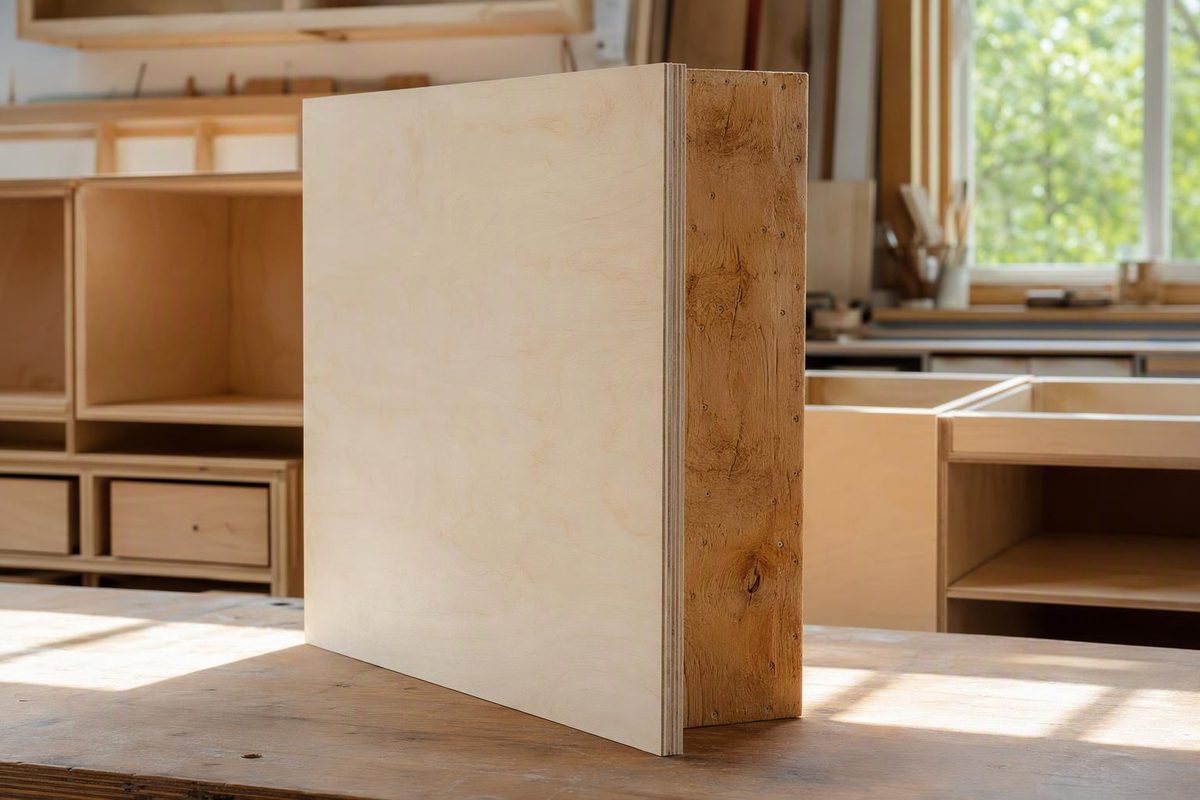
ACX plywood can be a practical material for painted built-ins, utility cabinets and some kitchen-cabinet parts. It is not automatically “cabinet-grade” plywood. The designation primarily tells you about the face and back veneers; the panel stamp identifies its bond classification and other attributes. It does not, by itself, promise a particular face species, ply count, void-free core or furniture-quality finish on both sides.
For a kitchen, the deciding question is usually simple: which faces and edges will remain visible?
What ACX plywood means
In the common ACX shorthand:
- A identifies the better face. It should be smooth and suitable for painting, although its grain and permitted repairs may still matter under a clear finish or stain.
- C identifies the lower-grade back, where more defects and repairs are permitted.
- X should not be treated as a complete exposure specification. Read the panel stamp for the actual bond classification: Exterior or Exposure 1.
APA explains that plywood panel grades commonly state the veneer grades on the face and back, such as A-B or B-C. Its veneer scale runs from A, described as smooth and paintable, to utility-grade D. APA separately defines Exterior panels as suitable for long-term weather exposure and Exposure 1 panels as resistant to temporary construction moisture, not permanent outdoor exposure (APA plywood guide).
That separation is important. Face grade and moisture-resistant glue lines describe different properties. Neither makes the wood waterproof: veneers and exposed edges can still absorb water. The same principle applies to marine-grade plywood, where bond durability should not be confused with waterproof material.
When ACX works for a cabinet box
ACX is most defensible when only its A face must look finished. Examples include a cabinet side with its good face toward the interior and its C face hidden against a wall, or a box that will receive a separate decorative end panel.
The trade-off becomes obvious when both sides matter. On a frameless end cabinet, the box interior and the outside end may both be visible. One A face and one C back will not provide two equivalent finishing surfaces. An applied end panel can solve that problem, but its material, finishing and installation belong in any quote comparison.
ACX also differs from decorative hardwood plywood in ways the letters do not settle:
- Its visible veneer may be a softwood with prominent grain rather than maple, birch, cherry or another cabinet species.
- Repairs acceptable in an A-grade structural panel may remain noticeable under stain or a clear finish.
- The A-C designation does not promise a void-free core or an edge attractive enough to expose.
- Actual thickness and thickness consistency can affect dados, grooves and inset backs.
These are not arguments against veneer-core plywood. They are reasons to specify the panel rather than buying by the word “plywood.” Columbia Forest Products describes veneer core as relatively light, strong and good at spanning, but also notes that it has wider thickness variation than particleboard or MDF cores and can telegraph through thin decorative veneers. Its guide describes particleboard and MDF cores as smoother, void-free and more uniform in thickness, with different weight, moisture and structural trade-offs (Columbia Forest Products core guide).
A decorative hardwood face supplies the appearance, while the core determines much of the panel’s machining and fastening behavior. Our guide to white oak veneer plywood explains that distinction in more detail.
Where ACX makes sense—and where it does not
ACX can make sense for:
- painted garage, workshop and laundry-room cabinets;
- concealed cabinet tops, stretchers and structural parts;
- built-ins with the C face against a wall;
- cabinet boxes receiving separate finished end panels;
- shelves where appearance requirements and supported span have been checked.
It is less convincing for clear-finished kitchen interiors, matched wood-grain cabinetry, exposed plywood edges or any component where both faces are visible. For those applications, specify a two-sided decorative hardwood panel, a prefinished cabinet-liner panel or another product with suitable faces on both sides.
Paint does not erase every material difference. Softwood grain and veneer repairs can remain visible through a smooth coating unless the surface is prepared appropriately. MDF generally provides a more uniform paint surface, although it is heavier and its edges need additional preparation. The better choice depends on the component: veneer-core plywood may suit a long shelf or box side, while MDF may suit a paint-grade flat panel.
How to inspect a sheet or cabinet quote
“ACX plywood box” is not a complete cabinet specification. Check the following before approving it:
- Read the stamp. Confirm the panel grade, product standard, declared thickness, manufacturer or mill identification, and Exterior or Exposure 1 bond classification. APA treats these as separate parts of its trademark, rather than properties implied by one grade name (APA stamp guide).
- Check both faces. Decide exactly where the C back will land after assembly. Inspect for repairs, open defects and surface roughness.
- Inspect several cut edges. Look at ply construction, gaps and overlaps. Do not infer a void-free core from the A face.
- Measure actual thickness. Cabinet joints and grooves should be sized to the material being used, not just its nominal label.
- Sight along the sheet. Reject badly bowed or twisted stock before parts are cut.
- Test the proposed finish. Apply the actual primer, paint or stain to an offcut, including an area with a veneer repair. For visible grain, approve a finished sample rather than relying on the letter A.
- Plan around leaks. Protect exposed edges near sinks and dishwashers, keep cabinet panels out of standing water and address plumbing leaks promptly. Exterior-rated glue is not a substitute for water management.
The practical verdict is narrow: ACX can be an economical cabinet material when its good face is the only face that matters and the actual panel meets the construction requirements. If a seller charges a premium for “plywood cabinets,” ask the quote to identify the face species, grades on both sides, core construction, thickness and finish. ACX alone does not answer those questions.