
Birch vs maple plywood: compare the core before paying for the face
Compare birch and maple plywood for cabinet boxes, visible panels, paint and stain. Learn which construction details justify an upgrade.
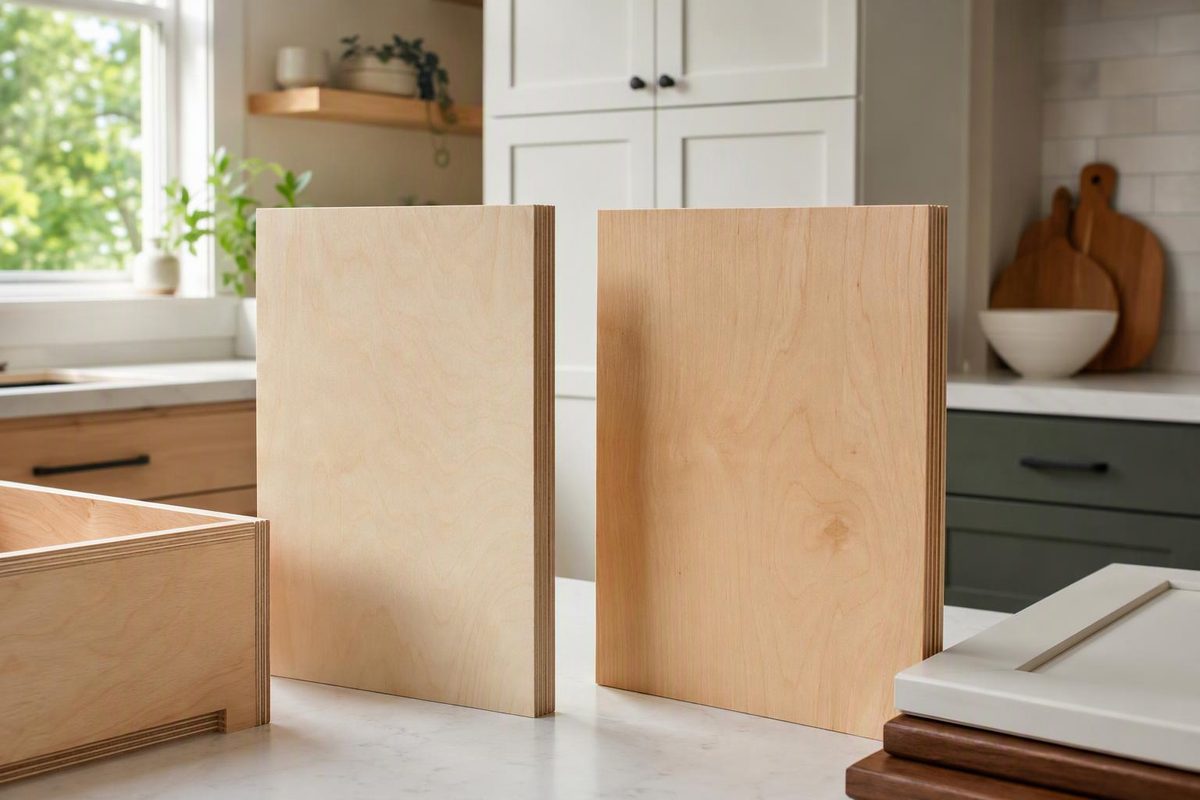
For cabinet boxes, don’t pay extra for maple plywood solely because you expect a stronger cabinet. First compare the core, thickness and cabinet construction. For visible end panels or wood-finished interiors, choose the face that delivers the appearance you want—and approve it with the actual finish applied.
That distinction matters because “birch plywood” and “maple plywood” describe a hardwood face species, not necessarily the wood throughout the panel. The core influences weight, screw-holding ability, stability and other performance properties. Columbia Forest Products explains this face-versus-core distinction.
Which should you choose?
| Cabinet application | Purchasing judgment |
|---|---|
| Concealed box sides and backs | Prefer the better-specified panel and cabinet construction, not the more prestigious face name. |
| Clear-finished interiors | Either can work. Compare color consistency, surface quality and the finished sample. |
| Exposed ends beside maple doors | Start with maple-faced panels, then verify the color and grain match rather than assuming the species name guarantees it. |
| Painted panels | Prioritize a smooth substrate and a proven paint system; a decorative maple face is not automatically a worthwhile upgrade. |
| Intentionally exposed plywood edges | Compare a specified multi-ply, all-birch panel separately from ordinary birch-faced plywood. |
The core matters more for box performance
Two panels can carry different face names while using comparable cores. Conversely, two products both labeled “birch plywood” can have substantially different construction.
Columbia’s hardwood plywood core guide describes North American veneer cores made with regional woods such as fir, pine, poplar or aspen. It also lists MDF, particleboard and combination cores. In that guide, veneer core offers better spanning properties than MDF or particleboard, while combination cores use MDF or HDF crossbands beneath the faces to provide a smoother surface and more consistent tolerances.
For a shelf carrying dishes, that means panel construction and shelf span are more useful questions than birch versus maple. Ask for the shelf thickness, unsupported width and any reinforcement. For hardware attachments, ask what the screws fasten into—not just what veneer you see inside the cabinet.
Ordinary birch is not automatically Baltic birch
Do not treat a birch face as proof of an all-birch core. Columbia identifies European-style, high-ply-count birch cores as a separate specialty construction used for drawer sides and exposed-edge applications. As a manufacturer example, WISA-Birch is made from birch veneers bonded with weather-resistant glue.
If a supplier offers “Baltic birch,” request the panel manufacturer, core construction, ply count and face/back grade. Compare that product with the proposed maple panel on those details. Otherwise, you may be comparing an all-birch multi-ply panel with maple veneer over an entirely different core.
Appearance, paint and stain
Both species can provide a relatively subtle grain, but neither name guarantees a uniform pale color. Columbia’s panel library describes birch as light tan to pale yellow with red to ruddy heartwood. Maple sapwood ranges from pinkish white to light yellow or khaki, with much darker heartwood; its growth rings can be barely visible.
For a light, clear-finished kitchen, ask whether the panels are selected for pale sapwood or include contrasting heartwood. Also specify the veneer cut and matching requirements. Inspect the exposed end panel beside a door sample, including the edge banding, under your kitchen lighting.
For paint, Columbia calls hard maple veneer an excellent painting surface. That supports its suitability—not a claim that every maple panel will paint better than every birch panel. Core smoothness still matters: irregularities beneath thin veneers can show through, which is why Columbia offers smoother crossbands and combination-core constructions.
For stain, neither species is a safe “easy staining” winner. General Finishes identifies maple as difficult to stain with penetrating stains, and lists birch among woods for which its oil-based pre-stain conditioner reduces streaking and blotching. Approve the complete finish on the actual panel material, not a stain swatch on another wood.
What would justify paying more?
A maple upgrade can be worthwhile when it buys an approved appearance match on visible surfaces. A better-specified birch panel can be worthwhile when it buys better core construction or a better finish-ready surface. Neither is justified by the species label alone.
Before accepting a price difference, require both options to identify:
- Where each material is used: box sides, shelves, backs, interiors and exposed ends.
- Panel construction: manufacturer/product, core type and finished thickness.
- Appearance: face/back grade, color selection, veneer cut and matching standard.
- Finish and edges: unfinished or prefinished faces, coating system and edge treatment.
- Upgrade scope: the added cabinet price and exactly which components change.
If the interior is prefinished, use the prefinished plywood specification guide to separate the coating from the panel beneath it. Choose the lower-priced option when construction and acceptable appearance are equivalent; pay more only for a documented difference you will use or see.