
Prefinished Ply Is a Finish Detail, Not a Complete Cabinet Specification
Learn what prefinished plywood means in a cabinet quote and which core, face, edge, thickness and finish details still need to be specified.
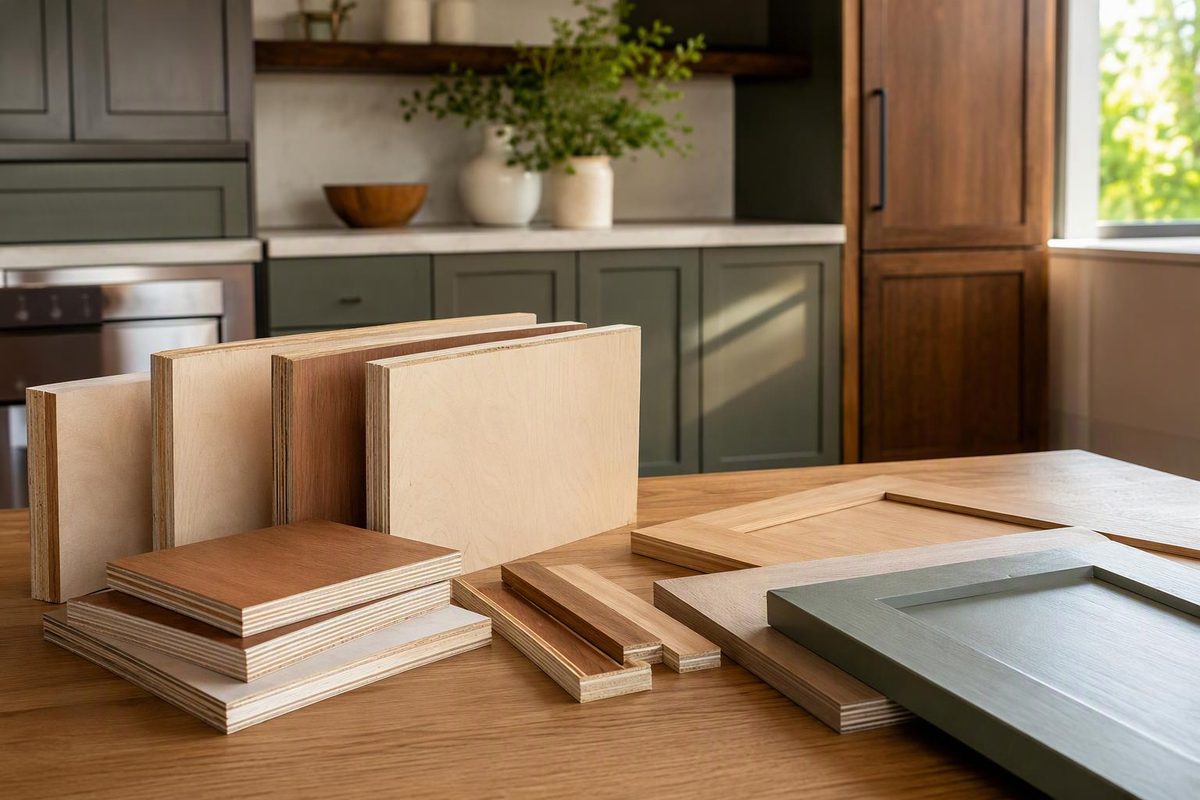
“Prefinished ply” generally means plywood supplied with a factory-applied finish, typically before the panel is cut and assembled into cabinets. For cabinet interiors, it can provide a consistent wood surface without requiring the cabinet shop to spray every box.
It is not a plywood grade or a complete construction specification. The phrase alone does not identify the core, face veneer, actual panel thickness, number of finished faces or treatment of cut edges.
What prefinished plywood actually describes
A common version is hardwood plywood with a clear UV-cured coating. Columbia Forest Products, for example, offers its clear UV Wood coating on one or two faces, in several gloss levels and over different core, face-grade and species combinations (Columbia Forest Products). That illustrates why “prefinished” describes a surface treatment rather than one standardized panel.
Factory finishing is also broader than clear UV coating. Columbia’s FinishLine range includes clear, custom-colored, chemical-resistant and pre-primed panels, each intended for a different next step or application (Columbia Forest Products). A quote should therefore say whether the panel is clear-coated, stained, painted, primed or covered with another material.
Do not assume every product called prefinished plywood has an all-veneer core. Hardwood plywood can be made with veneer, MDF, particleboard or combination cores. The EPA’s regulatory definition of hardwood plywood also recognizes multiple core constructions, although the scope of its formaldehyde rules depends on the particular product (EPA). The decorative wood face and factory coating do not reveal what lies underneath.
Where it makes sense in a kitchen
Clear prefinished plywood is most useful where a wood-grain surface is wanted inside cabinet boxes, on shelves or in drawers. Columbia lists residential kitchen cabinets and casework as suggested applications for its standard UV finish. Timber Products lists its RhinoCoat prefinished panels for cabinets, drawers, interior shelving and other low-wear uses (Timber Products).
The practical advantages are:
- Consistent interior surfaces: The large panel faces are coated under factory-controlled conditions before fabrication.
- Less shop finishing: The cabinetmaker can skip finishing the faces that arrived coated.
- Real-wood appearance: A clear coating leaves the face veneer and its natural variation visible.
- No additional face treatment: States Industries describes its NOVA panels as ready to use without further surface treatment (States Industries).
Those benefits do not automatically make a cabinet stronger. Core constructions differ in weight, screw holding, bending strength and dimensional behavior; Timber Products’ published values, for example, vary across veneer, combination, particleboard and MDF cores (Timber Products hardwood-plywood brochure).
The details most likely to cause surprises
One finished face or two
A panel may be coated on one side or both. Two-sided material is the straightforward choice where both faces remain visible, such as an adjustable shelf. One-sided material may be reasonable where the reverse face is concealed or will receive a different finish.
The quote should identify which cabinet components use one-sided and two-sided material. “Prefinished plywood boxes” does not settle that question.
Face species and grade
Clear finish exposes the veneer rather than making it uniform. Specify the species—such as maple or birch—and the acceptable face and back grades. Ask to see a sample from the cabinet line, not merely a generic piece of “cabinet-grade plywood.” Natural color and grain variation are part of the result.
If plywood will be visible on cabinet ends, ask whether that surface is the box side itself or a separate finished-end panel. A clear maple interior, painted door and veneered finished end can all belong to the same cabinet, but they are three different finish conditions.
Raw edges and machining
Factory coating covers the broad panel face. Cutting or drilling the sheet exposes the core at shelf fronts, cabinet edges, sink cutouts, dados and holes. Those areas require a separate decision: leave the plies visible, apply wood or plastic edge banding, add a solid-wood strip, or seal the edge where appearance and moisture exposure warrant it.
Inspect the sample for coating chips around holes and cuts. Pay particular attention to adjustable shelves because their front edges are visible and handled frequently.
Water exposure
A durable face coating is not a promise that the entire panel is waterproof. Cut edges, joints and damaged areas can still expose wood and adhesive lines. Under a sink, the useful questions are how the bottom panel’s edges and penetrations are treated and whether a removable leak tray is included. “UV prefinished” answers neither one. Even marine-grade plywood is defined around bond durability rather than making wood impervious to water.
Repair and matching
A factory finish can be consistent across panel faces, but a local repair may be difficult to blend invisibly. Ask what happens if an interior is scratched during installation: Is there an approved touch-up product, or will the affected shelf or panel be replaced? This matters more on an exposed end than inside a dark base cabinet.
A useful quote specification
Instead of accepting “3/4-inch prefinished ply boxes,” ask for wording that identifies:
- manufacturer and product line, if available;
- nominal and actual finished panel thickness;
- veneer, MDF, particleboard or named combination core;
- face and back species and grades;
- clear, stained, painted or primed finish;
- finish chemistry or product name;
- gloss or sheen;
- finished one side or two sides, by component;
- shelf and exposed-edge treatment;
- separate construction for backs, drawer boxes and finished ends; and
- for cabinets sold in the United States, applicable TSCA Title VI compliance documentation.
If the surface is actually melamine, TFL, HPL or another laminate over plywood, call it that rather than collapsing it into “prefinished ply.” Those materials create a different appearance and edge-detailing decision; the laminated plywood specification guide explains what to request.
Buying judgment
Prefinished plywood is a sensible cabinet-interior option when you want visible wood grain, a repeatable factory coating and less shop finishing. It is not automatically better than a well-specified laminate interior, nor does it compensate for a low-grade face, unsuitable core, thin back or poorly treated edges.
Approve it only after the sample and quote agree on four things: what the panel is, what coats it, which faces are finished and how fabrication exposes or covers the edges.