
Know What a Laminated Plywood Upgrade Actually Includes
Compare HPL, TFL, wood veneer and prefinished plywood, then verify the core, backer, edges and finished thickness before approving cabinets.
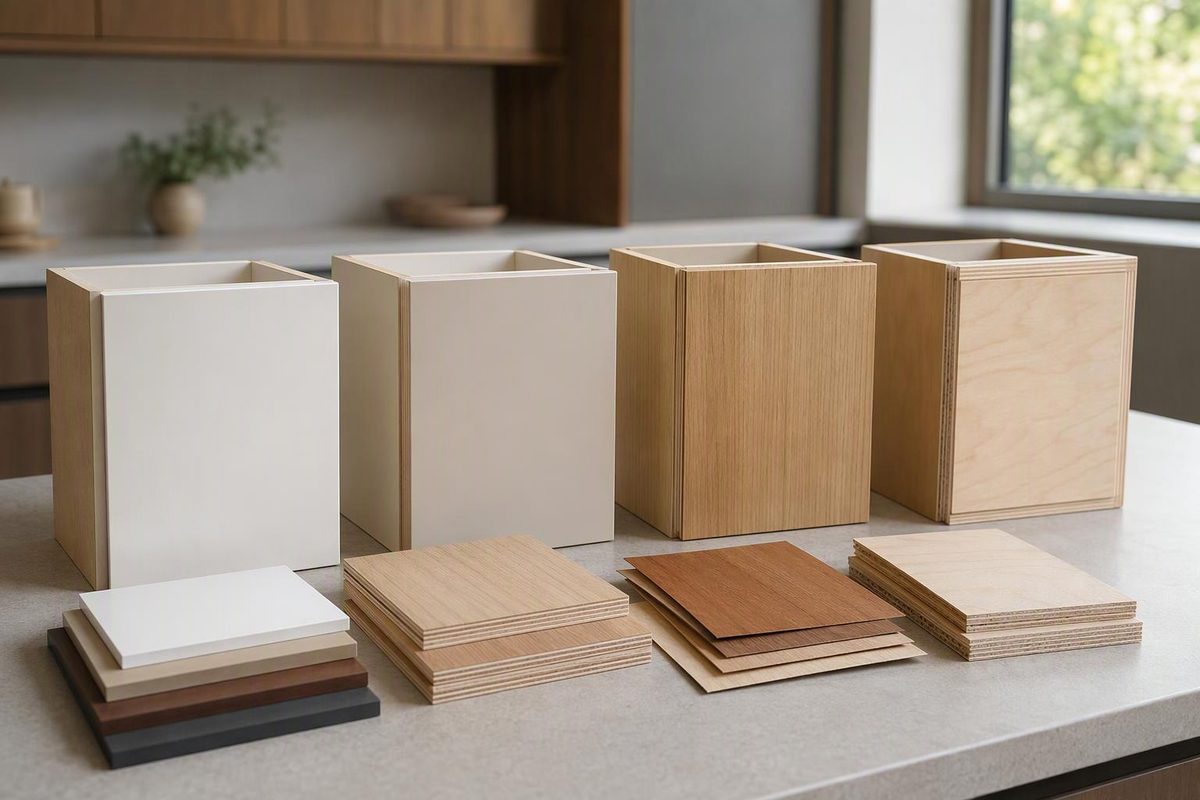
“Laminated plywood” is not a complete cabinet specification and does not prove quality. It may mean plywood faced with high-pressure laminate (HPL), real wood veneer or a clear factory finish. Approve an upgrade only when the quote identifies the face, core, reverse face, edges and finished panel thickness.
Choose what your quote identifies; the result shows whether the basic panel assembly is specified.
Is the panel assembly identified?
Check the written quote, not a salesperson’s verbal description.
A passing basic check is not the whole order
- Confirm which cabinet components use the assembly.
- Record finished panel thickness, edge material and edge locations.
- Specify seams, cutouts and exposed-edge treatment in wet areas.
- Identify the laminate grade or exact veneer and finish.
Basis: Composite Panel Association descriptions of HPL and TFL, plus Wilsonart substrate and backer fabrication data. This check does not grade a particular product.
First Identify the Face Material
A cabinet quote should name both the visible surface and the panel beneath it.
| Quoted Description | What It Commonly Describes | What to Verify |
|---|---|---|
| HPL-faced plywood | A separate high-pressure laminate sheet bonded to plywood | HPL grade, plywood core, reverse face and edges |
| Melamine or TFL panel | Resin-treated decorative paper fused directly to a substrate | Whether the substrate is particleboard, MDF or something else |
| Wood-veneer plywood | A thin real-wood face over an engineered core | Species, veneer cut and matching, core and finish |
| Prefinished plywood | Wood-faced plywood with a factory-applied clear coating | Face veneer, coating and whether one or both sides are finished |
HPL is made from resin-treated decorative paper and multiple kraft-paper layers pressed into a separate sheet, which is then bonded to a substrate. Thermally fused laminate (TFL), formerly called melamine, uses resin-treated décor paper fused directly to a panel.
The Composite Panel Association identifies particleboard and MDF as ideal TFL substrates. “Melamine cabinets” therefore should not be assumed to mean plywood boxes (CPA on HPL; CPA on TFL).
Real wood veneer is a different category. It has natural grain, while synthetic laminate may reproduce a wood pattern. If appearance is the priority, ask the same questions covered in our guide to oak veneer cabinets: species, veneer cut, grain matching, core and finish.
HPL Over Plywood Is Valid but Not Automatically Better
HPL-faced plywood can suit a buyer who wants a consistent, easy-clean surface and a veneer-core cabinet box. Veneer-core plywood is relatively light and offers good bending strength and screw holding, according to panel manufacturer States Industries (States Industries). HPL supplies the color or pattern and becomes the wear surface instead of a stained wood face.
The trade-off is fabrication. Formica says particleboard and MDF are used for most HPL work because their randomly oriented fibers respond to humidity more like HPL. It describes plywood as a marginal substrate because plywood and HPL move at different rates (Formica).
Wilsonart’s current fabrication data nevertheless allows suitable plywood with one A-grade face as a substrate for its basic laminates (Wilsonart).
The practical requirement is a documented assembly made with a laminate, substrate, adhesive and fabrication method intended to work together. The word plywood alone does not establish that the finished panel will stay flat or that the bond is suitable.
The Reverse Face Is Part of the Assembly
The back of a laminated panel matters even when it is hidden. Wilsonart specifies phenolic backer sheets for the reverse of HPL-faced substrates and says they provide some balancing characteristics and protection from normal humidity (Wilsonart backer-sheet data).
For cabinet doors, exposed ends and wide shelves, ask whether the panel receives:
- matching laminate on both faces;
- decorative HPL on the visible face and a named balancing backer; or
- another specified reverse-face treatment.
“Finished both sides” is not precise enough. The faces need not look alike, but the fabricator should identify both sides of the assembly.
Surface Durability Does Not Waterproof the Box
HPL comes in different grades. In Wilsonart’s basic line, thinner vertical-grade laminate is intended for cabinet walls, doors and drawer fronts. Thicker general-purpose laminate is used on surfaces expected to absorb more impact (Wilsonart laminate technical data). Ask for the manufacturer and grade instead of accepting “commercial laminate” as a complete description.
Edges, seams and cutouts matter as much as the broad face. Formica warns against flooding laminate near seams because penetrating water can swell the substrate (Formica care guidance).
On a sample cabinet, inspect for:
- securely bonded edge banding without lifted corners;
- sealed plumbing penetrations and other cut edges in the sink base;
- protected edges beside the dishwasher;
- clean hinge-boring holes without chipped laminate; and
- a removable sink-base liner, if one is part of the order.
A laminate face does not make exposed plywood edges, joints or penetrations waterproof.
Laminate Is Not a Clear Factory Finish
Some quote descriptions blur synthetic laminate and factory-finished plywood. They are not the same construction. Columbia Forest Products, for example, sells hardwood plywood with a clear UV-cured coating in one- or two-sided versions for cabinet interiors and exposed faces (Columbia UV Wood).
Prefinished hardwood plywood keeps real grain visible. HPL provides a uniform solid color or printed pattern and a surface designed for straightforward cleaning. Choose between them based on the appearance and use you want, not on which receives the more impressive-sounding label.
The Quote Should Name Seven Details
Before approving a laminated-plywood upgrade, ask the dealer to put these details on the order:
- Component: Box sides, backs, shelves, finished ends, doors or drawer bottoms.
- Finished panel thickness: Not only the nominal thickness of the plywood before surfacing.
- Core: Veneer core, combination core or another construction, plus the product line when available.
- Face: HPL manufacturer, pattern, finish and grade—or the exact wood veneer and clear finish.
- Reverse face: Matching laminate, cabinet liner or named balancing backer.
- Edges: Material, thickness, color and which edges receive it.
- Wet-area details: Treatment of seams, cutouts and exposed panel edges.
In the United States, EPA’s TSCA Title VI rule covers hardwood plywood, MDF and particleboard, along with finished goods containing those regulated panels. Covered products manufactured or imported after March 22, 2019, must be labeled as TSCA Title VI compliant (EPA).
Ask the seller to identify the applicable compliance label rather than treating “plywood” as an emissions claim. Our formaldehyde label guide explains what the paperwork does—and does not—establish.
Laminated plywood can justify an upgrade when the specified surface suits the kitchen and the plywood core provides a construction benefit that matters. It does not justify a premium when the seller cannot name the face, core, reverse face and edge system. Those details determine what you are buying.