
Specify Oak Veneer Cabinets Without Costly Surprises
Compare oak species, veneer cuts, grain matching, cores, edges and finishes so cabinet quotes describe the same construction and appearance.
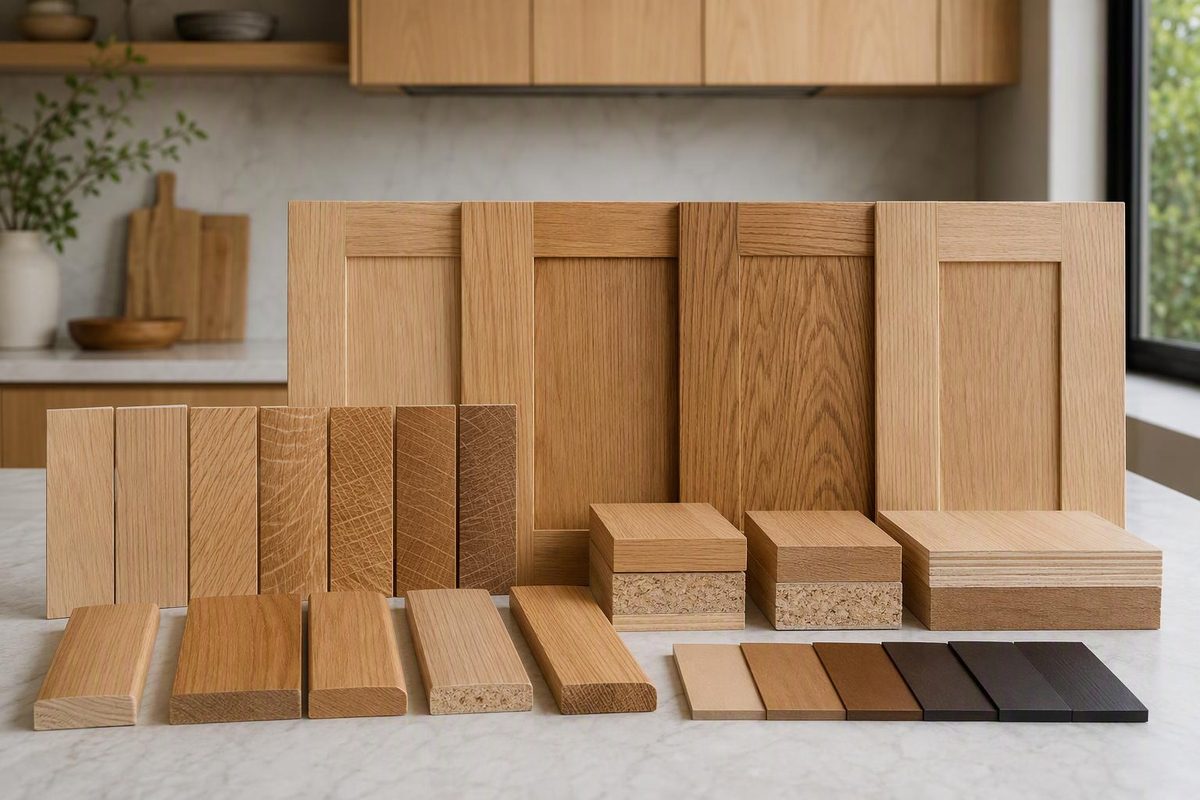
Natural oak veneer is an excellent face for broad, flat cabinet doors and finished ends, but “oak veneer” alone is not a complete specification. A useful quote must also identify the oak species, veneer cut, matching, panel core, edge construction and finish.
Natural veneer is a thin layer of real oak bonded to a panel core. The veneer supplies the appearance; the core supplies most of the panel’s thickness and affects its stability, weight and edge treatment.
Choose the species, cut and run matching; the specification starter updates below.
Natural Oak Veneer Specification Starter
Select the intended appearance and whether grain must continue across adjacent fronts.
White Oak / Rift-Cut / Standard Placement
Specification starter: Natural white oak veneer, rift-cut face; adjacent fronts are not continuously grain-matched.
- White oak is often selected for pale or neutral schemes, but the species name does not guarantee the finished color.
- Rift-cut veneer has narrow, linear grain with less ray flake, but it is not necessarily fleck-free.
- Standard placement can put neighboring fronts from different sheets, so grain continuity is not promised.
Still required: leaf match, core, balancing backer, edge construction, grain direction, finish sample and the list of veneered components.
Source note: Species descriptions are based on the USDA Wood Handbook; cut and matching guidance comes from Murphy Plywood, AWI, FormWood and the cited WalzCraft example. Supplier pricing and available constructions vary.
Confirm That the Surface Is Real Oak Veneer
Natural oak veneer has real pores, grain and color variation. Do not confuse it with oak-look melamine, thermofoil or printed film. Reconstituted veneer is another category: wood is dyed, layered and formed into a controlled pattern rather than sliced as the finished face directly from an oak log.
Search listings can mix these materials, so identify the visible surface before comparing prices. Our cabinet veneer guide explains the distinction.
The Architectural Woodwork Institute describes wood veneer as a thin slice of real wood bonded to a substrate such as MDF, particleboard or plywood (AWI veneer overview).
A veneered MDF slab is therefore not solid oak, but it is not an imitation wood print either. Judge it by the face veneer, core, bonding, edge treatment and finish.
Choose the Oak Species and Cut Together
Red Oak and White Oak Do Not Guarantee a Color
The species name does not promise a precise finished color. The USDA Forest Products Laboratory describes red-oak heartwood as brown with a red tinge and white-oak heartwood as generally grayish brown; both groups have nearly white sapwood (USDA Wood Handbook).
White oak is often selected for pale or neutral schemes, while red oak commonly reads warmer. That is a design tendency, not a color guarantee. Natural variation, stain, topcoat and lighting can make samples sold under the same species name look different.
Approve a finished sample made with the quoted veneer, stain and topcoat. A raw white-oak sample does not establish how the completed cabinets will look.
The Veneer Cut Controls the Grain
- Plain-sliced or flat-cut: Familiar cathedral arches mixed with straighter grain.
- Quarter-sliced: Predominantly straight grain, often with reflective ray flake.
- Rift-cut: Narrow, linear grain with less ray flake.
- Rotary-cut: Broad, varied grain produced by peeling the log; panel-to-panel matching is less predictable.
Yield helps explain the general price order. Plain slicing produces more veneer than quarter slicing, while rift cutting produces the narrowest components and the lowest yield. Murphy Plywood describes plain slicing as generally the least expensive sliced method and rift as generally the most expensive (veneer cutting and matching guide). That is a material tendency, not a guaranteed cabinet upcharge.
Do not read “rift-cut” as “completely fleck-free.” For work governed by its cited material standard, AWI permits medullary ray on as much as 25% of the exposed area of rift-grain oak (AWI panel-product requirements). If ray fleck matters, approve a representative range rather than one small sample.
For more detail on panel construction, see how to choose white oak veneer plywood.
Specify Matching Within Each Door
Narrow veneer leaves are joined to make a full cabinet face. Their arrangement is separate from the veneer cut.
- Book match flips every other leaf like facing pages, producing a mirrored pattern. Alternate leaves can reflect light or accept stain differently, creating light-and-dark “barber pole” bands.
- Slip match lays consecutive leaves face-up in the same direction. Reflection is more consistent, although the grain does not mirror at each joint.
- Plank match deliberately combines leaves that differ in width, color or grain for a more casual appearance.
Murphy Plywood and FormWood document these matching methods and the potential book-match color effect (Murphy guide; FormWood specification guide).
The quote should name the leaf match rather than relying on a showroom sample. Two rift-cut white-oak doors can look substantially different if one is slip matched and the other is plank matched.
Require Drawings for Continuous Grain Matching
Matching leaves within one door does not guarantee coordination across a run of cabinets. Standard production can place neighboring fronts from different sheets. Continuous grain matching requires an elevation showing how each door and drawer front relates to the next.
WalzCraft, for example, lists no grain matching as its standard option and requires drawings for its continuous-match option. It also states that continuous matching costs more (WalzCraft veneer-door options). That describes one manufacturer’s system, not a universal cabinet-industry price or ordering rule, but it shows why grain continuity must appear in the written order.
The upgrade is most visible on uninterrupted banks of slab fronts. It may add less visual value where appliances, framed doors or deliberately varied grain break up the run.
An order for continuous matching should identify the elevation, grain direction and treatment at appliance gaps, fillers and finished ends. It should also state whether replacement fronts can be matched later; a future door made from a different veneer sheet may not continue the original pattern.
Name the Core and Inspect All Four Edges
Ask for the slab-door core by name. MDF provides a smooth, uniform substrate, but other constructions exist. A quote describing the cabinet boxes as “plywood construction” does not establish the door or drawer-front core.
For work governed by AWI’s cited panel standard, balanced construction is required and veneer-core material is not permitted in cabinet doors or drawer fronts (AWI panel-product requirements). Cabinets not sold to that standard need their own written construction details.
Open a sample door and inspect it from the side. Possible edge treatments include:
- thin wood-veneer edge banding;
- a thicker solid-wood edge;
- an exposed or painted core;
- solid edging applied first, with face veneer laid over it to conceal the front glue line.
Application order matters. WalzCraft’s published options include machine-applied veneer and solid-wood bands with visible glue lines, as well as constructions that cover those lines with face veneer (WalzCraft veneer-door options). Inspect this closely on handleless doors, where fingers and sight lines emphasize the edges.
Also ask what is on the back. A balancing veneer or compatible backing helps the panel remain flat; a premium oak face on one side alone is not the same construction. AWI requires balanced faces where its standard applies, and FormWood likewise tells panel buyers to specify a balancing backer (FormWood specification guide).
Finished ends, fillers and toe kicks need the same scrutiny. A door sample does not establish that these adjoining components use the same veneer cut, grain direction or finish.
Make the Finished Sample Part of the Order
A small sample cannot show the likely range of cathedral grain, ray fleck, sapwood and variation between neighboring doors. The approval should cover:
- the specified red or white oak;
- the actual veneer cut and leaf match;
- a representative color and grain range, not only the most uniform piece;
- the quoted stain or clear finish and sheen;
- viewing under lighting similar to the planned kitchen;
- written acceptance rules for natural variation.
Do not assume a future refinisher can sand away a poor color choice. Veneer is thin, and sanding through it exposes the backer or core. FormWood’s flexible sheets, for example, are 0.024 to 0.039 inch thick including the backer, and the company warns against aggressive sanding (FormWood sanding guidance).
That thickness range applies to those FormWood products, not to every cabinet veneer. Obtain the cabinet manufacturer’s face-thickness and refinishing guidance before work begins.
Put the Complete Veneer Specification on the Quote
A useful oak-veneer line item identifies:
- red oak or white oak;
- natural or reconstituted veneer;
- plain-sliced, quarter-sliced, rift-cut or rotary-cut face;
- book, slip, plank or another leaf match;
- grain direction;
- whether adjacent fronts are continuously matched;
- the core of doors, drawer fronts and finished ends;
- the back veneer or balancing material;
- edge material, thickness and application sequence;
- finish, sheen and approved sample reference;
- every veneered component, including fillers, toe kicks and finished ends;
- how a future replacement front will be matched.
With those details written down, competing quotes describe comparable work. A lower price may otherwise reflect a different veneer cut, no grain coordination, simpler edges or unmatched exposed ends rather than the same oak-veneer package at a better price.