
Bamboo Veneer Cabinets: What to Check Beyond the Grain
Compare bamboo veneer patterns, color treatments, cores and finishes—and learn why a hard bamboo face does not guarantee a durable cabinet door.
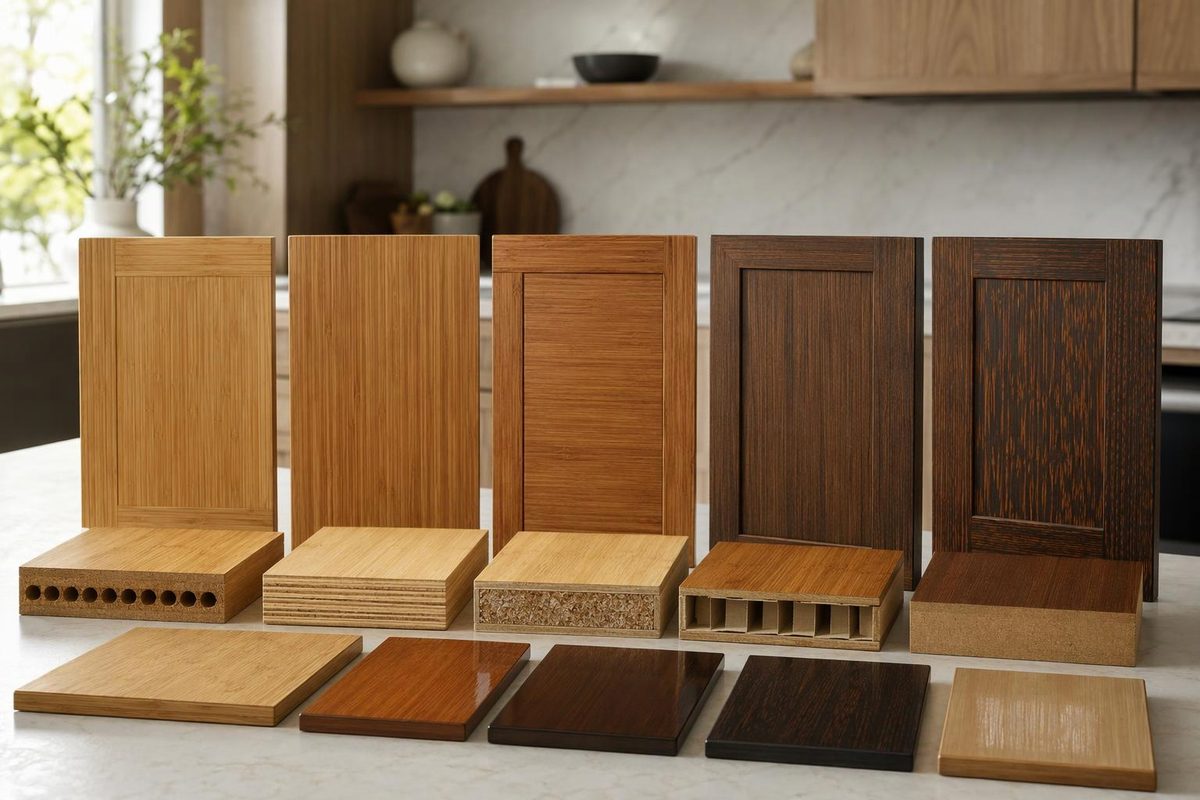
Bamboo veneer gives cabinet doors and exposed panels a real bamboo surface without making the whole component from bamboo. Its main buying appeal is the appearance: a regular strip pattern, visible bamboo nodes and colors ranging from pale yellowish tones to warm brown.
Choose it for the look, then judge the complete panel. Check the veneer’s thickness, supporting core, back face, edges and finish rather than relying on a general claim that bamboo is hard or durable.
What bamboo veneer actually is
Unlike veneer sliced directly from a tree log, MOSO’s bamboo veneer is sliced from blocks of laminated bamboo strips. The manufacturer backs it with cellulose fleece to reduce cracking during handling, then specifies pressing it onto a supporting panel, preferably on both sides. Its listed plain-pressed and side-pressed sheets are 0.6 mm thick; the high-density version is listed at 0.5 mm. These are product specifications, not universal bamboo-veneer dimensions. MOSO’s veneer product details
The supporting panel can be MDF, particleboard or plywood. MOSO’s technical sheet describes its standard 0.6 mm veneer as 0.5 mm bamboo plus 0.1 mm backing—so the advertised sheet thickness is not all sandable bamboo. MOSO’s veneer technical sheet
Do not confuse that construction with an all-bamboo laminated panel. Smith & Fong’s Plyboo panels, for example, include a three-ply version with bamboo faces and a perpendicular bamboo core. The company also makes linear constructions without that cross-core and specifically advises against those linear products for European-style single-piece cabinet doors. A quote saying only “bamboo doors” leaves an important distinction unresolved. Plyboo construction and usage guidance
Pick the strip pattern—not just the color
Bamboo’s appearance depends on how the strips are assembled before the veneer is sliced:
| Pattern | What you will see | What to inspect on a cabinet sample |
|---|---|---|
| Plain pressed | Wider lines and clearly visible bamboo nodes | Whether the prominent nodes suit the scale of the doors and drawers |
| Side pressed | Narrower lines with subtler nodes | Whether adjacent fronts have a consistent direction and visual rhythm |
| High density | Crushed, compressed strips producing a more wood-like, irregular pattern | Whether you prefer that variation to bamboo’s regular strip-and-node look |
These differences come from the strip arrangement, not simply from rotating the finished sheet. MOSO’s production explanation
Also separate pattern name from grain direction on the cabinet. A pattern label alone does not tell you whether the lines will run upward or sideways across your installed doors. Ask for the direction to be shown on the cabinet elevations, including drawer stacks and exposed ends.
Approve several fronts together rather than one small swatch. Smith & Fong notes that bamboo naturally varies in color and recommends color-pairing panels before fabrication. Plyboo preparation guidance
Brown bamboo is not necessarily stained
MOSO describes untreated bamboo as yellowish, with steam treatment producing its Ecru and warmer brown Caramel colors. It also describes additional coloring through stain, lacquer or oil. A brown sample therefore may owe its color to treatment of the bamboo, the finishing system, or both. MOSO’s color and production details
Ask for a finished sample made with the actual veneer and proposed coating. Do not assume bamboo cannot be stained, or that a stain selected on another material will reproduce the same result. Smith & Fong permits conventional finishes on its bamboo panels but requires compatibility testing on a sample. Plyboo finishing guidance
Sunlight can change the color, too. The processing guide currently linked from MOSO’s veneer page, dated October 2016, says natural bamboo becomes slightly darker under UV exposure while Caramel becomes slightly lighter. For a sunny kitchen, ask what color change the cabinet maker expects from the complete finish system. MOSO’s panel and veneer processing guide
Durability depends on what is underneath—and around it
A thin bamboo face is not a stand-alone measure of dent resistance. MOSO explicitly lists veneer indentation hardness as dependent on the substrate. A “high-density bamboo” label therefore does not establish how the finished cabinet panel will resist damage. MOSO’s veneer technical sheet
Before approving the order, require these details:
- Face and core: exact veneer product, face thickness, core material and finished door thickness.
- Back-face construction: how the maker balances the panel. MOSO generally specifies matching material type and thickness on both sides of a carrier to avoid bending.
- Edges: matching bamboo banding or another specified edge material. If exposed bamboo layers are proposed, confirm the panel construction. Inspect the corners and the face-to-edge transition on a finished door.
- Finish and care: coating system, cleaning instructions and any moisture or heat exclusions in the cabinet warranty.
- Repair plan: available touch-up materials and whether replacement fronts can be color-matched.
The panel-balancing guidance comes from MOSO’s processing instructions; the remaining items should be answered by the cabinet maker for your specific order.
Do not buy thin bamboo veneer expecting repeated sanding and refinishing. Start with the face thickness and condition before attempting any repair; our veneer sanding guide explains the preparation limits. The strongest sample approval is a complete finished door, with its back and edges visible—not just an attractive piece of bamboo.