
Sande Plywood vs Birch: Which Is Worth Buying for Cabinets?
Compare sande and birch plywood for cabinet boxes, paint, clear finishes and cost—and learn when a birch upgrade buys more than a different face.
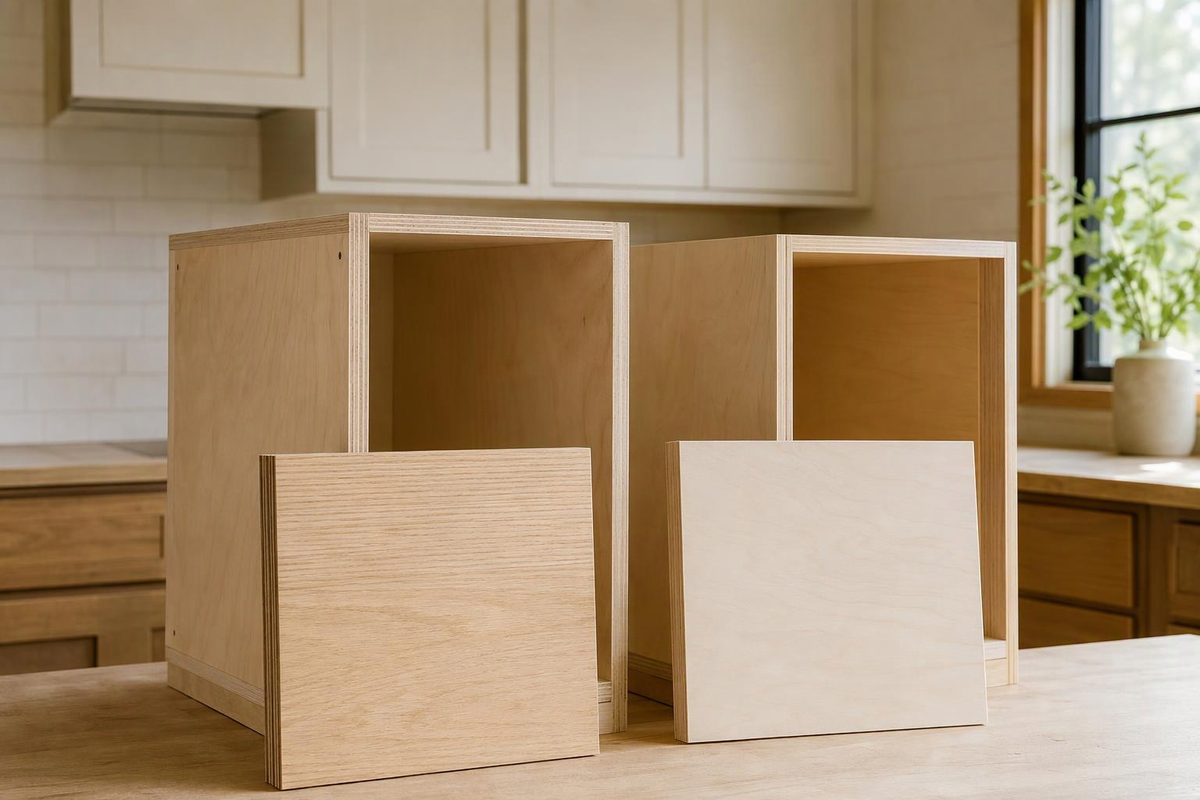
Choose sande for a cost-saving cabinet panel only when its construction and finished surface meet the job. Choose birch when you want its finer-grained appearance—or when the specified birch panel actually offers a better core. A birch label alone does not establish a stronger cabinet box, and a sande label does not establish better water resistance.
The comparison also changes depending on whether “birch” means ordinary birch-faced plywood or a high-ply-count, all-birch panel. Those are not interchangeable purchases.
Paint or visible wood: the clearest difference
Sande wood is yellowish white to light brown, with an even, medium-to-moderately-coarse texture and potentially interlocked grain. The USDA’s Wood Handbook describes it as easily stained and finished. Birch has a tighter, smoother grain; Columbia Forest Products describes its color as light tan to pale yellow, with red-to-ruddy heartwood. These USDA wood descriptions and Columbia’s birch guide describe the woods—not a guarantee that every sheet will look alike.
For clear-finished cabinet interiors, open shelves or exposed ends, birch is the more logical starting point if you want a fine-grained, pale wood appearance. Specify the color selection and approve a finished sample: “birch” does not necessarily mean uniformly pale faces.
Sande can also be left visible if you like its sample. Do not treat it as a drop-in color match for birch doors, drawer fronts or edge banding. Compare those parts together under the intended finish.
For painted panels, make the decision from a primed-and-painted sample rather than the raw wood alone. Home Depot lists its SANDEPLY panel as suitable for painting, staining or lamination; Metsä Wood likewise permits compatible paints and other wood finishes on its birch panel. Neither statement promises an equally smooth result with your coating system. SANDEPLY product listing · Metsä Wood Birch specifications
If sande needs extra surface preparation to achieve the approved painted finish, include that labor before calling it the cheaper choice.
Cabinet-box strength: compare cores, not just faces
Ordinary birch-faced plywood need not contain birch throughout. Columbia’s core guide describes North American veneer cores made from regional species such as fir, aspen and poplar, including constructions suitable for birch faces. It separately describes European-style, high-ply-count birch cores used where the layered edge is exposed. Columbia hardwood-plywood core guide
An all-birch product is a different comparison. For example, Metsä Wood specifies cross-bonded birch veneers and 13 plies in its standard 18 mm panel. That construction should not be assumed from an unspecified “birch plywood” cabinet quote. Metsä Wood Birch data sheet
For sande versus ordinary birch-faced cabinet boxes, require the same information from both suppliers:
- Actual panel thickness and core construction.
- Core-gap limits and a cut-edge sample showing gaps or separation.
- Shelf span, support arrangement and intended load.
- Joint construction and hardware-fastening details.
These checks are more useful than comparing the hardness of the face woods. A cut-edge sample is a screening check, not proof of the quality of every panel. For a broad “plywood upgrade” claim, see what a worthwhile plywood cabinet upgrade should include.
Neither species name is a moisture rating
Do not buy sande over birch on the assumption that tropical wood means waterproof plywood. Specified Components’ SANDEPLY lamination-grade specification lists Type 1 or Type 2 adhesive options; it does not establish the glue used in the Home Depot sheet. The USDA also describes sande wood as not durable against decay. SANDEPLY specification sheet · USDA wood descriptions
Conversely, birch plywood is not inherently restricted to an interior glue bond: Metsä Wood’s all-birch panel has a weather- and boil-resistant bond meeting EN 314-2 Class 3 (exterior). That specification belongs to the named product, not every birch sheet. Metsä Wood bonding specifications
For a sink cabinet, ask for the exact panel’s bond/exposure rating, finished faces and edges, treatment around plumbing cutouts, and water-damage warranty terms. Changing the face species is not a substitute for those details.
Is sande meaningfully cheaper?
A same-store retail example shows why the actual price gap matters. On November 9, 2026, Home Depot’s listings set to Fairfax, Virginia, showed these 4 × 8-foot sheets:
| Panel | Listed sheet price |
|---|---|
| SANDEPLY 18 mm, 3/4-inch category, model 454559 | $70.55 |
| PureBond birch, nominal 3/4-inch, model 165921 | $75.73 |
That is a $5.18 difference per sheet, not a cabinet-wide savings estimate. These are supply-only listed prices, before tax, delivery and fabrication; local prices can differ. The sande sheet is listed at an actual 0.709-inch thickness, so nominal category alone is not a like-for-like specification. Home Depot’s paired listings
For concealed or painted boxes, accept sande if the core, construction and approved finish meet the same requirements and the completed-cabinet saving is worthwhile. Pay more for birch when you can identify the benefit: the appearance you want, a better-specified core, or a finished-panel option that reduces work. If the only explanation is “birch is premium,” ask what actually changes.