
Choose the Cabinet Box That Fits the Actual Risk
Compare chipboard and plywood cabinet boxes for moisture, fasteners, shelves, testing and price, then learn what to require in a cabinet quote.
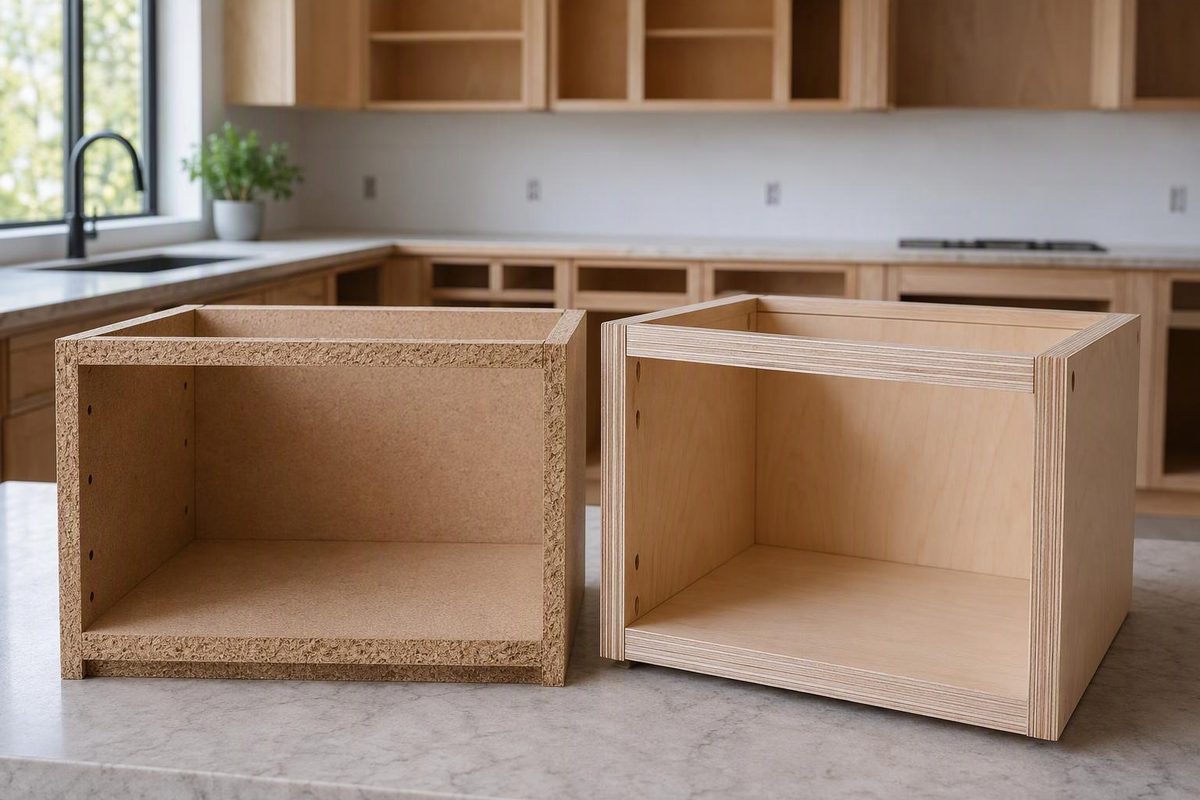
For a kitchen cabinet box, plywood is usually the safer upgrade where leaks or future alterations are realistic concerns. Chipboard can still make a sound cabinet when the panel, joints, hardware and edge treatment suit the application—and when the complete cabinet has credible performance evidence.
The label alone does not settle the purchase. “All-plywood construction” can leave the back, shelves, plywood core, thickness and finish unspecified. Conversely, a particleboard box is not automatically weak.
Choose your moisture risk, alteration plans and available documentation; the tool identifies the safer choice.
Cabinet Box Decision
Use the conditions for the exact cabinet location and construction being quoted.
Choose the plywood upgrade.
Elevated moisture risk makes plywood’s greater tolerance for brief wetting the deciding factor. Neither material is waterproof.
Verify: finished thickness, back construction, edge treatment and what else changes with the upgrade.
Chipboard Usually Means Particleboard
In cabinet discussions, chipboard generally refers to particleboard, also sold under terms such as furniture board or engineered wood. It consists of cellulosic particles bonded with resin; particle size, density, resin and additives can be varied for the intended use. The Composite Panel Association lists kitchen cabinets and shelving among common applications and explains that particleboard is manufactured with a range of physical properties (CPA).
Plywood is made from thin wood veneers bonded in layers, with adjacent grain directions usually crossed. This distributes strength and stiffness in both panel directions and improves dimensional stability, but performance still varies with veneer species, grade, thickness, core construction and adhesive bond (APA).
This comparison concerns boxes and shelves. Cabinet doors and drawer fronts may use solid wood, MDF, particleboard, plywood or a combination regardless of the box material.
The Practical Differences Depend on Construction
| Decision Factor | Chipboard/Particleboard Box | Plywood Box |
|---|---|---|
| Normal cabinet use | Can perform well in a properly designed and assembled cabinet | Usually offers more tolerance for site handling and later modifications |
| Wet edges | Exposed material can swell; moisture-resistant grades reduce specific risks but are not waterproof | Also absorbs moisture and can swell or delaminate, but commonly has better recovery after short exposure |
| Fasteners | Depends heavily on panel grade, pilot holes, suitable fittings and intact fixing points | Generally more forgiving when hardware must be removed and reattached |
| Shelves | Thickness, span, loading and front-edge reinforcement matter | The same variables matter, along with plywood grade and face-grain direction |
| Surface | Provides a consistent core for melamine, thermally fused laminate and other overlays | Can have a clear-finished wood face or an applied decorative surface |
| Price | Commonly the lower-priced standard box | Commonly an upgrade, but no universal premium is reliable |
Plywood Handles Brief Moisture Exposure Better
Neither material is waterproof. A plumbing or dishwasher leak can damage edge banding, joints, finishes and flooring regardless of the box core.
Particleboard can swell after absorbing water, especially at an exposed edge. Plywood can also swell or delaminate, but its layered construction generally gives it a better chance of remaining usable after brief wetting. A cabinet manufacturer offering both constructions describes permanent particleboard swelling and better drying recovery for plywood, while warning that both absorb water (Decor Cabinets). Treat that as a practical product comparison, not a promise that every plywood panel outperforms every particleboard panel.
Do not accept “moisture resistant” without a designation or product sheet. ANSI A208.1-2022 defines MR10, MR30 and MR50 particleboard for interior applications subject to periodic moisture exposure. The designations address reduced thickness swell, advanced bond integrity, or both; they do not mean waterproof (ANSI A208.1-2022).
For either material, inspect the sink base, dishwasher end panel and toe-kick area for exposed edges and unsealed penetrations. A tray or leak sensor can limit damage more effectively than expecting a panel label to withstand a prolonged leak.
Plywood Is More Forgiving of Reworked Fasteners
Plywood’s continuous veneers usually make it more forgiving when a screw must be removed and reinstalled. That matters if an installer relocates a slide or a later repair uses the same general fixing area.
Particleboard is not incapable of holding hardware. ANSI A208.1 includes face- and edge-screw-holding requirements for several grades. M-2, for example, is medium-density Grade 2 with specified minimum panel properties. The Architectural Woodwork Institute references M-2 or better particleboard in its panel-product requirements (AWI).
Dowels, confirmat screws and other engineered fittings can form sound joints when matched to the panel. Repeated screw removal, a damaged pilot hole or an unsuitable fastener can weaken the connection.
Shelf Design Matters More Than the Box Label
Do not infer shelf performance from the cabinet sides. Ask whether shelves are fixed or adjustable, their finished thickness, their unsupported span and whether the front edge is reinforced.
Testing of the assembled cabinet is more useful than a vague “strong box” claim. ANSI/KCMA A161.1-2022 does not prescribe plywood or particleboard; it evaluates complete factory-assembled cabinets. Its structural tests include loading shelves and bottoms at 15 pounds per square foot for seven days. Mounted wall cabinets up to 36 inches wide must also accept a 600-pound test load without visible failure of the cabinet or mounting system (ANSI/KCMA A161.1-2022). Those are controlled qualification tests, not recommended household loads.
A certification seal therefore supports the tested cabinet design, not a claim that one panel material is universally stronger.
Plywood Is Worth More Under Specific Conditions
Plywood is the more defensible purchase when:
- the sink or dishwasher area has elevated leak risk;
- cabinet ends or toe kicks may encounter damp flooring;
- you expect to relocate shelves, slides or other hardware later;
- easier handling matters during a difficult installation; or
- the upgrade also provides thicker shelves, a more substantial back or other useful construction changes.
Particleboard can be a reasonable value when:
- the exact cabinet line and construction carry current KCMA A161.1 certification;
- the quote identifies panel grade, thickness, shelf and back construction;
- edges are continuously covered and job-site cuts will be sealed;
- the joints and hardware are designed for the core; and
- paying for plywood would require a more consequential compromise in installation, hinges, slides or finish quality.
Do not assume the visible interior identifies the core. Both materials can sit beneath laminate, melamine or wood veneer. “Prefinished plywood” also describes a surface condition rather than a complete box specification; use the prefinished plywood guide to identify the missing details. If the quote says only “laminated plywood,” check the face, backer, core, edges and finished thickness against the laminated plywood specification checklist.
Put the Complete Box Construction in the Quote
Ask the dealer to record these details for the exact cabinet line and upgrade being priced:
- Material and finished thickness of box sides, tops, bottoms and shelves.
- Back material, thickness, attachment to the box and method of wall mounting.
- Particleboard grade and any MR designation, or the plywood core and face specification.
- Surface material on both faces and treatment of exposed and cut edges.
- Moisture protection at the sink base and dishwasher area.
- Joint method, hanging rail or mounting system, and required installation fasteners.
- Current KCMA A161.1 certification for the exact cabinet construction—not merely for the manufacturer generally.
- TSCA Title VI labeling for regulated composite-wood components. EPA’s rule covers particleboard, MDF and hardwood plywood, as well as finished goods containing them, so plywood is not an automatic exemption (EPA). The separate guide to cabinet formaldehyde labels and testing explains what that paperwork establishes.
- The itemized plywood-upgrade price and any bundled changes, such as thicker shelves or different drawer boxes.
If the seller cannot define the standard box and plywood upgrade at this level, the material names are not yet precise enough for a value comparison.