
Plywood Cabinets: Check the Box, Not Just the Label
Learn what plywood cabinets actually include, how to inspect backs, shelves and finishes, and when a plywood upgrade is worth paying for.
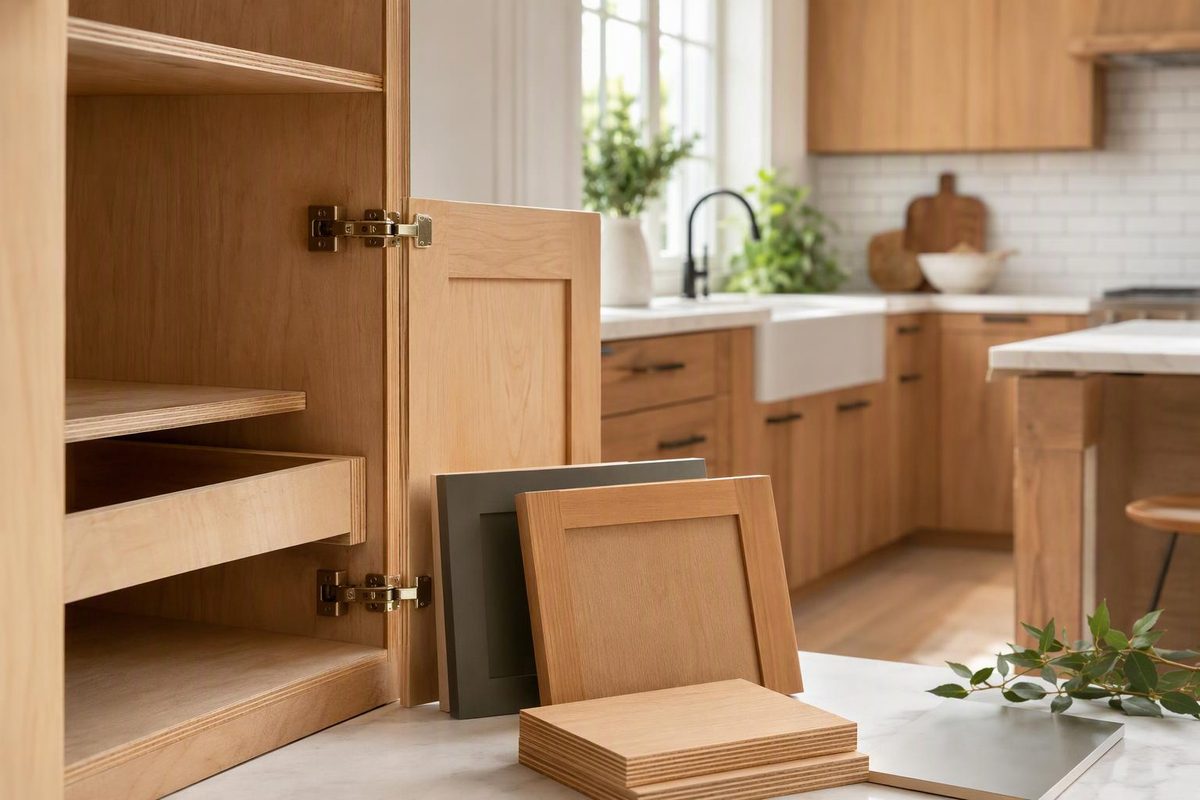
Plywood can be a worthwhile cabinet-box material, but “plywood cabinets” is not a complete construction specification. Before paying extra, find out which components change, what the panels contain, and how the cabinet is assembled. A plywood side panel does not tell you enough about the back, shelves, doors or installation.
For a homeowner comparing kitchen quotes, the useful question is not simply “Is it plywood?” It is “What does this upgrade improve in the cabinets I am buying?”
What “plywood cabinets” actually means
Veneer-core plywood consists of wood layers bonded together, with alternating grain directions for stability and strength. Its decorative face can be a different species from the inner layers. A maple-faced panel, for example, does not necessarily have maple throughout its core. Columbia Forest Products explains this distinction in its panel-construction guidance.
The cabinet label also needs unpacking:
- Plywood end panels may mean only the cabinet sides are upgraded.
- All-plywood construction needs a component-by-component definition, including any exceptions.
- Plywood boxes do not establish the material used for doors, face frames or drawer boxes.
These are real purchasing distinctions. As of October 2026, KraftMaid Simplicity lists separate plywood-end-panel and all-plywood construction options, while its standard drawer boxes are described as dovetailed solid wood.
Even “all plywood” does not necessarily mean every layer is veneer. Cabinet Joint’s Conestoga specifications disclose that some panels in its all-plywood boxes contain thin MDF layers between the real-wood veneer layers. That is not automatically a defect: Columbia’s Classic Core deliberately combines veneer inner plies with MDF crossbands to produce a smoother surface and reduce the chance of core irregularities showing through the face.
If you specifically want veneer-only cores, confirm that the maker offers them and put that requirement in writing. Do not rely on the upgrade’s name. Cabinet Joint explicitly says it cannot substitute a different panel for Conestoga’s specified construction.
Where plywood earns its keep
Columbia identifies strength, lower weight and higher screw-holding properties as advantages of veneer core over MDF and particleboard cores. Those properties are relevant to cabinet boxes and hardware attachment, but they do not establish the performance of every finished cabinet. Source: Columbia’s veneer-core guidance.
Construction still matters. KraftMaid, for example, specifies dado and rabbet joints—recessed joints that align adjoining panels and increase gluing surface—along with base-cabinet bracing and solid-wood wall-cabinet hanging rails. These details accompany the panel material rather than being replaced by it. See KraftMaid’s construction details.
For the direct material trade-off, see our chipboard versus plywood cabinet guide. When evaluating a plywood quote, concentrate on the actual assembly.
Inspect the back, shelves and finished surfaces
Ask to see a sample cabinet or a construction drawing, not just a door sample.
| Component | What to verify | Purchasing judgment |
|---|---|---|
| Sides and floors | Core type, thickness and how adjoining panels connect | “Plywood” alone leaves both panel construction and assembly unresolved. |
| Back and hanging system | Back material and thickness; presence of rails or cleats; specified mounting locations | A back panel and a hanging rail serve different roles. Establish where installation screws belong. |
| Shelves | Material, thickness, clear span, supports and stated load limit | Do not infer shelf capacity from the box-side material. |
| Interior surfaces | Wood veneer, laminate or other finish; shelf-edge treatment | Approve the surface you will actually clean and see. |
| Exposed ends | Which cabinet sides receive a matching finish or decorative panel | A plywood upgrade is not a substitute for specifying visible ends. |
Thickness is a specification, not a universal ranking. KraftMaid lists 1/2-inch plywood end panels for its all-plywood construction. Cabinet Joint specifies 1/2-inch plywood sides, tops and bottoms for Conestoga cabinets, a 1/2-inch back, and standard 3/4-inch plywood shelves. Neither example supports a blanket rule that every quality cabinet component must be 3/4 inch. KraftMaid specifications; Conestoga specifications.
For wall cabinets, have the installer follow the manufacturer’s mounting instructions. Do not assume that a thin back skin is an approved fastening point, or that a thick back eliminates the need to check those instructions. KraftMaid’s installation guide, for example, specifies mounting locations and additional screws through the center hanging rail for certain cabinet heights.
If the interior is described as prefinished, our prefinished plywood guide explains which core, edge and finish details still need specifying.
Do not buy plywood as leak insurance
A plywood box is not permission to leave water under the sink. KraftMaid’s care guide instructs owners to avoid excessive moisture, dry surfaces immediately and pay particular attention around sinks and dishwashers. See the manufacturer’s care guide, page 17.
Ask how plumbing cutouts and exposed edges will be treated, and whether a removable sink-base tray is included. Keep leaks accessible for inspection rather than treating the material upgrade as waterproofing.
For U.S. purchases, also request TSCA Title VI compliance information. EPA’s formaldehyde rules cover hardwood plywood made with veneer or composite cores, as well as MDF and particleboard. A veneer core does not by itself put cabinet plywood outside those rules. Structural plywood is a separate, excluded category. EPA’s guidance explains the covered products and exceptions.
Decide whether the upgrade is worth its price
Request two dated quotes for the same cabinet schedule: standard construction and the defined plywood option. Keep doors, finish, hardware, accessories and installation scope identical. Require the upgrade charge and the affected components to be listed separately.
Favor a clearly specified veneer-core plywood upgrade when lower panel weight or screw-holding properties matter to your choice, and the price leaves room for good hardware, the finish you want and proper installation. Do not pay a substantial premium for an undefined label.
If performance evidence is offered, check the exact cabinet line. KCMA’s A161.1 quality certification covers tests of cabinet structure, drawers, doors and finish—not merely the sheet material.
Before signing, the quote should let you identify the core, component thicknesses, back and mounting system, shelf specifications, interior finish, exposed-end treatment and exact upgrade charge. If those remain unclear, ask for clarification rather than assuming “all plywood” answers them.