
Full Overlay vs Partial Overlay: Compare the Fronts, Not Just the Price
Compare full and partial overlay cabinets by visible frame, cost, hardware and clearances—and learn what to keep identical in competing quotes.
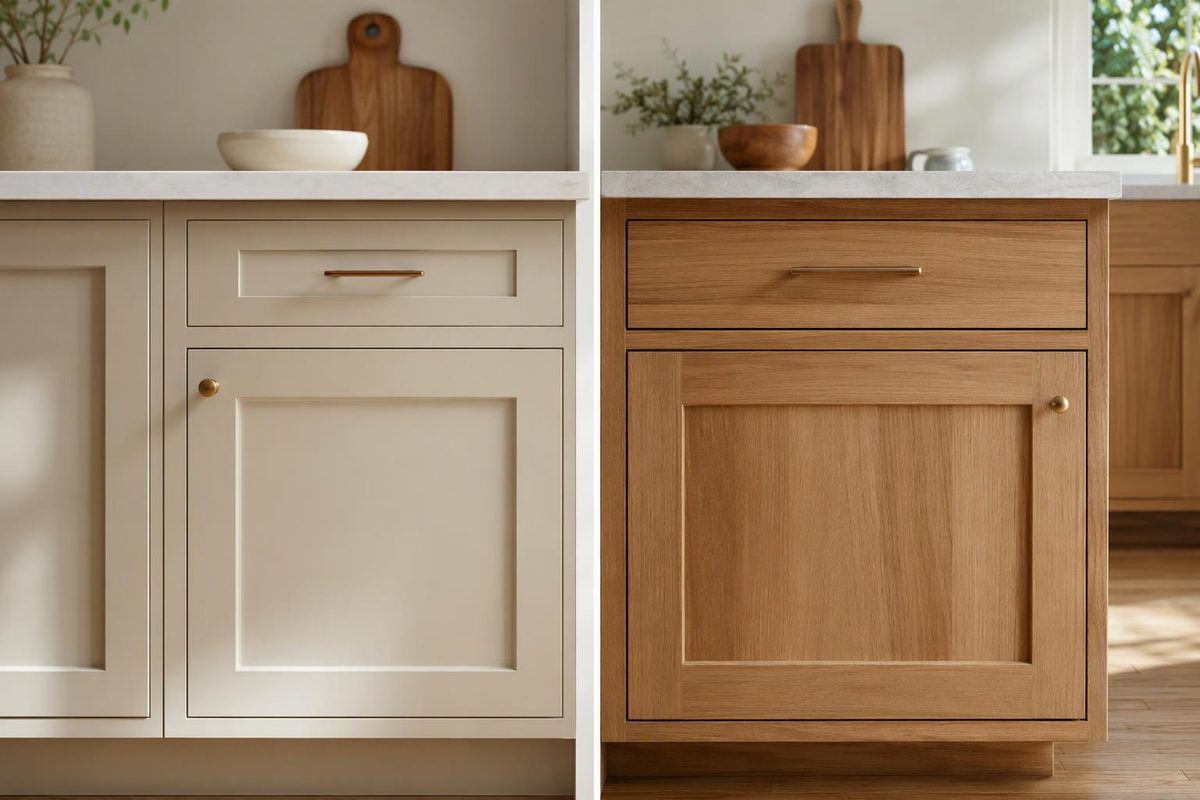
Full overlay covers nearly all of the cabinet face frame; partial overlay leaves more frame visible around the doors and drawer fronts. Choose full overlay if you want a more continuous cabinet front. Choose partial overlay if you like the visible-frame look or a matched quote makes it a worthwhile saving. Neither label, by itself, establishes cabinet quality.
The main comparison here is between two overlay options on face-frame cabinets—cabinets with a wood frame attached to the front of the box. If one quote is frameless, you are also comparing a different box construction—not just different-sized doors.
What the difference looks like
Overlay describes how much a door or drawer front overlaps the cabinet frame. It is separate from the door’s decorative profile. A Shaker or raised-panel door can have an overlay specification; “Shaker” does not tell you how much frame will show. Brakur’s explanation of door styles and overlays makes that distinction.
| Decision factor | Full overlay | Partial overlay |
|---|---|---|
| Visible frame | Nearly all covered, with narrow spaces between fronts | More exposed frame surrounding each front |
| Overall appearance | Doors and drawers read as a more continuous surface | Each door and drawer looks more individually outlined |
| Opening the fronts | Plan for knobs, pulls or a specified alternative opening system | Some designs can be opened by gripping the edges |
| Price | Can cost more within a comparable cabinet line | Can offer savings when other specifications match |
| Storage in the same box | Larger fronts do not enlarge the cabinet interior | Smaller fronts do not shrink the cabinet interior |
The frame exposure is not a universal measurement. For example, American Woodmark’s February 2025 PRO XPRESS specification guide says its partial-overlay doors show about an inch of frame, while full-overlay doors cover nearly all of it. That is a product-specific description, not a dimension to apply to every brand. Ask for the actual front sizes and visible gaps—often called reveals—for your order. See the guide’s overlay dimensions.
Judge the appearance on an assembled cabinet, preferably beside another cabinet. A loose door sample cannot show the frame exposure between cabinets or the spacing in a drawer stack.
Cost: compare more than the overlay label
Partial overlay can be a sensible budget choice, but do not assume a fixed percentage saving across brands.
KraftMaid’s undated budget guide, checked October 31, 2026, estimates approximately 10–20% savings for partial overlay “for an identical door.” Treat that as the manufacturer’s budgeting guidance, not a dated quote or a guaranteed discount on an installed kitchen.
Even two options called “Shaker” may not be equivalent. In American Woodmark’s 2025 guide, the full-overlay Shaker option has a five-piece recessed-panel drawer front, while the partial-overlay option has a slab drawer front. Switching between them changes more than frame coverage. The door-style specifications show both constructions.
Request prices using the same cabinet list, materials, finish, drawer-front construction, hinges, slides and installation scope. If an exact match is unavailable, have the differences itemized. Otherwise, the apparent overlay premium may include other upgrades.
Storage and quality: do not confuse full overlay with frameless
A full-overlay door can hide a face frame without removing it. Crystal Cabinets lists full overlay as an option within framed construction and explains that frameless construction improves access by eliminating the face frame. Its construction comparison is useful for separating those two decisions.
If the box and opening dimensions stay the same, changing overlay does not create more storage. If access is the priority, compare clear opening widths, usable drawer dimensions and any center stile—not photographs of closed doors.
Likewise, do not pay for full overlay expecting automatically better hardware. American Woodmark’s guide specifies six-way-adjustable CushionClose hinges for its standard wall and base cabinets across these overlay options. See the wall and base construction specifications. Check the actual hinge and slide specifications for each cabinet rather than using frame coverage as a quality shortcut.
Hardware and clearances need their own check
Full overlay is not gapless, and the doors still need room to swing. American Woodmark requires decorative hardware for its full-overlay option and specifies at least a 1-inch filler between the hinged side and deeper adjacent objects, including walls, cabinets, appliances and countertops. Its partial-overlay option does not require decorative hardware. Those requirements belong to that cabinet system; use your chosen manufacturer’s instructions. See the overlay and clearance requirements.
Before approving the layout, ask the designer to show:
- Door and pull clearance beside walls, corners and appliances.
- Filler widths and how those fillers will look with the selected overlay.
- How doors and drawers will be opened, including any added hardware cost.
- The expected gaps between fronts and who will adjust their alignment after installation.
Pay the full-overlay premium for an appearance you prefer—not for an assumed storage or durability upgrade. Partial overlay is worth choosing when you like the exposed frame and the savings survive a properly matched quote.