
What Finish Will Actually Work on Your MDF Shaker Panel?
Bare MDF can be colored wood-toned but has no natural grain. An intact real-wood veneer may accept stain, so identify the visible face before sanding.
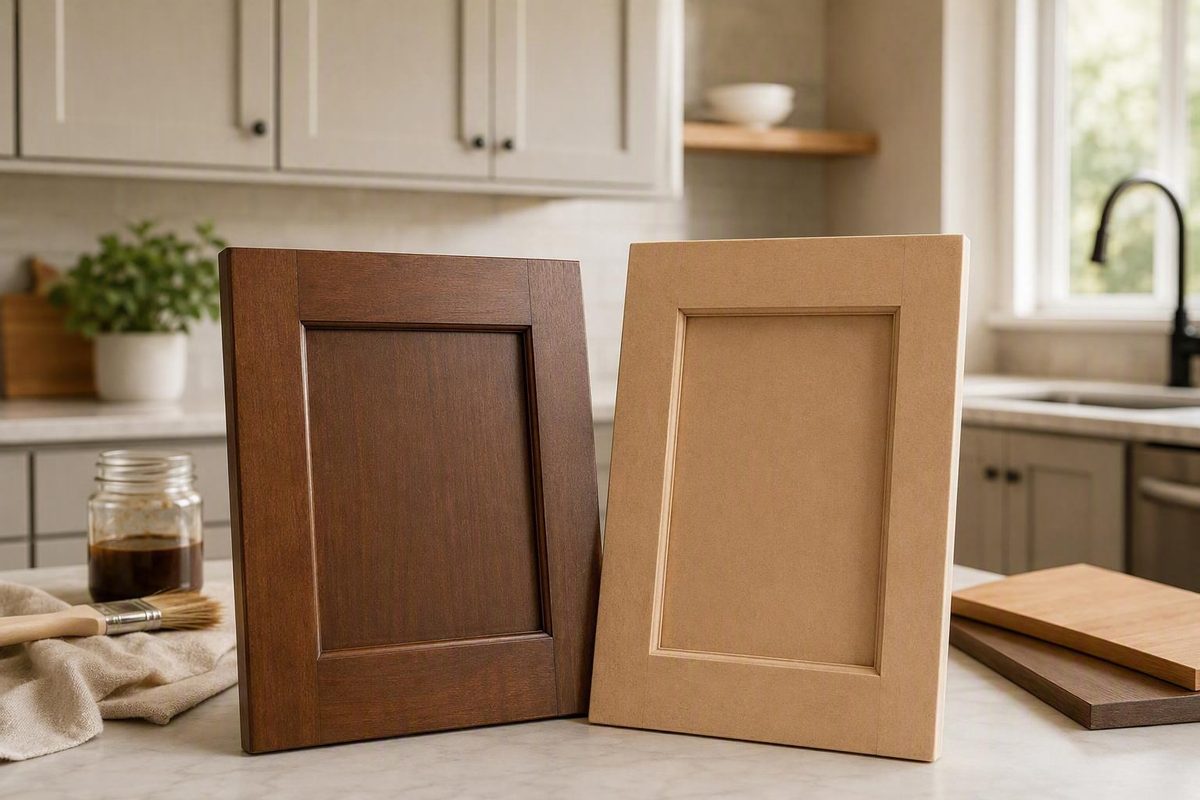
The Short Answer: You Can Color MDF, but It Will Not Stain Like Wood
If the visible center panel is bare MDF, you can make it brown or wood-toned, but ordinary transparent penetrating stain generally will not make it look like naturally stained wood. Conventional stain colors wood while allowing its grain to remain visible. MDF is made from bonded wood fibers and has a smooth face without decorative natural grain, which is why cabinet suppliers generally position MDF for paint and natural wood for grain-visible finishes (MDF and natural-wood finish comparison).
The practical answer depends on what you mean by “stain”:
- If you want transparent color over authentic grain: bare MDF is the wrong surface.
- If you only want a brown or wood-toned color: dyes, sprayed shading colors, tinted coatings, or faux-grain techniques may create a simulated stained effect.
- If the MDF has an intact real-wood veneer: that exposed wood face may be stainable.
- If the panel is primed, painted, sealed, laminated, or thermofoil-covered: penetrating stain cannot simply be applied as though the surface were unfinished lumber.
For bare MDF, paint is the most predictable finish. It takes advantage of the material’s smooth, uniform surface instead of trying to reveal grain that does not exist.
Specialty coloring is different from conventional wood staining. A finishing system might color the MDF, place translucent color between sealed layers, or create artificial grain on the surface. Those methods can produce a wood-toned appearance, but they do not reveal authentic grain within the MDF.
Results vary with the particular board, existing surface, coloring product, application method, and protective finish. Reports from contributors to an archived trade-finishing discussion repeatedly recommend preparing complete samples before treating the actual doors (archived discussion of coloring MDF).
The first decision, therefore, is not which stain color to buy. It is identifying what material or covering is actually exposed on the panel.
First Identify What Is Actually on the Center Panel
An “MDF center panel” describes the core or structural component, not necessarily the visible face. The MDF may be:
- Bare and unfinished
- Factory-primed
- Painted or sealed
- Faced with real-wood veneer
- Wrapped in thermofoil
- Covered with laminate or another factory film
- Printed or embossed to imitate wood grain
These surfaces cannot be refinished interchangeably.
Shaker doors also use different construction methods. A traditional five-piece door has two vertical stiles, two horizontal rails, and a recessed center panel. A hybrid version may combine a solid-wood frame with an MDF panel. Another door may be routed from one piece of MDF, making the frame and recessed field the same material. Commercial cabinet literature describes both wood-frame/MDF-panel construction and doors made entirely from MDF (overview of MDF cabinet-door construction).
Before sanding, inspect the following:
- Manufacturer information. Look for the original order, specification sheet, product page, sample-door label, or finish schedule.
- The back of the door. It may reveal joints, surface transitions, or a different finish.
- The perimeter and panel edges. Existing exposure may show primer, veneer, film, or the MDF core.
- The hinge-cup opening. This can help identify the stile or show that a door is routed from one material. On a five-piece door, however, it may reveal only the frame—not the center panel.
- An existing chip or damaged area. It may expose distinct layers without requiring a new test cut.
Use existing openings or damage rather than creating a fresh cut. Visual inspection can help, but it is not always conclusive. Conversely, an opaque factory finish may conceal either wood or MDF.
If a model number or manufacturer label is available, confirmation from the manufacturer is safer than exploratory sanding. Real veneer often shows natural fiber variation, but appearance alone is not proof.
Identify the frame material as well as the panel. Possible combinations include:
- Solid-wood frame around bare MDF
- Solid-wood frame around veneered MDF
- MDF frame and MDF panel
- Veneered components over engineered cores
- Different coatings on the face and back
That distinction matters because the same coloring product can produce different appearances on different substrates.
Do not sand first and investigate later.
Choose a Finish Path Based on the Panel Surface
There is no universal method for staining an MDF Shaker panel. Choose the finish according to the visible substrate, not merely the core material named in the cabinet description.
Bare MDF
Choose paint when you want the most uniform and repeatable result. Bare MDF has no decorative grain, so transparent stain cannot produce the depth and grain contrast associated with oak, walnut, cherry, or another natural wood.
A dye, shading color, tinted coating, or faux finish may make MDF look brown or wood-toned. The result should be described accurately: it is a simulated stained effect, not transparent stain revealing natural grain.
Intact real-wood veneer over MDF
The exposed wood face may accept stain because the finish is being applied to actual wood rather than to the MDF core. Suitability still depends on:
- Whether the veneer is intact
- Whether it has already been sealed
- The wood species and veneer cut
- The intended stain color
- How much preparation the surface can tolerate
- The manufacturer’s refinishing guidance
Use minimal preparation. If sanding exposes a different color, texture, or layer, stop.
Bare solid wood
Conventional staining is possible when the wood is unfinished and suitable for the selected product. Results can still vary with species, grain direction, contamination, surface preparation, and stain type. A solid-wood surface is not a guarantee of effortless or perfectly uniform color.
Factory-primed, painted, or sealed MDF
Removing the coating also does not solve the central appearance problem: exposed MDF still has no decorative grain.
Repainting is usually the more practical route. Other options include professional faux finishing, adding real-wood veneer where feasible, or replacing the panel or door. Cabinet-finish guidance similarly describes changing painted MDF to a transparent stained appearance as difficult and often impractical (painted-versus-stained cabinet guidance).
Thermofoil or laminate over MDF
Do not sand and stain these coverings as though they were wood veneer. Identify the covering and determine whether its manufacturer supports a compatible coating approach. If the covering is failing, replacement may be more sensible than trying to expose and stain the MDF underneath.
The likely outcomes are:
| Finish path | Likely appearance |
|---|---|
| Paint on properly prepared MDF | Uniform opaque color |
| Transparent stain on intact veneer or solid wood | Authentic grain remains visible |
| Dye, shading color, or tinted coating on MDF | Wood-toned color without natural grain |
| Faux graining | Simulated grain created on the surface |
| Replacement with stain-grade material | Most reliable route to authentic stained wood |
Choose according to the appearance you actually want. A method can successfully make MDF brown and still fail if your goal is a convincing oak, walnut, or cherry grain.
Why a Wood Frame and MDF Panel May Not Match
A hybrid Shaker door may have solid-wood rails and stiles surrounding an MDF center panel. That construction works well under opaque paint because the coating visually unifies the materials. Transparent stain does the opposite: it exposes their differences.
On a wood frame, stain leaves visible:
- Grain direction
- Pores and growth patterns
- Natural color variation
- Cross-grain and end-grain absorption differences
- Figure associated with the species
Bare MDF has no comparable grain to reveal. The panel may look flat or muddy while the frame still looks recognizably wooden.
Adding more stain cannot create the frame’s grain within the MDF. Darkening the panel might bring its color closer to the frame, but the two surfaces can still look optically different.
A real-wood-veneered MDF panel has a better chance of coordinating with a solid-wood frame because both visible surfaces are wood. Matching is still not assured. Contributors to a cabinet discussion report that species, veneer quality, stain color, manufacturing control, and aging can all affect the relationship between veneered panels and solid-wood frames (community discussion of veneered Shaker panels).
Even when the veneer and frame are nominally the same species, they may differ because:
- The veneer may be cut differently from the frame lumber.
- The frame may display more natural variation.
- One surface may retain more of the original sealer.
- Preparation may affect the two materials differently.
- Old finish may remain in corners or profile transitions.
- The materials may have changed color differently over time.
Judge the assembled door, not the panel sample alone. View the sample beside the frame in daylight and under the kitchen’s artificial lighting. A difference that seems minor on a workbench may become obvious when the door is vertical and surrounded by matching cabinets.
Staining the wood frame while painting the MDF center can be a valid two-tone design. Treat it as an intentional aesthetic choice with a clear color boundary, not as a way to disguise substrates that cannot be made identical.
If You Only Want a Wood-Like Color, Specialty Finishes May Be Possible
Authentic visible grain and wood-like color are different goals. Bare MDF cannot provide natural grain, but it may receive color through a specialty finishing system.
Contributors to an archived trade-forum discussion reported experimenting with:
- Alcohol-based dye
- Color applied between seal and clear coats
- Spray-applied shading stain
- Very lightly applied penetrating color
- Factory-colored MDF
These are practitioner anecdotes from an archived discussion, not controlled tests or current product-specific instructions. They do not establish that any particular product is still available, unchanged, or compatible with your doors.
The approaches work conceptually in different ways:
- Dye adds color without depending on prominent wood pores or grain.
- Shading color places controlled translucent color within a coating system.
- Tinted coating adds color while building a film on the surface.
- Faux graining creates an artificial pattern before protective coats are applied.
None creates natural grain inside MDF.
The complete coating system also has to be compatible. A color layer that looks acceptable by itself may change after the protective coating is applied. Product suitability should therefore be established from current manufacturer instructions and a completed sample, not from an old product recommendation or a partial color test.
Avoid saturating bare MDF or repeatedly working a wet coloring product into the surface. A contributor to the archived trade discussion warns that overworking penetrating color can damage the MDF face and produce an unsatisfactory texture.
A specialty finish is most reasonable when:
- Replacement is impractical.
- Wood-toned color matters more than authentic grain.
- Some visual variation is acceptable.
- A complete sample can be approved first.
- The existing coating does not require destructive removal.
If a cabinet-grade simulated wood appearance is important, consult a professional finisher who can inspect the actual substrate and evaluate an appropriate coating system. If authentic grain is nonnegotiable, specialty coloring remains a compromise rather than a substitute for wood.
Test the Entire Finish System Before Touching Every Door
Never use the whole kitchen as the test surface. Start with the closest available match:
- A scrap of the same MDF
- A spare or manufacturer sample door
- An unused drawer front
- A removable matching component
- An inconspicuous area, if no representative sample exists
A generic MDF offcut can help screen a finish, but a spare door is more informative because it includes the same factory surface, profiles, edges, and frame-to-panel relationship.
Test the complete system, including:
- Cleaning and surface preparation
- Any necessary scuffing or sanding
- Sealer or primer, if specified
- Color layer
- Shading or faux grain, if used
- Protective finish
- The intended application method
A color test without the final protective layer is incomplete. Likewise, applying color to bare MDF does not meaningfully test a proposed system in which color will be placed between sealed layers.
After the sample has dried according to the product instructions, compare it with the assembled door. Check for:
- Agreement between frame and panel color
- Texture differences
- Uneven color
- Raised or rough fibers
- Visible sanding scratches
- Cloudy or muddy areas
- Inconsistent sheen
- Weak adhesion or easy marking
- An artificial appearance that is unacceptable at normal viewing distance
Inspect the sample in daylight and under each main kitchen light source. Examine it close up, then step back to the distance from which cabinet doors are normally viewed. Shadows around a recessed Shaker panel can emphasize differences that are less obvious on a flat sample.
When testing veneer, prepare it as lightly as possible. Stop if the surface begins to reveal another layer or loses its normal wood appearance.
Use the current instructions for the selected sealer, color, and protective finish to determine substrate suitability, layer compatibility, application conditions, and drying requirements. Do not substitute generic timing from an unrelated product or archived discussion.
Reject the plan if the finished sample remains blotchy, rough, easily marked, poorly adhered, or visibly incompatible with the frame. A successful sample reduces uncertainty, but it does not prove every existing door is identical. Doors may differ in wear, residue, sunlight exposure, moisture history, or previous touch-ups.
If doors near the sink or dishwasher appear different from the rest of the kitchen—or if the set may include multiple production batches—test more than one representative piece.
Protect MDF From Sanding Dust and Moisture Damage
Sanding, drilling, routing, or machining MDF creates wood dust. Use effective dust collection and suitable respiratory and eye protection, and follow the safety instructions supplied with the tool and abrasive. An MDF cabinet-door product page specifically warns against inhaling dust generated during machining and advises using personal protection (MDF door specifications and dust warning).
Do not sand more aggressively than the finishing system requires. Excessive sanding can:
- Disturb the smooth face of bare MDF
- Round crisp Shaker edges
- Produce uneven color absorption
- Expose softer material beneath the face
- Cut through thin veneer
- Damage a film that was never intended to be sanded
Moisture also requires care. Standard MDF can swell after substantial water exposure, particularly at cut edges, hinge holes, chips, and other unsealed areas (MDF material and moisture overview). This does not mean every water-based coating necessarily ruins MDF. It means the product must be suitable for the substrate and wet application should remain controlled.
Avoid soaking the surface during cleaning or finishing. Inspect doors beside sinks, dishwashers, kettles, and other splash or steam zones carefully.
Do not assume every MDF product has the same moisture performance. Standard and moisture-resistant grades may behave differently, and the grade used in an existing door may be unknown. Protect exposed areas, avoid prolonged wetting, and test the proposed system on representative material.
For coating-related precautions, consult and follow the current label and manufacturer instructions for the products actually selected. Do not rely on general cabinet advice to replace product-specific safety requirements.
When Painting, Veneering, or Replacing the Door Is the Better Choice
Trying to color an existing MDF panel is worthwhile only if the result can meet your visual goal without unacceptable risk.
Choose repainting when:
- The visible panel is bare, primed, or painted MDF.
- Uniform cabinet color matters more than visible grain.
- The doors are otherwise sound.
- The door combines MDF and wood that should look visually consistent.
- Replacing the full set is undesirable.
MDF is routinely used for paint-grade cabinet doors because its smooth, grain-free surface supports an even opaque finish (guide to paint-grade cabinet-door materials).
Choose real-wood veneer or a stain-grade component when:
- Authentic grain is essential.
- The existing surface can accept veneer without compromising the door.
- The door remains structurally suitable.
- A qualified finisher can evaluate the profile, transitions, and frame match.
The existing profile, panel construction, available space, and proposed veneering system all require evaluation before the original finish is removed.
Choose professional faux finishing when:
- You want a wood-toned or wood-patterned effect.
- Replacement is impractical.
- You accept that the grain will be simulated.
- You can approve a completed representative sample first.
Choose replacement when:
- Genuine grain is nonnegotiable.
- The MDF is swollen, damaged, or heavily coated.
- Removing the existing finish would risk damaging the door.
- Veneering is unsuitable for the profile.
- Mixed materials cannot be made visually coherent.
- Refinishing uncertainty outweighs the value of preserving the doors.
Converting painted or sealed MDF to a transparent stained appearance is often impractical for three reasons: the existing coating must be addressed, the exposed MDF has no decorative grain, and surrounding wood may respond differently. Removing paint does not convert paint-grade MDF into stain-grade lumber.
Before deciding, weigh five factors:
- Desired appearance: Do you want uniform color, a simulated wood tone, or authentic grain?
- Existing surface: Is it bare MDF, wood veneer, paint, primer, laminate, or thermofoil?
- Acceptable risk: Can you tolerate visible variation or a failed sample?
- Scale: Are you treating one door or the entire kitchen?
- Replacement tolerance: Are new panels or doors acceptable if refinishing cannot produce the desired result?
The safest recommendation is straightforward: do not apply ordinary stain until you have confirmed the visible panel surface and frame material, then approved the complete preparation, color, and protective-finish system on a representative sample. Choose paint for the most predictable result on bare MDF. Use conventional stain only where a suitable real-wood face is intact. If genuine grain is the priority, use veneer, stain-grade wood, or replacement.
Will gel stain make bare MDF look like stained wood?
Gel stain cannot reveal natural grain that bare MDF does not have.
Test any proposed gel-stain system on matching MDF, including the intended preparation and protective finish. If visible wood grain is the goal, use intact wood veneer, stain-grade wood, or a deliberately executed faux-grain finish.
Can I stain MDF if it has a real-wood veneer?
Potentially, yes. In that situation, you are staining the real-wood face rather than the MDF core. Confirm that the grain is genuine veneer, that the veneer remains intact, and that an existing sealer will not prevent the selected finish from working as intended.
Prepare the surface minimally because aggressive sanding can cut through thin veneer. Matching a veneered panel to a solid-wood frame is possible but not guaranteed; species, veneer cut, previous finish, stain color, and aging can all affect the result.
Can I stain only the solid-wood frame and paint the MDF center panel?
Yes, if the two-tone appearance is intentional and each product is suitable for its respective surface. Transparent stain can display the wood frame’s grain while opaque paint gives the MDF panel a uniform color.
Make a sample that includes the actual frame-to-panel boundary. A carefully chosen contrast can look deliberate, while an accidental near-match may make the door appear mismatched.
Can previously painted or primed MDF be stripped and stained?
Removing paint or primer does not turn MDF into stain-grade wood.
For most painted or primed MDF panels, repainting is more practical. If a wood appearance is essential, consider professional faux finishing, veneering where feasible, or replacement with a stain-grade panel or door.
Why do cabinetmakers use MDF in Shaker center panels?
MDF has a smooth, grain-free face that suits an opaque painted finish. It is therefore commonly used in paint-grade recessed panels and in one-piece routed Shaker doors.
A hybrid door may combine solid-wood rails and stiles with an MDF center, while another door may be made entirely from MDF. Its presence does not automatically indicate poor cabinetry; it reflects a material and finish choice. The limitation is simply that a surface selected for uniform paint is not automatically suitable for a transparent, grain-visible stain.