
Before Refinishing Hardwood Cabinets, Check More Than the Doors
Decide whether wood cabinets need touch-up, recoating or full refinishing—and what a quote should include before you approve the work.
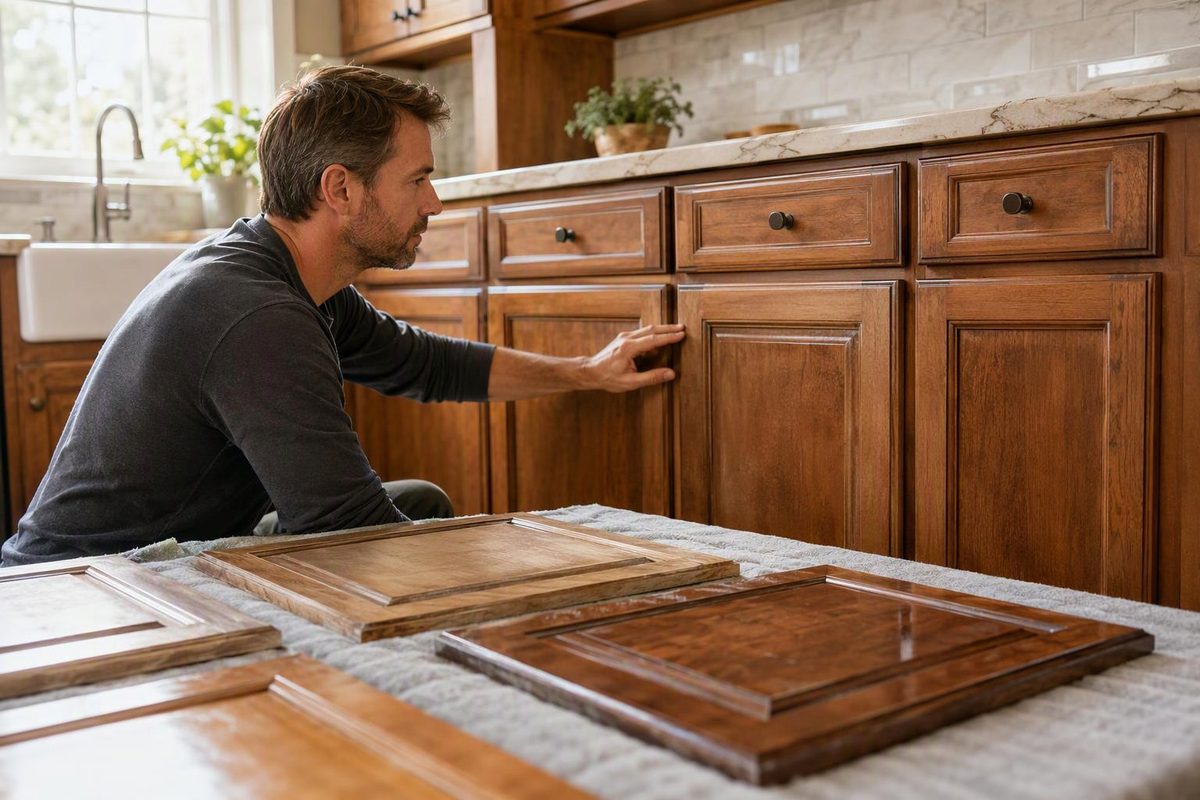
Hardwood refinishing makes sense when you want to keep the cabinet layout and door style, and the cabinets are worth keeping structurally. But an oak or maple door does not mean every visible surface can tolerate the same sanding and staining process.
For kitchen cabinets—not hardwood floors—the first decision is whether to repair the existing finish, coat over it, or remove it and start again. Those are different jobs, and a quote should say which one you are buying.
Identify each surface before sanding
Check doors, drawer fronts, face frames, exposed ends, trim and toe kicks separately. Find the original construction specification if possible; otherwise, have the refinisher identify the materials before quoting removal work.
Mixed construction is not automatically a quality problem. For example, KraftMaid specifies solid-hardwood face frames and describes a separate finishing process for its veneered cabinet sides. The important point for refinishing is that those surfaces are not interchangeable. KraftMaid’s construction details illustrate why a kitchen needs a component-by-component assessment.
- Solid wood: Offers more scope for sanding, but preserving edges, profiles and fit still matters.
- Real-wood veneer: Has a limited face layer. Sanding through it exposes the glue line or core rather than fresh matching wood—a failure described by veneer supplier Oakwood.
- Printed laminate or wrapped film: Is not a wood face to strip and restain. Ask about a coating system explicitly suitable for that surface, refacing or replacement instead.
If the construction is uncertain, start with this cabinet veneer guide. Do not assume that visible grain proves solid wood.
There is also a safety gate for older painted cabinets. In U.S. homes built before 1978, investigate lead-based paint before disturbing painted surfaces. EPA recommends testing by a certified lead inspector or risk assessor and hiring a lead-safe certified contractor.
Match the work to the problem
| What you want to change | Work to investigate | What must be checked |
|---|---|---|
| A few scratches; overall color and finish are acceptable | Local touch-up | Whether the repair blends without treating the whole kitchen |
| Worn sheen; existing coating remains well attached | Cleaning, light abrasion and a compatible clear recoat | Adhesion to the old finish and the final appearance |
| A darker wood tone | A compatible stain-over-finish or toning system | Grain visibility, evenness and drying time |
| A much lighter stained appearance, or a failing coating | Finish removal and restaining | Whether each surface can survive removal and reach the target color |
| A different door style, damaged faces or an unsuitable substrate | New fronts, refacing or replacement | Whether keeping the boxes still serves the kitchen plan |
For isolated marks, consider cabinet scratch repair before committing to a whole-kitchen finish change.
Darkening and lightening are not equivalent. General Finishes permits its gel stain over properly prepared existing finishes, but requires testing and longer drying times. Its guidance also says that hardened Java gel stain cannot simply be lightened with another stain application: the existing stain must be removed or covered with paint. Treat a dramatic dark-to-light request as a removal-and-sample question, not a promised result from a color chart. General Finishes’ gel-stain instructions explain these limits.
Require a test before approving the kitchen
A sound coating is not necessarily a clean, compatible coating. General Finishes calls for deeper cleaning of high-use surfaces with grime and hand oils, and warns that wax, polish or silicone contamination can compromise a refinish. It requires testing for both adhesion and appearance before starting. Its preparation and compatibility guidance is more useful than a “no-prep” promise.
Ask for the complete proposed sequence—cleaning, removal or scuffing, color and protective topcoat—on an agreed test area. Choose a heavily used door or drawer rather than relying only on an untouched surface. Allow the specified drying and curing time before judging adhesion. Also ask how the result will be matched across solid wood and veneer; one successful door does not establish the appearance of every exposed end.
Approve the finished sample, not stain alone. General Finishes notes that wood species, existing finish and application method affect color, and that topcoat deepens it. For specification details, see stain finishes on wood cabinets.
Make the quote describe the job
Compare itemized scopes rather than headline totals. Request:
- Surfaces included: Door faces and backs, drawer fronts, frames, ends, trim and toe kicks; identify excluded interiors.
- Preparation: Cleaning, repairs, light abrasion or full removal—and how veneer will be protected.
- Finish system: Named color and coating products, sheen, application method and approved sample.
- Handling and protection: Removal, labeling, transport, masking, dust control, ventilation and reinstallation.
- Schedule and remedy: Recoat times, return-to-use restrictions, warranty coverage and what happens if the test fails.
Stop for split joints, loose veneer, swollen panels or deteriorated boxes and obtain a repair assessment before paying for cosmetic work.
A worthwhile refinishing proposal should explain what stays, what comes off, and how the contractor will prove the new finish works before committing the whole kitchen.