
Solid Oak Cabinets: Check the Parts, Not Just the Label
Learn what solid oak means in a cabinet quote, how it differs from oak veneer, and which door, box, finish and warranty details to verify.
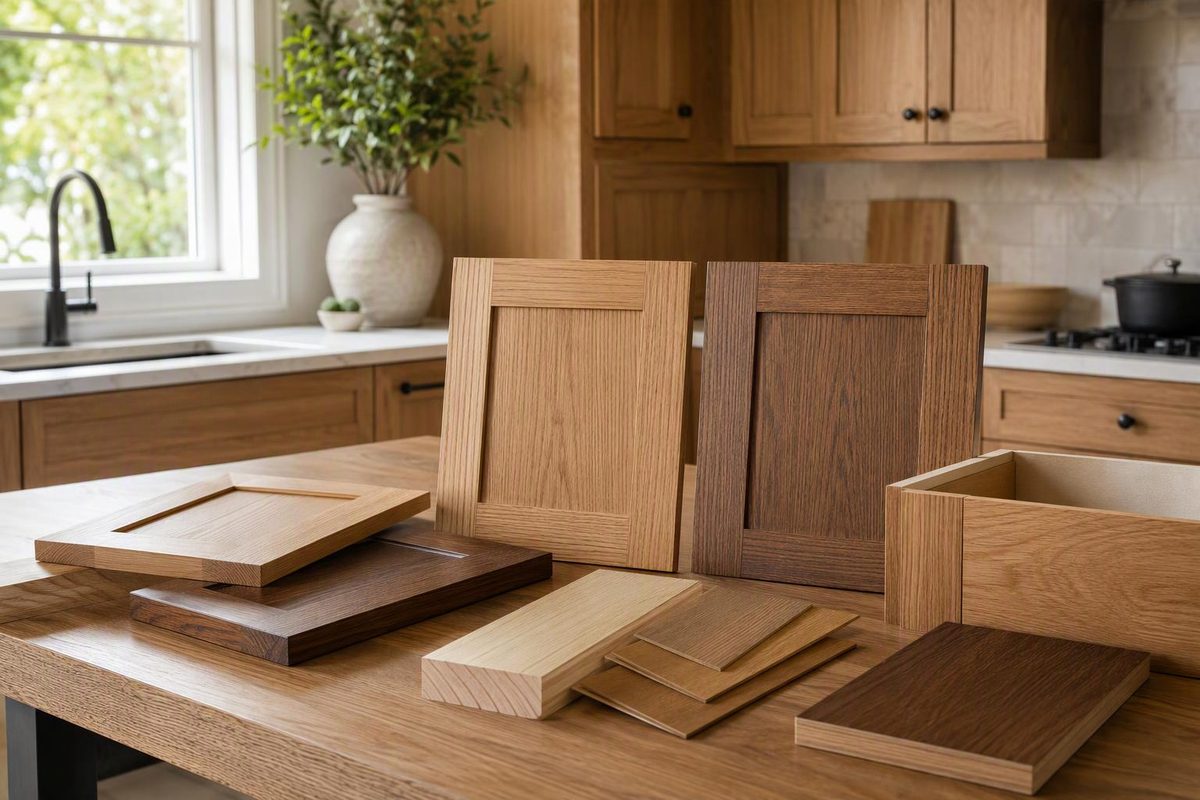
Solid oak can be a good choice for cabinet frames and doors, but it is not a complete cabinet specification. Before paying a premium, establish which parts are oak lumber, which have an oak veneer, and what makes up the cabinet box. A solid oak door does not tell you how the shelves, backs or exposed ends are built.
The useful question is not “Is this kitchen solid oak?” It is “Where is solid oak being used, and does that construction suit the door style and finish I want?”
What “solid oak” should mean
A solid oak component is oak lumber through its thickness, rather than a thin oak face bonded to a different core. Solid does not necessarily mean a single board; ask whether a wide panel is assembled from glued boards and what grain variation is allowed.
Separate the following parts in the quote:
| Component | What to establish |
|---|---|
| Door frame | Oak species, thickness and joint construction |
| Door center panel | Solid oak or oak veneer; if veneer, identify the core |
| Slab door or drawer front | Solid lumber or veneered panel, edge treatment and size limits |
| Cabinet face frame | Solid oak, another material, or no face frame in a frameless cabinet |
| Box sides, back and shelves | Material and thickness, specified separately from the doors |
| Exposed ends and fillers | Visible face material, core and finish matching |
Mixed construction is not automatically a shortcut. As of October 2026, Scherr’s 112-style door uses solid wood frames with 1/4-inch veneer panels for most wood species as standard, with a solid wood panel upgrade available. The frame and panel are separate purchasing choices.
Likewise, KraftMaid Simplicity’s construction details list engineered-wood end panels as standard and plywood as an option. Evaluate the box specification independently of the wood chosen for the front.
Door construction matters more than an all-solid claim
Solid wood takes on and releases moisture as conditions change. It expands and contracts, principally across the grain; a finish slows that exchange but does not stop it. Frame-and-panel construction accommodates this movement by allowing the solid center panel to float within grooves in the frame. Plywood and veneered MDF move much less with humidity changes. WOOD’s explanation of wood movement describes both approaches.
For a Shaker or raised-panel door, a solid oak frame with a veneered center can therefore be a sensible specification—not an imitation-wood door. If you choose a solid center, ask how its movement is accommodated and whether shrinking could reveal an unfinished edge.
For a wide, flat slab door, be more cautious about treating solid oak as the default upgrade. Scherr’s recommends its veneer slab construction over solid wood because it reduces the risk of cupping and warping. If the design depends on consistently flat fronts and close, even gaps, discuss an engineered panel with a real oak face before insisting on solid lumber. Our slab-door guide explains the other material choices.
Specify the oak appearance, not just the species name
“Oak” leaves considerable room for variation. Red oak commonly has a reddish cast; white oak commonly has a more olive cast. Both can be light to medium brown, and color alone is not a reliable way to identify them. See the Wood Database’s descriptions of red oak and white oak.
The cut also changes the result. Plain-sawn oak can show broad cathedral patterns, while quartersawn oak tends toward straighter grain with visible ray flecks. Oak’s open grain also creates a coarse texture, not just a visual pattern. KraftMaid’s oak guide illustrates these differences.
Approve a finished door sample, not just an unfinished wood chip. Ask to see the accepted range of color, grain and mineral streaks, and compare the door with the proposed exposed-end panel. If you want a smooth painted surface rather than visible oak character, require a sample demonstrating that exact finish.
Check the warranty before paying the premium
Ask for the maker’s humidity requirements, maximum door sizes, warp tolerances and exclusions for natural movement. These can matter more than the word “solid.”
For a concrete example, Scherr’s October 2026 terms provide no warranty on the width of solid wood slab doors and exclude joint cracks caused by natural wood movement. Those are that manufacturer’s terms, not an industry-wide rule. Confirm the terms that will apply to your order.
Solid oak also does not remove the need for careful moisture management. KraftMaid’s care guidance calls for prompt spill cleanup, thorough drying and avoiding wet towels draped over cabinet doors. Follow your cabinet maker’s or finish supplier’s cleaning instructions.
What is worth paying for?
Request two itemized quotes with the same layout, hardware, box construction, finish and installation scope. Change only the oak component you are comparing—for example, a solid center panel versus a veneered center.
Pay the difference when it buys the construction or appearance you actually want, with acceptable movement allowances and warranty terms. Do not pay an unexplained “solid oak” surcharge that leaves the panel core, cabinet backs or exposed ends unspecified. If the alternative is veneered construction, use our oak veneer buying checks to make that quote equally precise.